Union Cabinet Raises Wheat MSP to ₹2585 & National Pulses Mission
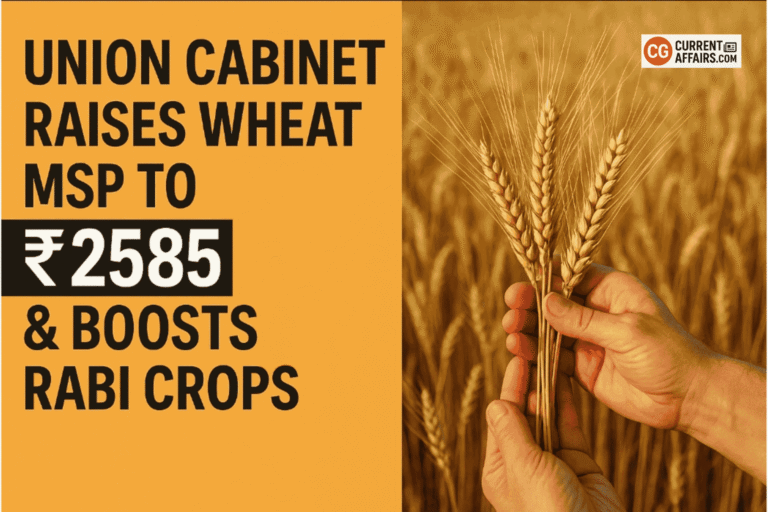
The Union Cabinet renewed a ₹160 increase in wheat MSP under PM Narendra Modi, which has now been fixed at 2585 per quintal of the marketing year 2026-27. Other rabi crops- safflower received an increment of ₹600, lentils ₹300, mustard/rapeseed ₹250, gram 225 and barley 170. Another initiative that was sanctioned by the Cabinet is the ambitious National Pulses Mission with a 2025-26 budget of 11440 crore. The Mission aims to increase pulses production to 35 million tonnes by 2030-31 compared to 24.2 million tonnes (2024-25). These were historic decisions, as referred to by Agriculture Minister Shri Shivraj Singh Chouhan, in order to promote farmers and secure their income as well as the food security of the nation.
In News
- MSP hike for rabi crops for the 2026–27 marketing season, with wheat MSP increased to ₹2,585/quintal.
- The National Pulses Mission to strengthen domestic pulses production and nutritional security.
- Agreement to purchase all the tur, urad and lentils in MSP to ensure farmer returns.
Key Highlights
Minimum Support Price (MSP) -Introduction
- Minimum Support Price (MSP) refers to the minimum payment that the government guarantees some crops, aiming at guaranteeing the farmers a good income.
- The government (such as FCI) buys crops at MSP in case the prices in the market are below.
- Union Budget 2018-19 adopted the policy of fixing MSP at 1.5 times of the weighted average cost of production in India.
- Protein security is highly dependent on pulses and India had been relying on imports. Therefore, a special mission was required.
| Crop | MSP 2025–26 (₹/qtl) | MSP 2026–27 (₹/qtl) | Increase (₹) |
|---|---|---|---|
| Wheat | 2,425 | 2,585 | +160 |
| Barley | 1,980 | 2,150 | +170 |
| Gram (Chana) | 5,650 | 5,875 | +225 |
| Lentils (Masur) | 6,700 | 7,000 | +300 |
| Rapeseed / Mustard | 5,950 | 6,200 | +250 |
| Safflower | 5,940 | 6,540 | +600 |
Crops Covered under MSP
| Category | Crops |
|---|---|
| Cereals (7) | Paddy, Wheat, Maize, Bajra, Jowar, Ragi, Barley |
| Pulses (5) | Chana, Arhar/Tur, Urad, Moong, Masur |
| Oilseeds (7) | Rapeseed-Mustard, Groundnut, Soyabean, Sunflower, Sesamum, Safflower, Nigerseed |
| Commercial Crops (4) | Cotton, Sugarcane, Copra, Raw Jute |
How MSP is Determined?
Agency:
- Commission on Agricultural Costs and Prices (CACP) – official organ of the Ministry of Agriculture (established 1965).
- Recommendation: CACP Cabinet Committee on Economic Affairs (CCEA) Government finalizes MSP.
Factors Considered:
- Supply & demand situation
- Domestic and international market trends.
- Cost of production (A2, A2+FL, C2)
- Crop parity and terms of trade with other non-agriculture sectors.
- Consumer price implications & environment issues.
Cost Formulas:
- A2: Cash costs (seeds, fertilisers, labour, fuel, machinery)
- A2 + FL: A2 + value of family labour (currently used for MSP)
- C2: Comprehensive cost (A2 + FL + imputed land rent + interest on fixed capital + lease rent)
MSP Calculation:
- Current: MSP = 1.5 × (A2 + FL)
- Farmer demand: MSP = 1.5 × C2 (as per MS Swaminathan Commission recommendation)
Effectiveness:
- It only benefits about 15% paddy and 10% wheat farmers (ICAR-NIAP).
- Small and marginal farmers (86% of workforce) typically left out.
- Incidents of larger farmers controlling procurement gains is a form of income inequality.
Challenges:
- Fiscal impact: on FCI- storage and procurement, wastage.
- Environmental impact: water-intensive crops are leading to depletion of soil and groundwater.
- Distortions in the marketplace include overproduction of MSP crops, disregard of non-MSP crops.
- locking out poor farmers.
- Absence of legislation is something that is not enforced – MSP is voluntary.
Why Farmers are Squeezing the Legal MSP?
- Adverse market conditions → farmers are selling in bulk. Price is determined by supply-demand.
- Retail purchases include seeds, fertilizers, diesel, etc.
- Debt & farmer suicides → 47 lakh suicides in 30 years; 14.72 lakh crore loss in 2023 (OECD).
- Agricultural stability → stabilize prices, eliminate distress and migration.
- Water conservation → promote crop diversification (reduced paddy/ wheat)
- Minimize reliance on imports on pulses and oilseeds, the production of domestic products.
- Public health/ national wealth → MSP makes sure that there are healthy options, less debt, and a more robust economy.
National Pulses Mission
- Goal: Increase pulses production from 24.2 MT (202425) to 35 MT ( 203031).
- Coverage: 416 districts with special attention being given to rice-fallow and intercropping areas.
- Action plan: Quality seeds, irrigation support, market linkages, technical support.
- Budget: ₹11,440 crore for 2025–26
- Procurement: Procurement of 100 percent tur, urad and lentils at MSP.
Significance
- Improves the welfare and incomes of farmers.
- Against starvation, provides food and nutritional security by being self-sufficient in the pulses.
- Lessons dependence on imports and promotes Atmanirbhar Bharat.
- Encourages rotated cropping systems, effective utilization of fallow land and improved soil quality.
Additional Info
- Production target: 119 million tonnes 2025-26 crop year.
- Pulses Mission is in line with Poshan Abhiyaan nutrition objectives and UN SDG 2 (Zero Hunger).
- It announced it on Navratri in the run up to Dussehra, which was a symbolic move of the farmer-first strategy.
Conclusion
The increase in the wheat MSP and the initiation of the National Pulses Mission is the bold move towards doubling the income of farmers and providing nutritional security. Such programs go hand in hand with India’s intention to make agriculture profitable and sustainable. In an attempt to limit the dependency on imports, the government aims at ensuring MSP-based procurement and the increase in production. All these efforts demonstrate that the Modi government is a farmer-first government and dedicated to rural prosperity.
CGPSC Practice Questions
CGPSC Prelims Practice Questions
Q1. The MSP for wheat for the 2026–27 marketing year has been fixed at:
(a) ₹2,425
(b) ₹2,585
(c) ₹2,700
(d) ₹2,350
Q2. The National Pulses Mission aims to raise pulses production to:
(a) 30 million tonnes by 2029–30
(b) 28 million tonnes by 2027–28
(c) 35 million tonnes by 2030–31
(d) 40 million tonnes by 2030–31
CGPSC Mains Practice Questions
Q1. Discuss the significance of the National Pulses Mission in ensuring food and nutritional security in India.
Q2. “Rising MSPs reflect the government’s sensitivity towards farmers but also pose fiscal challenges.” Critically analyze this statement in the context of recent MSP hikes.
Read in Hindi
केंद्रीय मंत्रिमंडल ने गेहूं का MSP बढ़ाकर 2585 रुपये किया और राष्ट्रीय दलहन मिशन
केंद्रीय मंत्रिमंडल ने पीएम नरेंद्र मोदी के तहत गेहूं के एमएसपी में ₹160 की बढ़ोतरी को नवीनीकृत किया, जिसे अब विपणन वर्ष 2026-27 के लिए 2585 प्रति क्विंटल तय किया गया है। अन्य रबी फसलें- कुसुम में ₹600, मसूर में ₹300, सरसों/रेपसीड में ₹250, चना में 225 और जौ में 170 की बढ़ोतरी हुई। कैबिनेट द्वारा स्वीकृत एक अन्य पहल 11440 करोड़ के 2025-26 के बजट के साथ महत्वाकांक्षी राष्ट्रीय दलहन मिशन है। मिशन का लक्ष्य 2030-31 तक 24.2 मिलियन टन (2024-25) की तुलना में दालों का उत्पादन बढ़ाकर 35 मिलियन टन करना है। ये ऐतिहासिक निर्णय थे, जैसा कि कृषि मंत्री श्री शिवराज सिंह चौहान ने किसानों को बढ़ावा देने और उनकी आय के साथ-साथ राष्ट्र की खाद्य सुरक्षा को सुरक्षित करने के लिए संदर्भित किया था
समाचार में
- 2026-27 विपणन सत्र के एमएसपी में रबी फसलों की वृद्धि की गई तथा गेहूं का एमएसपी बढ़ाकर 2585 रुपये प्रति क्विंटल कर दिया गया।
- राष्ट्रीय दलहन मिशन का उद्देश्य घरेलू दलहन उत्पादन और पोषण सुरक्षा को मजबूत करना है।
- किसानों को लाभ सुनिश्चित करने के लिए तुअर, उड़द और मसूर की सभी फसलों को एमएसपी पर खरीदने का समझौता।
प्रमुख बिंदु
न्यूनतम समर्थन मूल्य (एमएसपी) – परिचय।
परिभाषा:
- एमएसपी से तात्पर्य न्यूनतम भुगतान से है जो सरकार कुछ फसलों के लिए गारंटी देती है, जिसका उद्देश्य किसानों को अच्छी आय की गारंटी देना है।
- सरकार (जैसे एफसीआई) बाजार में कीमतें कम होने पर एमएसपी पर फसल खरीदती है|
- केंद्रीय बजट 2018-19 में भारत में उत्पादन की भारित औसत लागत के 1.5 गुना पर एमएसपी तय करने की नीति अपनाई गई।
- प्रोटीन सुरक्षा काफी हद तक दालों पर निर्भर है और भारत आयात पर निर्भर रहा है; इसलिए, एक विशेष मिशन की आवश्यकता थी।
रबी फसलों के लिए एमएसपी वृद्धि (2026-27)
| काटना | एमएसपी 2025–26 | एमएसपी 2026–27 | वृद्धि (₹) |
|---|---|---|---|
| गेहूँ | 2,425 | 2,585 | +160 |
| जौ | 1,980 | 2,150 | +170 |
| चना | 5,650 | 5,875 | +225 |
| मसूर | 6,700 | 7,000 | +300 |
| रेपसीड / सरसों | 5,950 | 6,200 | +250 |
| कुसुम | 5,940 | 6,540 | +600 |
एमएसपी के अंतर्गत आने वाली फसलें
| वर्ग | फसलें |
|---|---|
| अनाज (7) | धान, गेहूँ, मक्का, बाजरा, ज्वार, रागी, जौ |
| दालें (5) | चना, अरहर/तूर, उड़द, मूंग, मसूर |
| तिलहन (7) | रेपसीड-सरसों, मूंगफली, सोयाबीन, सूरजमुखी, तिल, कुसुम, नाइजरसीड |
| वाणिज्यिक फसलें (4) | कपास, गन्ना, खोपरा, कच्चा जूट |
एमएसपी का निर्धारण कैसे किया जाता है?
एजेंसी:
- कृषि लागत और मूल्य आयोग (सीएसीपी) – कृषि मंत्रालय का आधिकारिक अंग (1965 में स्थापित)।
- सिफारिश: सीएसीपी आर्थिक मामलों की कैबिनेट समिति (सीसीईए) सरकार ने एमएसपी को अंतिम रूप दिया।
विचारणीय कारक:
- आपूर्ति और मांग की स्थिति
- घरेलू और अंतर्राष्ट्रीय बाजार के रुझान।
- उत्पादन लागत (A2, A2+FL, C2)
- फसल समानता और अन्य गैर-कृषि क्षेत्रों के साथ व्यापार की शर्तें।
- उपभोक्ता मूल्य निहितार्थ एवं पर्यावरण मुद्दे।
लागत सूत्र:
- ए2:नकद लागत (बीज, उर्वरक, श्रम, ईंधन, मशीनरी)
- ए2 + एफएल:A2 + पारिवारिक श्रम का मूल्य (वर्तमान में एमएसपी के लिए उपयोग किया जाता है)
- सी2:व्यापक लागत (A2 + FL + आरोपित भूमि किराया + स्थायी पूंजी पर ब्याज + पट्टा किराया)
एमएसपी गणना:
- मौजूदा: एमएसपी = 1.5 × (ए2 + एफएल)
- किसानों की मांग:एमएसपी = 1.5 × सी2(एम.एस. स्वामीनाथन आयोग की सिफारिश के अनुसार)
प्रभावशीलता:
- इससे केवल 15 प्रतिशत धान और 10 प्रतिशत गेहूं किसानों को लाभ मिलता है (आईसीएआर-एनआईएपी)।
- छोटे और सीमांत किसान (कार्यबल का 86 प्रतिशत) आमतौर पर इससे वंचित रह जाते हैं।
- बड़े किसानों द्वारा खरीद लाभ को नियंत्रित करने की घटनाएं आय असमानता का एक रूप है।
चुनौतियाँ:
- एफसीआई पर राजकोषीय प्रभाव- भंडारण और खरीद, अपव्यय।
- पर्यावरणीय प्रभाव: अधिक पानी की आवश्यकता वाली फसलों के कारण मृदा और भूजल का क्षरण हो रहा है।
- बाजार में विकृतियों में एमएसपी फसलों का अधिक उत्पादन, गैर-एमएसपी फसलों की उपेक्षा शामिल है।
- गरीब किसानों को बाहर कर दिया गया।
- कानून का अभाव एक ऐसी चीज है जिसका क्रियान्वयन नहीं होता – एमएसपी स्वैच्छिक है।
किसान कानूनी एमएसपी का दुरुपयोग क्यों कर रहे हैं?
- प्रतिकूल बाज़ार परिस्थितियाँ → किसान थोक में बेच रहे हैं। कीमत आपूर्ति-माँग से तय होती है।
- खुदरा खरीद में बीज, उर्वरक, डीजल आदि शामिल हैं।
- ऋण एवं किसान आत्महत्याएं → 30 वर्षों में 47 लाख आत्महत्याएं; 2023 में 14.72 लाख करोड़ का नुकसान (ओईसीडी)।
- कृषि स्थिरता → कीमतों को स्थिर करना, संकट और पलायन को समाप्त करना।
- जल संरक्षण → फसल विविधीकरण को बढ़ावा देना (धान/गेहूं की खेती कम करना)
- दालों और तिलहनों के आयात पर निर्भरता को कम करना, घरेलू उत्पादों का उत्पादन बढ़ाना।
- सार्वजनिक स्वास्थ्य/राष्ट्रीय संपत्ति → एमएसपी यह सुनिश्चित करता है कि स्वस्थ विकल्प उपलब्ध हों, ऋण कम हो और अर्थव्यवस्था अधिक मजबूत हो।
राष्ट्रीय दलहन मिशन
- लक्ष्य: दालों का उत्पादन 24.2 मीट्रिक टन (202425) से बढ़ाकर 35 मीट्रिक टन (203031) करना।
- कवरेज: 416 जिले, जिनमें चावल-परती और अंतर-फसल क्षेत्रों पर विशेष ध्यान दिया जा रहा है।
- कार्य योजना: गुणवत्तापूर्ण बीज, सिंचाई सहायता, बाजार सम्पर्क, तकनीकी सहायता।
- बजट: 2025-26 के लिए ₹11,440 करोड़
- खरीद: एमएसपी पर 100 प्रतिशत तुअर, उड़द और मसूर की खरीद।
महत्व
- किसानों के कल्याण और आय में सुधार होगा।
- भुखमरी के विरुद्ध, दालों में आत्मनिर्भरता द्वारा खाद्य एवं पोषण सुरक्षा प्रदान करता है।
- आयात पर निर्भरता कम होगी और आत्मनिर्भर भारत को बढ़ावा मिलेगा।
- फसल चक्रीय प्रणाली, परती भूमि के प्रभावी उपयोग और मृदा गुणवत्ता में सुधार को प्रोत्साहित करता है।
अतिरिक्त जानकारी
- उत्पादन लक्ष्य: 119 मिलियन टन 2025-26 फसल वर्ष।
- दाल मिशन, पोषण अभियान के पोषण उद्देश्यों और संयुक्त राष्ट्र एसडीजी 2 (शून्य भूख) के अनुरूप है।
- इसने दशहरा से पहले नवरात्रि पर इसकी घोषणा की, जो किसान-प्रथम रणनीति का एक प्रतीकात्मक कदम था।
निष्कर्ष
गेहूँ के न्यूनतम समर्थन मूल्य में वृद्धि और राष्ट्रीय दलहन मिशन की शुरुआत किसानों की आय दोगुनी करने और पोषण सुरक्षा प्रदान करने की दिशा में एक साहसिक कदम है। ऐसे कार्यक्रम कृषि को लाभदायक और टिकाऊ बनाने के भारत के इरादे के अनुरूप हैं। आयात पर निर्भरता को सीमित करने के प्रयास में, सरकार का लक्ष्य न्यूनतम समर्थन मूल्य (MSP) आधारित खरीद सुनिश्चित करना और उत्पादन में वृद्धि सुनिश्चित करना है। ये सभी प्रयास दर्शाते हैं कि मोदी सरकार किसान-प्रथम सरकार है और ग्रामीण समृद्धि के लिए समर्पित है।
सीजीपीएससी प्रश्न
सीजीपीएससी प्रारंभिक परीक्षा अभ्यास प्रश्न
प्रश्न 1.विपणन वर्ष 2026-27 के लिए गेहूं का एमएसपी निर्धारित किया गया है:
(ए) ₹2,425
(बी) ₹2,585
(ग) ₹2,700
(घ) ₹2,350
प्रश्न 2.राष्ट्रीय दलहन मिशन का उद्देश्य दालों का उत्पादन बढ़ाना है:
(ए) 2029-30 तक 30 मिलियन टन
(b) 2027-28 तक 28 मिलियन टन
(ग) 2030-31 तक 35 मिलियन टन
(घ) 2030-31 तक 40 मिलियन टन
सीजीपीएससी मुख्य परीक्षा अभ्यास प्रश्न
प्रश्न 1. भारत में खाद्य एवं पोषण सुरक्षा सुनिश्चित करने में राष्ट्रीय दलहन मिशन के महत्व पर चर्चा कीजिए।
प्रश्न 2. “बढ़ते एमएसपी किसानों के प्रति सरकार की संवेदनशीलता को दर्शाते हैं, लेकिन साथ ही राजकोषीय चुनौतियाँ भी उत्पन्न करते हैं।” हाल ही में एमएसपी में हुई बढ़ोतरी के संदर्भ में इस कथन का आलोचनात्मक विश्लेषण कीजिए।
FAQs: Wheat MSP 2026–27 & National Pulses Mission
What is the new MSP for wheat for 2026-27?
Which other rabi crops got an MSP hike?
What is the National Pulses Mission 2025-26?
Why is the National Pulses Mission important?
Who recommends the MSP in India?
Related Articles
Category
- Chhattisgarh
- National
- International
- Environment
- Geography
- Art & Culture
- Economics
- Polity
- History
- CGPSC Previous Year Papers
- Union Budget Summary
- CG Budget Summary
- Economic Survey Summary
- Current Affairs Monthly Magazine
- Monthly MCQ Consolidation
- Daily Answer Writing Practice
- Practice Quiz
- Download PDF