The National Payments Corporation of India (NPCI) has introduced a new Merchant Discount Rate (MDR) framework for selected UPI Person-to-Merchant (P2M) transactions.
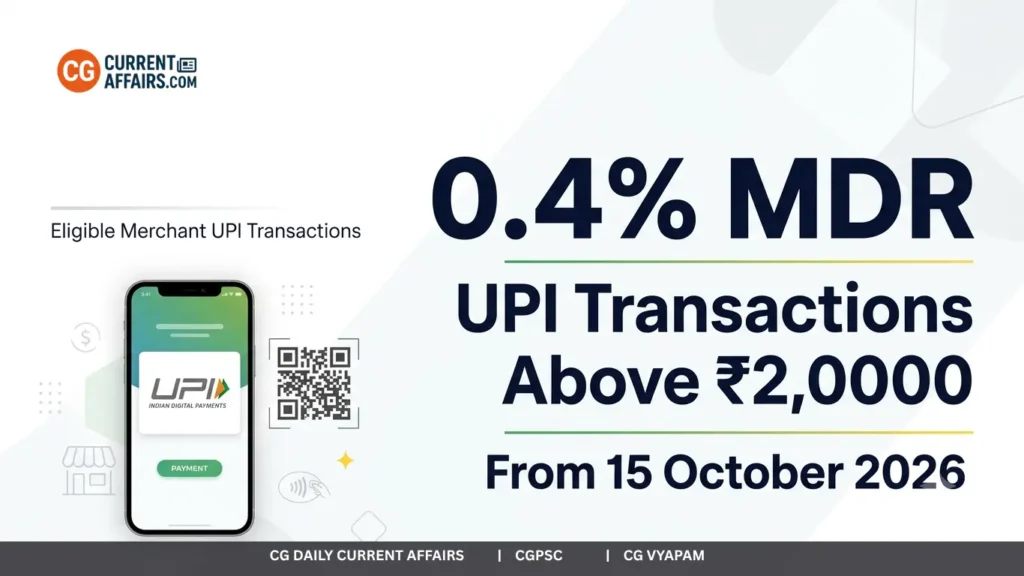
Under the new framework, a 0.4% MDR will apply to eligible merchant UPI transactions above ₹2,000 from 15 October 2026. The announcement has led to increased searches about tax on UPI, but it is important to understand that MDR is a merchant-side payment-processing charge and not a government tax.
For students preparing for CGPSC, CG Vyapam and other Chhattisgarh government examinations, the new UPI tax rules 2026 are important from the perspective of digital payments, financial inclusion, fintech and Digital Public Infrastructure.
Why in News?
- NPCI has introduced a new MDR framework for selected UPI merchant transactions.
- The framework will come into effect from 15 October 2026.
- Eligible P2M transactions above ₹2,000 will attract 0.4% MDR.
- MDR for transactions of ₹75,000 and above will be capped at ₹300.
- Consumers will not be separately charged the MDR.
- Searches for UPI tax India have increased because of the new merchant-side charge.
What is Merchant Discount Rate (MDR)?
Merchant Discount Rate (MDR) is a fee associated with accepting digital payments. It is paid on the merchant side within the payment ecosystem and is distributed among participating entities such as banks, payment service providers and payment application providers.
In the new UPI framework, MDR applies only to specified categories of Person-to-Merchant (P2M) transactions.
Exam Fact: MDR is a merchant-side payment-processing charge, not a government tax.
Therefore, when people search for the MDR full form, the answer is Merchant Discount Rate. Similarly, the term UPI tax rule is commonly used in searches, but the new charge should technically be understood as MDR rather than a direct government tax.
New UPI MDR Structure
| Transaction Category | MDR |
|---|
| P2P transactions | No MDR |
| Eligible P2M transactions up to ₹2,000 | 0% |
| Eligible P2M transactions above ₹2,000 | 0.4% |
| Transactions ₹75,000 and above | Maximum ₹300 |
| Specified essential sectors above ₹2,000 | ₹5 flat MDR |
| Capital-market transactions | 0.02%, capped at ₹300 |
| Eligible small merchants | Exempt |
The 0.4% rate applies to eligible transactions rather than automatically applying to every merchant receiving a payment above ₹2,000.
This distinction is important when studying UPI transaction tax charges 2026, because the charge applies to specified merchant transactions and is not a blanket tax on all UPI payments.
Examples
- ₹3,000 payment: 0.4% = ₹12 MDR
- ₹50,000 payment: 0.4% = ₹200 MDR
- ₹75,000 payment: 0.4% = ₹300, so the cap applies.
- ₹1 lakh payment: 0.4% would be ₹400, but the MDR is capped at ₹300.
These examples explain how the new UPI tax rules 2026 work for eligible merchant transactions.
Which Transactions Are Exempt?
The framework provides exemptions to reduce the impact on ordinary users and smaller businesses.
Key exemptions
- Person-to-Person (P2P) transactions remain free.
- Eligible small merchants receiving up to ₹1 lakh per month through P2M UPI are protected from MDR.
- Merchant transactions up to ₹2,000 remain free.
- Consumers are not supposed to be separately charged the MDR.
These exemptions are important when understanding tax on UPI, because the framework does not mean that every UPI payment will attract a charge.
For UPI tax India searches, candidates should remember that P2P transactions and eligible low-value merchant transactions remain protected under the stated framework.
Essential Services
Certain sectors have a separate flat-rate structure.
For specified essential services, including areas such as:
- Railways
- Telecom
- Fuel
- Insurance
- Utility payments
- Agricultural inputs
a flat MDR of ₹5 applies to eligible payments above ₹2,000.
This separate structure is another important point for UPI transaction tax charges 2026.
Capital Market Transactions
A separate MDR structure applies to specified capital-market payments.
- MDR: 0.02%
- Maximum cap: ₹300
This covers categories such as payments involving mutual funds, securities and stockbrokers, according to reports on the new framework.
Why Has MDR Been Introduced?
UPI has developed into a major component of India’s digital payment infrastructure. Its continued expansion requires investment in:
- Payment infrastructure
- Server and processing capacity
- Cybersecurity
- Fraud prevention
- Technology upgrades
- Customer support
- Innovation
The MDR framework creates a payment-ecosystem revenue mechanism while retaining free access for many low-value and P2P transactions.
The framework is therefore different from a conventional UPI tax rules 2026, because MDR is collected within the payment ecosystem rather than being a government tax.
- Financial Sustainability
- The new mechanism is intended to reduce the dependence of the payment ecosystem on continuing government support and create a more sustainable revenue model.
- Cybersecurity
- As digital transactions increase, payment networks require continuous investment in fraud detection, cybersecurity and system resilience.
- Infrastructure
- Revenue generated within the ecosystem can help support technological upgrades and increased transaction-processing capacity.
Impact on Consumers
For ordinary consumers, the framework does not mean that every UPI payment will become chargeable.
- P2P payments remain free.
- Payments up to ₹2,000 remain free.
- Consumers are not supposed to be separately charged MDR.
- Selected higher-value merchant transactions will generate a merchant-side MDR.
Therefore, the immediate change is primarily on the merchant/payment-ecosystem side, rather than a direct UPI fee imposed on consumers.
This is why the phrase tax on UPI 2026 can be misleading when used to describe the new MDR framework.
Impact on Merchants
The impact will vary according to the merchant’s category and transaction volume.
- Large Merchants
- Eligible large merchants receiving higher-value P2M payments will have to account for the MDR.
- Small Merchants
- Eligible small merchants remain exempt under the specified conditions, helping protect low-volume businesses and street vendors.
- High-Value Transactions
- The ₹300 cap limits the MDR burden on very large eligible transactions.
Concerns and Challenges
The introduction of MDR has also generated concerns among sections of the retail and financial industry.
- 1. Risk of Cash Reversion
- Retail organisations have argued that additional merchant costs could encourage some businesses to return to cash transactions.
- 2. Merchant Cost
- Businesses operating on narrow margins may view even a small transaction charge as an additional operating cost.
- 3. Consumer Pass-Through
- Although MDR is intended to be paid by merchants and not separately recovered from customers, there are concerns that businesses could indirectly incorporate the cost into prices. This remains a potential concern rather than an established outcome.
4. Digital Payment Adoption
Industry groups have raised concerns that additional costs could affect the continued adoption of UPI tax rules 2026 among certain merchant segments.
UPI and India’s Digital Public Infrastructure
Unified Payments Interface (UPI) is a real-time payment system that enables interoperable digital transactions between bank accounts.
It was developed by the National Payments Corporation of India (NPCI) and has become a major component of India’s Digital Public Infrastructure (DPI).
Key Features of UPI
- Real-time payments
- 24×7 availability
- Interoperability between participating banks
- Multiple bank accounts through a single application
- Two-factor authentication
- QR-based payments
- API-based digital payment ecosystem
Understanding UPI is essential for CGPSC aspirants because questions on digital payments can cover NPCI, MDR, financial inclusion, fintech and Digital Public Infrastructure rather than only the latest UPI tax rules.
UPI’s Global Expansion
UPI has also expanded internationally through partnerships and acceptance arrangements.
Countries associated with UPI acceptance or linkage include:
- UAE
- Singapore
- Nepal
- Bhutan
- Sri Lanka
- France
- Mauritius
- Qatar
- Maldives
- Cambodia
- Greece
Exam Note: International UPI availability can change as new partnerships are added, so candidates should treat the country list as time-sensitive.
About NPCI
The National Payments Corporation of India (NPCI) is the umbrella organisation responsible for operating and developing major retail payment and settlement systems in India.
Key Facts
- Established: 2008
- Headquarters: Mumbai, Maharashtra
- Legal structure: Section 8 company
- Promoted by: Reserve Bank of India and Indian Banks’ Association
- Major systems: UPI, RuPay, IMPS, Bharat BillPay, NETC/FASTag and AePS
NPCI plays a central role in India’s retail digital-payment infrastructure.
For exam preparation, remember the MDR full form, NPCI’s role and the distinction between MDR and a government tax.
Significance for India’s Economy
The MDR framework represents a shift from the earlier model in which UPI merchant transactions operated without a standard MDR.
Its significance can be understood through three dimensions:
- Financial sustainability → Creates a revenue mechanism within the payment ecosystem.
- Digital infrastructure → Supports continued investment in technology, cybersecurity and payment capacity.
- Inclusion → Exemptions aim to protect small merchants and ordinary low-value transactions.
The framework therefore attempts to balance the affordability of digital payments with the long-term financial sustainability of payment infrastructure.
Chhattisgarh Perspective
The topic is relevant to Chhattisgarh because UPI and digital payments are increasingly important for:
- Small retailers
- Street vendors
- Farmers and rural businesses
- Self-help groups
- Small service providers
- Digital government payments
For CGPSC, the topic can be linked with Digital India, Digital Public Infrastructure, financial inclusion, fintech, cashless economy and rural digitalisation.
The new UPI tax rules 2026 can therefore be studied as part of India’s broader digital-payment and financial-inclusion developments.
CGPSC Prelims Current Affairs 2026
Remember these facts:
- UPI: Unified Payments Interface.
- Developer/operator: NPCI.
- MDR: Merchant Discount Rate.
- MDR full form: Merchant Discount Rate.
- New MDR effective: 15 October 2026.
- Eligible P2M transactions above ₹2,000: 0.4%.
- ₹75,000 and above: MDR capped at ₹300.
- P2P transactions: No MDR.
- Eligible small merchants: Exempt under specified conditions.
- Specified essential sectors: ₹5 flat MDR above ₹2,000.
- Capital-market transactions: 0.02%, capped at ₹300.
- NPCI established: 2008.
- NPCI headquarters: Mumbai.
- UPI is part of India’s Digital Public Infrastructure.
- MDR is not a government tax.
Exam Alert: If a question uses the phrase UPI tax rule 2026, remember that the new framework described here is an MDR framework, not a direct government tax on UPI users.
CGPSC Prelims Practice Questions 2026
Q1. With reference to the new UPI MDR framework, consider the following statements:
- A 0.4% MDR applies to specified P2M transactions above ₹2,000.
- MDR on transactions of ₹75,000 and above is capped at ₹300.
- Person-to-person UPI transactions will attract the new MDR.
Which of the statements given above is/are correct?
Answer: 1 and 2 only.
Q2. What is the full form of MDR in the context of UPI payments?
A. Market Digital Rate
B. Merchant Discount Rate
C. Money Deposit Rate
D. Merchant Digital Revenue
Answer: B. Merchant Discount Rate
Q3. Which organisation operates the Unified Payments Interface (UPI)?
A. SEBI
B. NPCI
C. IRDAI
D. NABARD
Answer: B. NPCI
Q4. Which statement is correct regarding the new UPI framework?
A. Every UPI transaction will attract a government tax.
B. All P2P transactions will attract 0.4% MDR.
C. Selected P2M transactions above ₹2,000 will attract 0.4% MDR.
D. All UPI payments below ₹2,000 will attract MDR.
Answer: C. Selected P2M transactions above ₹2,000 will attract 0.4% MDR.
CGPSC Mains Practice Questions 2026
Q1. Discuss the significance and challenges of introducing MDR on selected UPI transactions in India.
Q2. Explain the role of UPI in strengthening India’s Digital Public Infrastructure.
Conclusion
The new UPI MDR framework marks an important change in India’s digital-payment ecosystem. While eligible higher-value merchant transactions will attract a fee from 15 October 2026, P2P transactions, low-value payments and eligible small merchants remain protected.