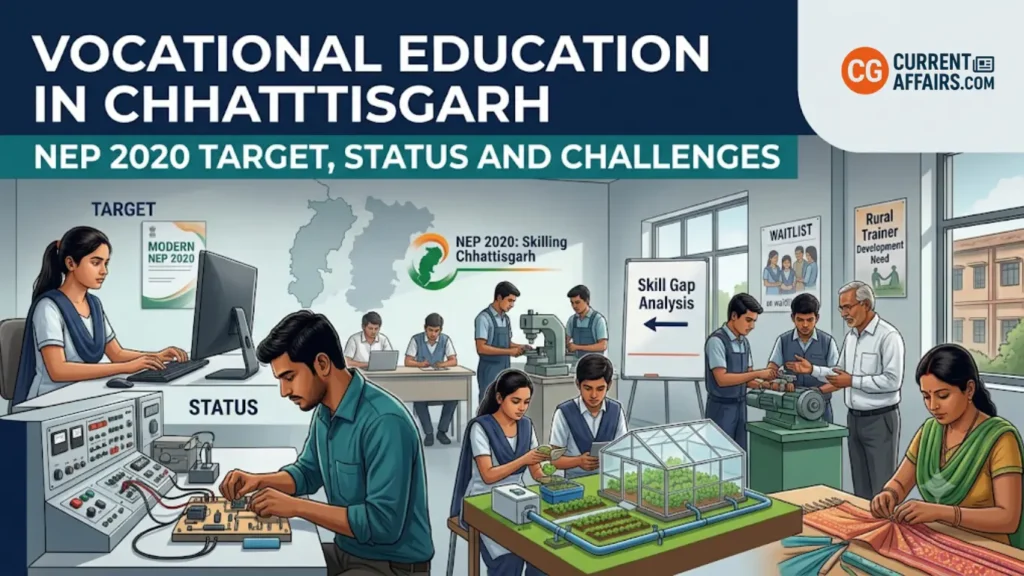
The implementation of vocational education in Chhattisgarh schools remains behind the intended pace under the National Education Policy (NEP) 2020. The policy emphasizes integrating skill-based and employment-oriented education with mainstream schooling.
Chhattisgarh has around 4,814 schools offering Classes 9–12, but vocational education has so far been introduced in only 1,285 schools. This means vocational education is currently available in roughly 27% of these schools, leaving a significant gap in coverage.
The state began school-level vocational education in 2014 with 10 trades, which has now increased to 15 trades. However, expansion of schools, availability of trained instructors and continuity of the training system remain major challenges.
Why in News?
Chhattisgarh is lagging behind its vocational education targets, with vocational education currently operating in only 1,285 of around 4,814 schools offering Classes 9–12.
Key Points
- Schools offering Classes 9–12: Around 4,814.
- Schools with vocational education: 1,285.
- Approximate coverage: Around 27% of schools.
- Schools without vocational education: Around 3,529.
- NEP 2020: Emphasizes vocational exposure and skill-based education.
- Vocational education in Chhattisgarh: Started in 2014.
- Trades at the beginning: 10.
- Current trades: 15.
- Major challenge: Availability and continuity of vocational instructors.
- Future objective: Expand vocational education across schools and strengthen employment-oriented skills.
Background
What is Vocational Education?
Vocational education is education that develops practical skills and job-related competencies in specific occupations or sectors.
Unlike purely theoretical education, vocational education focuses on:
- Practical skills
- Technical knowledge
- Industry-oriented training
- Employability
- Entrepreneurship
- Work readiness
The broader objective is to make students capable of applying their knowledge in real-world occupational settings.
Vocational Education under NEP 2020
The National Education Policy 2020 seeks to integrate vocational education into mainstream schooling rather than treating it as a separate stream.
The policy emphasizes:
- Early exposure to vocational skills
- Integration of skill education with academic learning
- Development of 21st-century skills
- Greater focus on experiential learning
- Connecting education with employment and entrepreneurship
- Reducing the perceived separation between academic and vocational education
Exam Note: NEP 2020 aims to provide vocational exposure to a much larger proportion of learners and emphasizes the integration of vocational education into mainstream schooling.
Vocational Education in Chhattisgarh
Chhattisgarh introduced vocational education in schools in 2014.
Expansion of Trades
| Indicator | Status |
|---|
| Vocational education started | 2014 |
| Trades at the beginning | 10 |
| Current number of trades | 15 |
| Schools offering Classes 9–12 | Around 4,814 |
| Schools with vocational education | 1,285 |
| Schools without vocational education | Around 3,529 |
| Approximate school-level coverage | Around 27% |
The number of vocational trades has increased from 10 to 15, providing students with more skill-development options. However, the expansion of vocational education across schools has remained comparatively slow.
Current Status in Chhattisgarh
Out of approximately 4,814 schools conducting Classes 9–12, vocational education is currently being offered in only 1,285 schools.
This leaves approximately 3,529 schools without vocational education at the secondary and higher-secondary levels.
Coverage Gap
4,814 total schools → 1,285 schools with vocational education → 3,529 schools without vocational education
Thus, vocational education is currently available in approximately 27% of schools in this category.
According to the report, if the benchmark of 50% school coverage is applied, around 2,407 schools would need to offer vocational education, indicating a substantial gap.
Important: The NEP 2020 target is framed around vocational exposure for learners, not simply a target that exactly 50% of schools must offer vocational education. Therefore, the school-level 50% figure should be used carefully in examination answers.
Major Areas of Vocational Education
Vocational education can help students develop skills relevant to different sectors, including:
- Information technology
- Agriculture and allied activities
- Healthcare
- Retail
- Tourism and hospitality
- Automobile services
- Electrical and technical work
- Beauty and wellness
- Banking and financial services
- Handicrafts and traditional occupations
The exact trades offered depend on the vocational education programme and school-level infrastructure.
Major Challenges
- Limited School Coverage
- The biggest challenge is the limited number of schools offering vocational education.
- With only 1,285 out of approximately 4,814 schools covered, a large number of students remain outside the vocational education system.
- Shortage of Instructors
- Several schools face difficulty in ensuring adequate availability of trained vocational instructors.
- Without qualified instructors, merely introducing a trade does not guarantee effective skill development.
- Instructor Service Conditions
- According to the supplied report, vocational instructors are engaged through a tender-based arrangement/VTP model in many institutions.
- This can create concerns related to:
- Timely payment
- Remuneration
- Continuity of employment
- Accountability
- Long-term availability of instructors
- Quality of Training
- Vocational education requires practical exposure, equipment and trained instructors. Inadequate infrastructure or limited practical training can reduce the effectiveness of the programme.
- Limited Employment Linkages
- Vocational education should be connected with:
- School → Skill → Internship/Practical Training → Employment/Entrepreneurship
- Weak links between schools, industries and local employment opportunities can reduce the usefulness of vocational training.
- Limited Early Exposure
- NEP 2020 places emphasis on introducing vocational exposure at an earlier stage, including middle-school education. Expanding vocational exposure beyond Classes 9–12 therefore remains an important task.
Why is Vocational Education Important?
- Employment and Employability
- Vocational education equips students with practical and job-oriented skills, improving their readiness for employment.
- Skill Development
- It helps bridge the gap between classroom learning and workplace requirements.
- Entrepreneurship
- Students can potentially use vocational skills to establish small businesses and self-employment activities.
- Reduction in Skill Gap
- Industry-oriented education can help address the mismatch between skills demanded by employers and skills possessed by job seekers.
- Inclusive Education
- Vocational education can provide alternative learning pathways for students with different interests, abilities and career goals.
- Rural Development
- In a state like Chhattisgarh, vocational education can be linked with local economic activities such as:
- Agriculture
- Food processing
- Forest-based livelihoods
- Handicrafts
- Construction
- Tourism
- Rural services
Government Measures
National Education Policy 2020
NEP 2020 seeks to transform education by giving greater importance to:
- Skill development
- Vocational exposure
- Experiential learning
- Practical education
- Employment-oriented education
- Integration of vocational and academic education
The policy aims to remove the traditional perception that vocational education is separate or inferior to mainstream academic education.
Chhattisgarh Perspective
Chhattisgarh has expanded its school vocational programme from 10 trades in 2014 to 15 trades currently.
However, further strengthening is required in:
- Expansion to more schools
- Recruitment and availability of trained instructors
- Practical training infrastructure
- Industry partnerships
- Student counselling
- Employment and apprenticeship linkages
- Monitoring of training quality
Chhattisgarh-Specific Significance
Vocational education has particular importance for Chhattisgarh because the state has a significant rural population and a diverse economic base.
A stronger vocational education system can support:
Education → Skills → Employment → Entrepreneurship → Rural Income
Potential Areas for Chhattisgarh
- Agriculture and agri-processing
- Mining-related technical skills
- Forest-based industries
- Handicrafts and traditional skills
- Tourism and hospitality
- Healthcare services
- Information technology
- Construction and electrical trades
- Food processing
- Small-scale manufacturing
Linking school-level vocational education with the state’s local economic opportunities can make training more relevant to students.
Way Forward
- Expand School Coverage
- The state should progressively bring more secondary and higher-secondary schools under vocational education programmes.
- Strengthen Instructor Availability
- A stable and qualified vocational instructor system is essential for the success of the programme.
- Improve Practical Infrastructure
- Schools should have access to:
- Laboratories
- Workshops
- Tools and equipment
- Digital learning resources
- Practical training facilities
- Build Industry Partnerships
- Schools can collaborate with industries, local enterprises and institutions to provide:
- Internships
- Apprenticeships
- Practical exposure
- Industry visits
- Career guidance
- Align Trades with Local Demand
- The selection of trades should reflect regional employment opportunities and emerging sectors.
- Introduce Stronger Career Counselling
- Students should understand how vocational education can lead to:
- Employment + Higher Education + Entrepreneurship
- Strengthen Monitoring
- The government should regularly evaluate:
- School coverage
- Student participation
- Instructor availability
- Training quality
- Certification
- Employment outcomes
Conclusion
Chhattisgarh has made progress in expanding school-based vocational education, with the number of trades increasing from 10 in 2014 to 15 currently. However, the coverage remains limited, with vocational education available in only 1,285 of approximately 4,814 schools offering Classes 9–12.
The key challenge is therefore not merely increasing the number of trades but ensuring wider school coverage, trained instructors, quality practical training and strong employment linkages.
For Chhattisgarh, effective implementation of NEP 2020’s skill-oriented education vision can help transform school education from a primarily academic model into one that combines knowledge, skills, employability and entrepreneurship.
CGPSC Prelims Practice Questions
Question 1
Consider the following statements regarding vocational education in Chhattisgarh:
- Vocational education in the state was introduced in 2014.
- The number of vocational trades has increased from 10 to 15.
- Vocational education is currently available in all schools offering Classes 9–12.
- Availability of trained instructors remains a challenge.
Which of the statements given above is/are correct?
A. 1, 2 and 4 only
B. 1 and 3 only
C. 2 and 3 only
D. 1, 2, 3 and 4
Correct Answer: A
Question 2
With reference to vocational education in Chhattisgarh, consider the following:
- Around 4,814 schools offer Classes 9–12.
- Vocational education is currently being offered in around 1,285 schools.
- Approximately 27% of these schools currently have vocational education.
Which of the statements given above is/are correct?
A. Only 1
B. Only 2
C. 1, 2 and 3
D. Only 3
Correct Answer: C
Question 3
The National Education Policy 2020 places emphasis on which of the following?
- Integration of vocational education with mainstream education
- Experiential learning
- Skill and employment-oriented education
- Complete separation of vocational and academic education
Select the correct answer using the code below:
A. 1, 2 and 3 only
B. 1 and 4 only
C. 2 and 4 only
D. 1, 2, 3 and 4
Correct Answer: A
CGPSC Mains Practice Questions
Question 1:
Examine the status, challenges and prospects of vocational education in Chhattisgarh in the context of the National Education Policy 2020.
Question 2:
“Vocational education can bridge the gap between schooling and employment.” Discuss with special reference to Chhattisgarh.
One-Minute Revision
- Current Issue: Chhattisgarh is behind in expanding school-level vocational education.
- Policy: National Education Policy 2020.
- Vocational Education Started in Chhattisgarh: 2014.
- Trades in 2014: 10.
- Current Trades: 15.
- Schools offering Classes 9–12: Around 4,814.
- Schools with vocational education: 1,285.
- Schools without vocational education: Around 3,529.
- Approximate coverage: 27%.
- Major Challenge: Limited school coverage.
- Another Major Challenge: Shortage and service-related issues of vocational instructors.
- NEP Focus: Skill development, experiential learning and vocational exposure.
- Key Objective: Improve employability and entrepreneurship.
- Way Forward: Expand schools, strengthen instructors, improve practical infrastructure and develop industry linkages.
- Chhattisgarh Relevance: Agriculture, food processing, tourism, forest-based activities, technical services and other local sectors can provide opportunities for skill-linked education.