CG Surajpur: 75 Village Panchayats Declared Child Marriage-Free
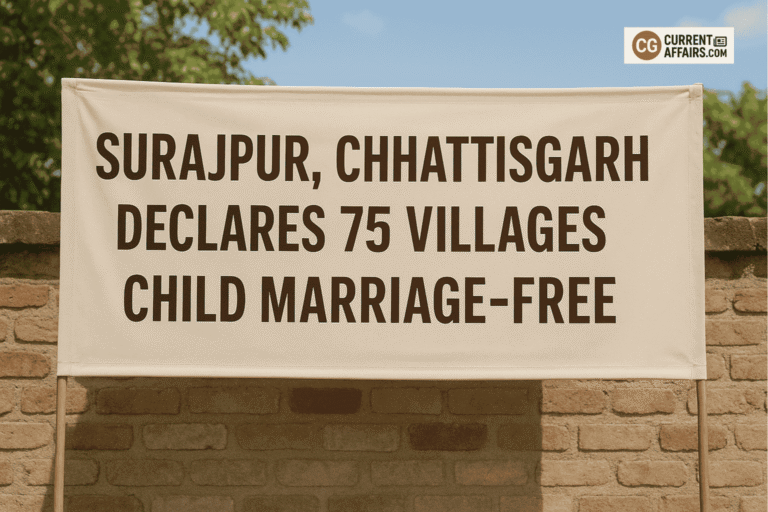
The Surajpur district in Chhattisgarh has already proclaimed 75 village panchayats as being Child Marriage-Free, a social reform benchmark. The campaign involves awareness campaigns, enforcing the law and community involvement. It is incorporated with the maternal health and nutrition programs to bring into focus the dangers of early marriage. It is having the effect of making the district a role model to other districts and states. It is aimed at turning Chhattisgarh into a Child Marriage-Free State in the not so distant future.
In News
- Surajpur is the first district in Chhattisgarh to declare child marriage in 75 village panchayats.
- Well known as a model that can be replicated in other parts of India.
- The project correlates education, nutrition and child rights against child marriage.
Key Highlights
Surajpur – Model for Child Marriage Eradication
- The project of Surajpur is a social reform programme in the district level whose aim is to eliminate child marriage by a mixture of law enforcement, awareness creation and community surveillance.
- This initiative has been hailed as a model both at the state and national levels, which has acted as an example to other districts that would want to address child marriage.
Aims
- Deliver an end to child marriage and save the rights of children.
- Wait to bring children to the world before turning eighteen to enhance maternal and infant health outcomes.
- Let the girls be ensured in schools, and empowered through education, to help bring some long-term social and economic gains.
Key Features
- Community Participation: The active presence of panchayats, Anganwadi workers, self-help groups (SHGs), NGOs, and parents to keep a check and control on child marriages.
- Awareness Drives: Sensitizes communities about child rights, the value of education, legalities, and health dangers of early marriage.
- Health & Nutrition Linkages: Co-ordinates programmes with National Nutrition Month and maternal-child health programmes to encourage the well-being of the population.
- Replication Model: This is a model that is supposed to be replicated at Chhattisgarh and then be extended to other states to have maximum impact.
Child marriage in India, status (NFHS-5)
- Overall, 23.3% of women aged 20 to 24 were married below 18.
- Another result was 17.7% of men under 25 were married before 21.
- Child marriage rates fell to 23.3% (2019-21) compared to 47% in 2006.
- Andhra Pradesh, Assam, Bihar, Jharkhand, Rajasthan, Telangana, Tripura and West Bengal are the states with more than the national average.
- NCRB Data: The cases registered under the Prohibition of Child Marriage Act, 2006 saw improvement and rose to 1050 (2021) (compared to 395 (2017) due to the improved reporting and monitoring.
Policies/Plans to Girl Child Welfare
- The Sukanya Samriddhi Yojana (2015): This initiative helps parents to save their girl child towards marriage and education.
- Balika Samriddhi Yojana: Gives financial and educational support to economically disadvantaged girls.
- Beti Bachao Beti Padhao: is an initiative that encourages the safety, education, and empowerment of girl children, and tackles gender inequalities and social inclusion.
Additional Insights
- There is a strong association between child marriage and malnutrition, maternal mortality, and poverty cycles.
- The eradication must be sustained through multi-sectoral convergence, including education, health, law enforcement, and community mobilization.
- The success of Surajpur is used as a pilot to a National Strategy on Ending Child Marriage with the success proving the effectiveness of community-based interventions.
Conclusion
The action of Surajpur emphasizes the importance of how social norms can be changed via grass-root government and community consciousness. It provides a roadmap that can be used to end child marriage by combining legal enforcement, health interventions and education. This model will tend to motivate other states to emulate it, bringing India a step closer to having a society that is safe, educated and empowered girls.
CGPSC Practice Questions
CGPSC Prelims Practice Questions
- Surajpur district, recently in news, is located in which state?
A) Jharkhand
B) Chhattisgarh
C) Odisha
D) Madhya Pradesh - Which of the following statements is correct regarding Child Marriage in India (as per NFHS-5)?
A) 47% of women aged 20–24 were married before 18 years.
B) 23.3% of women aged 20–24 were married before 18 years.
C) 35% of men aged 25–29 were married before 21 years.
D) Child marriage prevalence is highest in Kerala.
CGPSC Mains Practice Questions
- Discuss the role of community participation and awareness campaigns in eradicating child marriage with reference to Surajpur model.
- Analyze the challenges of child marriage in India and evaluate the effectiveness of schemes like Beti Bachao Beti Padhao and Sukanya Samriddhi Yojana.
Read in Hindi
छत्तीसगढ़ के सूरजपुर जिले में 75 ग्राम पंचायतें बाल विवाह मुक्त घोषित
छत्तीसगढ़ के सूरजपुर ज़िले ने पहले ही 75 ग्राम पंचायतों को बाल विवाह मुक्त घोषित कर दिया है, जो एक सामाजिक सुधार का मानक है। इस अभियान में जागरूकता अभियान, कानून का पालन और सामुदायिक भागीदारी शामिल है। इसे मातृ स्वास्थ्य और पोषण कार्यक्रमों के साथ जोड़कर बाल विवाह के खतरों पर ध्यान केंद्रित किया जा रहा है। इससे यह ज़िला अन्य ज़िलों और राज्यों के लिए एक आदर्श बन रहा है। इसका उद्देश्य निकट भविष्य में छत्तीसगढ़ को बाल विवाह मुक्त राज्य बनाना है।
समाचार में
- सूरजपुर छत्तीसगढ़ का पहला जिला है जिसने 75 ग्राम पंचायतों में बाल विवाह पर प्रतिबंध लगा दिया है।
- यह एक ऐसा मॉडल है जिसे भारत के अन्य भागों में भी दोहराया जा सकता है।
- यह परियोजना शिक्षा, पोषण और बाल विवाह के विरुद्ध बाल अधिकारों को जोड़ती है।
प्रमुख बिंदु
प्रमुख बिंदु
- सूरजपुर परियोजना ज़िला स्तर पर एक सामाजिक सुधार कार्यक्रम है जिसका उद्देश्य कानून प्रवर्तन, जागरूकता सृजन और सामुदायिक निगरानी के माध्यम से बाल विवाह को समाप्त करना है।
- इस पहल को राज्य और राष्ट्रीय स्तर पर एक आदर्श के रूप में सराहा गया है, जिसने बाल विवाह की समस्या से निपटने के इच्छुक अन्य ज़िलों के लिए एक उदाहरण प्रस्तुत किया है।
उद्देश्य
- बाल विवाह को समाप्त करें और बच्चों के अधिकारों की रक्षा करें।
- मातृ एवं शिशु स्वास्थ्य परिणामों को बेहतर बनाने के लिए अठारह वर्ष की आयु से पहले ही बच्चों को दुनिया में लाने का इंतजार करें।
- लड़कियों की स्कूलों में उपस्थिति सुनिश्चित की जाए तथा शिक्षा के माध्यम से उन्हें सशक्त बनाया जाए, ताकि दीर्घकालिक सामाजिक और आर्थिक लाभ प्राप्त करने में मदद मिल सके।
प्रमुख विशेषताऐं
- सामुदायिक भागीदारी: बाल विवाह पर नियंत्रण रखने के लिए पंचायतों, आंगनवाड़ी कार्यकर्ताओं, स्वयं सहायता समूहों (एसएचजी), गैर सरकारी संगठनों और अभिभावकों की सक्रिय उपस्थिति।
- जागरूकता अभियान: समुदायों को बाल अधिकारों, शिक्षा के महत्व, कानूनी पहलुओं और बाल विवाह के स्वास्थ्य संबंधी खतरों के बारे में संवेदनशील बनाता है।
- स्वास्थ्य एवं पोषण संबंध: जनसंख्या के कल्याण को प्रोत्साहित करने के लिए राष्ट्रीय पोषण माह और मातृ-शिशु स्वास्थ्य कार्यक्रमों के साथ समन्वय स्थापित करना।
- प्रतिकृति मॉडल: यह एक ऐसा मॉडल है जिसे छत्तीसगढ़ में दोहराया जाना है और फिर अधिकतम प्रभाव के लिए इसे अन्य राज्यों में भी लागू किया जाना है।
भारत में बाल विवाह की स्थिति (एनएफएचएस-5)
- कुल मिलाकर, 20 से 24 वर्ष की आयु की 23.3 प्रतिशत महिलाओं की शादी 18 वर्ष से कम उम्र में हुई।
- एक अन्य परिणाम यह था कि 25 वर्ष से कम आयु के 17.7 प्रतिशत पुरुषों का विवाह 21 वर्ष से पहले हो गया था।
- बाल विवाह की दर 2006 में 47% की तुलना में 2019-21 में 23.3% तक गिर गई।
- आंध्र प्रदेश, असम, बिहार, झारखंड, राजस्थान, तेलंगाना, त्रिपुरा और पश्चिम बंगाल ऐसे राज्य हैं जहां यह दर राष्ट्रीय औसत से अधिक है।
- एनसीआरबी डेटा: बेहतर रिपोर्टिंग और निगरानी के कारण बाल विवाह निषेध अधिनियम, 2006 के तहत दर्ज मामलों में सुधार हुआ और यह बढ़कर 1050 (2021) हो गया (395 (2017) की तुलना में)।
बालिका कल्याण के लिए नीतियां/योजनाएं।
- सुकन्या समृद्धि योजना (2015): यह पहल माता-पिता को अपनी बालिकाओं की शादी और शिक्षा के लिए धन बचाने में मदद करती है।
- बालिका समृद्धि योजना: आर्थिक रूप से वंचित बालिकाओं को वित्तीय और शैक्षिक सहायता प्रदान करती है।
- बेटी बचाओ बेटी पढ़ाओ: यह एक पहल है जो बालिकाओं की सुरक्षा, शिक्षा और सशक्तिकरण को प्रोत्साहित करती है, तथा लैंगिक असमानताओं और सामाजिक समावेशन से निपटती है।
अतिरिक्त जानकारी
- बाल विवाह और कुपोषण, मातृ मृत्यु दर और गरीबी चक्र के बीच गहरा संबंध है।
- उन्मूलन को शिक्षा, स्वास्थ्य, कानून प्रवर्तन और सामुदायिक लामबंदी सहित बहु-क्षेत्रीय अभिसरण के माध्यम से बनाए रखा जाना चाहिए।
- सूरजपुर की सफलता को बाल विवाह समाप्त करने की राष्ट्रीय रणनीति के लिए एक पायलट के रूप में उपयोग किया जा रहा है, जिससे समुदाय-आधारित हस्तक्षेपों की प्रभावशीलता सिद्ध होती है।
निष्कर्ष
सूरजपुर की कार्रवाई इस बात पर ज़ोर देती है कि ज़मीनी स्तर पर सरकार और सामुदायिक जागरूकता के ज़रिए सामाजिक मानदंडों को कैसे बदला जा सकता है। यह एक ऐसा रोडमैप प्रस्तुत करता है जिसका इस्तेमाल क़ानूनी प्रवर्तन, स्वास्थ्य हस्तक्षेप और शिक्षा को मिलाकर बाल विवाह को समाप्त करने के लिए किया जा सकता है। यह मॉडल अन्य राज्यों को भी इसका अनुकरण करने के लिए प्रेरित करेगा, जिससे भारत एक सुरक्षित, शिक्षित और सशक्त बालिका समाज के निर्माण के एक कदम और क़रीब पहुँच जाएगा।
सीजीपीएससी प्रश्न
सीजीपीएससी प्रारंभिक परीक्षा अभ्यास प्रश्न
- हाल ही में खबरों में रहा सूरजपुर जिला किस राज्य में स्थित है?
A) झारखंड
बी) छत्तीसगढ़
C) ओडिशा
D) मध्य प्रदेश - भारत में बाल विवाह के संबंध में निम्नलिखित में से कौन सा कथन सही है (एनएफएचएस-5 के अनुसार)?
A) 20-24 वर्ष की आयु की 47% महिलाओं की शादी 18 वर्ष से पहले हो गई थी।
बी) 20-24 वर्ष की आयु की 23.3% महिलाओं की शादी 18 वर्ष से पहले हो गई थी।
C) 25-29 आयु वर्ग के 35% पुरुषों की शादी 21 वर्ष से पहले हो गई थी।
D) बाल विवाह का प्रचलन केरल में सबसे अधिक है।
सीजीपीएससी मुख्य परीक्षा अभ्यास प्रश्न
- सूरजपुर मॉडल के संदर्भ में बाल विवाह उन्मूलन में सामुदायिक भागीदारी और जागरूकता अभियानों की भूमिका पर चर्चा कीजिए।
- भारत में बाल विवाह की चुनौतियों का विश्लेषण कीजिए और बेटी बचाओ, बेटी पढ़ाओ और सुकन्या समृद्धि योजना जैसी योजनाओं की प्रभावशीलता का मूल्यांकन कीजिए।
FAQs: Surajpur Child Marriage-Free Initiative – Chhattisgarh
What is the Surajpur Child Marriage-Free initiative?
What are the main objectives of the initiative?
How does the programme involve the community?
What makes Surajpur’s model unique?
How does this initiative contribute to broader social goals?
Related Articles
Category
- Chhattisgarh
- National
- International
- Environment
- Geography
- Art & Culture
- Economics
- Polity
- History
- CGPSC Previous Year Papers
- Union Budget Summary
- CG Budget Summary
- Economic Survey Summary
- Current Affairs Monthly Magazine
- Monthly MCQ Consolidation
- Daily Answer Writing Practice
- Practice Quiz
- Download PDF