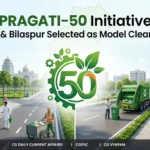
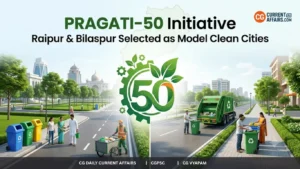
The PRAGATI-50 initiative of the Ministry of Housing and Urban Affairs (MoHUA) aims to develop 50 model cities for Swachhata across India. Under the initiative, Raipur and Bilaspur have been selected from Chhattisgarh.
The initiative focuses on improving urban cleanliness, solid waste management, used water management, sanitation infrastructure and citizen participation through targeted action, KPI-based assessment and technology-enabled monitoring.
For Chhattisgarh, the selection of Raipur and Bilaspur is important because the two cities can adopt national-level best practices and develop models that may be replicated by other Urban Local Bodies (ULBs) in the state.
Exam Point: Raipur and Bilaspur are the two Chhattisgarh cities selected under PRAGATI-50.
Why in News?
The Union Minister for Housing and Urban Affairs, Manohar Lal, launched the PRAGATI-50 initiative through video conferencing on 29 September 2026.
The initiative has been launched within the framework of Swachh Bharat Mission–Urban 2.0 (SBM-U 2.0) and focuses on creating clean, sustainable and better-managed urban areas.
Key Highlights
- 50 cities have been selected under PRAGATI-50.
- The selected cities are spread across 24 states.
- Raipur and Bilaspur are the two selected cities from Chhattisgarh.
- The initiative operates under Swachh Bharat Mission–Urban 2.0.
- It aims to develop selected cities as clean role-model cities.
- Major focus areas include solid waste management, used water management, sanitation and citizen participation.
- The initiative uses KPI-based action and technology-enabled monitoring.
- A digital review mechanism has been established through the Swachhatam Portal.
- Regular review meetings will be conducted to assess progress.
What is PRAGATI-50?
PRAGATI-50 is a national initiative of the Ministry of Housing and Urban Affairs (MoHUA) aimed at developing 50 model cities for Swachhata.
The initiative was launched in pursuance of directions given during the 51st PRAGATI meeting chaired by Prime Minister Narendra Modi.
It operates within the framework of Swachh Bharat Mission–Urban 2.0 and seeks to move beyond conventional cleanliness activities by focusing on measurable outcomes, technology-enabled monitoring and continuous improvement.
Objectives of PRAGATI-50
The major objective is to achieve measurable improvements in urban sanitation and cleanliness.
- Improve Urban Cleanliness
- The initiative aims to improve visible cleanliness in selected cities through systematic planning, implementation and monitoring.
- Strengthen Solid Waste Management
- The focus includes:
- Door-to-door waste collection
- Scientific source segregation
- Waste processing
- Sustainable solid waste management
- Better utilisation of waste-processing infrastructure
- Improve Used Water Management
- The initiative promotes:
- Treatment of used water
- Reuse of treated water
- Proper wastewater management
- Sustainable water-management practices
- Strengthen Sanitation Infrastructure
- Public sanitation facilities and related urban cleanliness infrastructure are expected to be improved.
- Increase Citizen Participation
- Citizens, institutions, elected representatives and Urban Local Bodies are expected to participate actively in cleanliness and sanitation activities.
Key Focus Areas Under PRAGATI-50
Focus Area | Major Objective |
Urban Cleanliness | Improve visible cleanliness |
Solid Waste Management | Collection, segregation and processing |
Used Water Management | Treatment, reuse and proper management |
Sanitation | Improve public sanitation facilities |
Citizen Participation | Increase community involvement |
Monitoring | KPI-based and technology-enabled review |
Best Practices | Adoption and replication of successful models |
The initiative places emphasis on door-to-door collection, scientific waste segregation and processing, improved solid waste management and better public sanitation facilities.
KPI-Based Monitoring
One of the important features of the initiative is its Key Performance Indicator (KPI)-based approach.
Instead of measuring success only through activities completed, the initiative seeks to assess the actual performance and outcomes of selected cities.
Performance can be assessed through:
- Defined indicators
- Outcome-based assessments
- Technology-enabled monitoring
- Regular review meetings
- Digital monitoring mechanisms
This approach aims to make urban sanitation efforts more measurable, transparent and accountable.
Technology-Enabled Monitoring
A digital review mechanism has been established on the Swachhatam Portal for monitoring the initiative.
Officers from the Ministry will be assigned specific cities for regular supervision, monitoring and handholding.
The technology-based system is intended to strengthen:
- Monitoring
- Accountability
- Timely implementation
- Coordination
- Performance assessment
Important Exam Fact
PRAGATI-50 digital monitoring → Swachhatam Portal
This is an important fact for CGPSC current affairs 2026 and other Chhattisgarh government examinations.
PRAGATI-50 Chhattisgarh: Raipur and Bilaspur
The selection of Raipur and Bilaspur makes the initiative particularly significant from the Chhattisgarh perspective.
Both cities can benefit from:
- Technical support
- Central Government guidance
- Adoption of best practices
- Improved sanitation systems
- Better waste management
- Used water management
- Technology-enabled monitoring
- Improved citizen services
The experiences and innovations developed in these cities can potentially become models for other Urban Local Bodies in Chhattisgarh.
Special Technical Support from the Centre
The selected cities will receive technical cooperation, continuous guidance and intensive monitoring from the Central Government.
The initiative also promotes the adoption and sharing of best practices among selected cities.
Technical support can help cities improve their sanitation systems through:
- Technical expertise
- Standardised practices
- Capacity building
- Innovation
- Performance reviews
- Knowledge sharing
“City as a Whole” Approach
An important feature of the initiative is the “City as a Whole” approach.
Under this approach, sanitation and cleanliness are not treated as isolated projects. Instead, different stakeholders are expected to work together to improve the overall urban environment.
Stakeholders may include:
- Urban Local Bodies
- Government departments
- Citizens
- Institutions
- Private and technical partners
- Other relevant stakeholders
The approach seeks to create an integrated system for urban cleanliness and sanitation.
Related Swachhata Initiatives
The PRAGATI-50 launch was accompanied by several initiatives related to urban sanitation, innovation, technology and behavioural change.
Swachh Bharat Test Bed & Innovation Centre
The Ministry, in collaboration with CSIR-CMERI, launched the Swachh Bharat Test Bed & Innovation Centre at Durgapur.
The centre is intended to support:
- Research
- Product development
- Testing
- Validation
- Certification
- Capacity building in sanitation technologies
Swachhata Startups
The Ministry also launched the third cohort of sanitation and waste-management startups in collaboration with IIT Kanpur.
The third cohort includes 13 startups working on technology-driven solutions for sanitation and waste management.
Overall, the initiative has engaged 75 startups across the waste-value chain.
Swachhata Behaviour Change Digital Kosh
The Swachhata Behaviour Change Digital Kosh was also launched during the programme.
It functions as a digital repository containing:
- Ideas
- Creatives
- Campaigns
- Communication resources
- Advocacy materials
Its objective is to help States, Urban Local Bodies and other stakeholders promote behavioural change and citizen participation in cleanliness activities.
Dedicated WhatsApp Channel for Swachhata
A dedicated WhatsApp channel was launched to complement the Swachhata App.
The channel aims to make it easier for citizens to:
- Register complaints
- Seek grievance redressal
- Participate in cleanliness initiatives
This reflects the growing role of digital platforms in citizen-centric urban governance.
Reduce, Reuse and Recycle Centre
A Reduce, Reuse and Recycle (RRR) Centre was inaugurated at Sankalp Bhawan, New Delhi, as part of Swachhata Hi Seva 2026.
The initiative promotes:
- Sustainable consumption
- Reuse
- Resource recovery
- Circular economy principles
It was described as the first such centre in a Union Ministry office.
Significance of PRAGATI-50
- Development of Model Clean Cities
- The initiative aims to create 50 cities that can serve as role models for urban cleanliness and sanitation.
- Better Waste Management
- Scientific collection, segregation and processing can improve the overall efficiency of urban waste-management systems.
- Sustainable Urban Development
- Used-water treatment, reuse and circular-economy practices can contribute to more sustainable cities.
- Technology-Enabled Governance
- Digital monitoring can make urban sanitation efforts more measurable and improve accountability.
- Citizen Participation
- The initiative recognises citizens as important stakeholders in maintaining cleanliness and improving urban services.
- Capacity Building
- Technical support and best-practice sharing can strengthen the capacity of Urban Local Bodies.
- Importance for Chhattisgarh
- The selection of Raipur and Bilaspur under PRAGATI-50 gives Chhattisgarh an opportunity to develop and demonstrate innovative urban sanitation practices.
Challenges
Successful implementation will depend on effective ground-level execution.
Major challenges include:
- Ensuring regular door-to-door waste collection
- Achieving complete source segregation
- Strengthening waste-processing capacity
- Proper treatment and reuse of wastewater
- Encouraging behavioural change among citizens
- Addressing capacity constraints in Urban Local Bodies
- Maintaining cleanliness over the long term
- Ensuring coordination among departments
- Converting monitoring into actual on-ground improvements
The key challenge is to convert targets and monitoring mechanisms into sustained outcomes.
Way Forward
For effective implementation, cities should focus on:
- Strengthening door-to-door waste collection.
- Ensuring source segregation at the household level.
- Expanding scientific waste-processing facilities.
- Promoting wastewater treatment and reuse.
- Using digital tools for real-time monitoring.
- Strengthening Urban Local Body capacities.
- Increasing citizen participation.
- Encouraging sanitation startups and innovation.
- Sharing successful models among cities.
- Integrating cleanliness with long-term sustainable urban planning.
Conclusion
The PRAGATI-50 initiative seeks to develop 50 model clean cities through targeted action, KPI-based assessment, technical support and technology-enabled monitoring.
For Chhattisgarh, the selection of Raipur and Bilaspur is particularly important. The two cities can use technical support and best-practice sharing to improve urban cleanliness, solid waste management, used water management, sanitation infrastructure and citizen services.
The initiative also represents a broader shift towards measurable, technology-driven and outcome-oriented urban governance.
What is PRAGATI-50?
Topic | Important Fact |
Initiative | PRAGATI-50 |
Ministry | Ministry of Housing and Urban Affairs |
Objective | Develop 50 model cities for Swachhata |
Number of cities | 50 |
States covered | 24 |
Chhattisgarh cities | Raipur and Bilaspur |
Mission framework | Swachh Bharat Mission–Urban 2.0 |
Based on | Directions from the 51st PRAGATI meeting |
Major focus | Urban cleanliness and sanitation |
Waste focus | Collection, segregation and processing |
Water focus | Treatment and reuse of used water |
Monitoring | KPI-based and technology-enabled |
Digital platform | Swachhatam Portal |
Approach | “City as a Whole” |
Startup partner | IIT Kanpur |
Third startup cohort | 13 startups |
Total startups engaged | 75 |
Test Bed | Swachh Bharat Test Bed & Innovation Centre |
Technology partner | CSIR-CMERI |
Test Bed location | Durgapur |
Digital repository | Swachhata Behaviour Change Digital Kosh |
Citizen platform | Swachhata App + dedicated WhatsApp channel |
RRR Centre | Sankalp Bhawan, New Delhi |
CGPSC Prelims Practice Questions 2026
Q1. Consider the following statements about PRAGATI-50:
- It aims to develop 50 model cities for Swachhata.
- It operates under Swachh Bharat Mission–Urban 2.0.
- Raipur and Bilaspur are the selected cities from Chhattisgarh.
- The initiative covers 24 states.
Which of the statements given above are correct?
- Only 1 and 2
B. Only 1, 2 and 3
C. Only 2, 3 and 4
D. 1, 2, 3 and 4
Answer: D
Q2. Which two cities of Chhattisgarh have been selected under PRAGATI-50?
- Raipur and Durg
B. Bilaspur and Korba
C. Raipur and Bilaspur
D. Raipur and Rajnandgaon
Answer: C. Raipur and Bilaspur
Q3. PRAGATI-50 primarily focuses on:
- Rural road development
B. Urban cleanliness and sanitation
C. Agricultural exports
D. Industrial corridors
Answer: B. Urban cleanliness and sanitation
Q4. The digital review mechanism for PRAGATI-50 has been established on:
- DigiLocker
B. Swachhatam Portal
C. UMANG
D. GeM
Answer: B. Swachhatam Portal
Q5. The Swachh Bharat Test Bed & Innovation Centre was launched in collaboration with:
- ISRO
B. DRDO
C. CSIR-CMERI
D. NITI Aayog
Answer: C. CSIR-CMERI
Q6. How many cities are included under PRAGATI-50?
- 25
B. 40
C. 50
D. 75
Answer: C. 50
Q7. PRAGATI-50 is associated primarily with which sector?
- Urban sanitation and cleanliness
B. Rural agriculture
C. Defence production
D. Higher education
Answer: A. Urban sanitation and cleanliness
Q8. Which of the following is a major component of PRAGATI-50?
- Solid waste management
B. Defence exports
C. Crop insurance
D. Rural electrification
Answer: A. Solid waste management
Q9. The “City as a Whole” approach under PRAGATI-50 emphasises:
- Development of only municipal roads
B. Integrated participation of multiple stakeholders
C. Only private-sector investment
D. Rural development planning
Answer: B. Integrated participation of multiple stakeholders
Q10. Which initiative is associated with sanitation and waste-management startups?
- Swachhata Startups
B. Digital India Mission
C. Startup India Defence
D. PM Gati Shakti
Answer: A. Swachhata Startups
CGPSC Mains Practice Questions 2026
Q1. Explain the significance of PRAGATI-50 for sustainable urban development in India.
Q2. Discuss the significance of selecting Raipur and Bilaspur under PRAGATI-50 for Chhattisgarh.