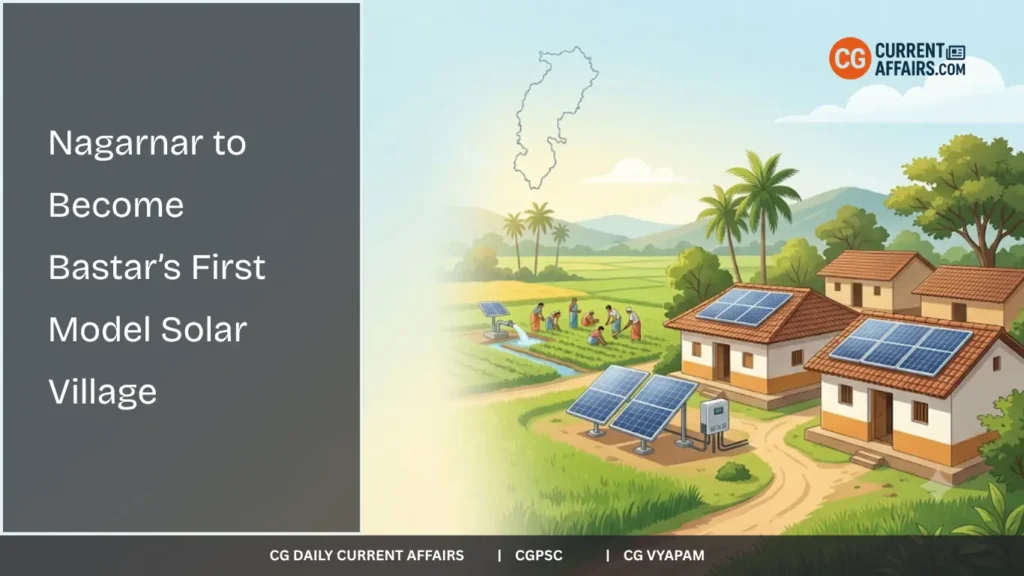
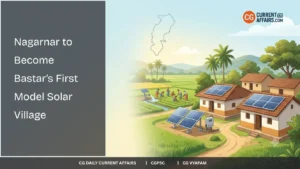
Nagarnar Model Solar Village in Bastar district is set to become an important example of renewable-energy adoption in Chhattisgarh. The initiative aims to develop Nagarnar as the state’s first Model Solar Village, marking a shift from its identity as an industrial and steel-producing area towards greater use of clean and decentralised energy.
The project will initially involve the installation of solar power systems on 20 government buildings, while local residents will also be encouraged to install solar panels on their rooftops.
The initiative is being planned under the Model Solar Village component of the PM-Surya Ghar: Muft Bijli Yojana. Its objective is not only to reduce electricity expenditure in government buildings but also to demonstrate the practical benefits of solar energy to rural communities.
Why in News?
- Nagarnar in Bastar is being developed as a Model Solar Village.
- Solar plants will initially be installed on 20 government buildings.
- The buildings include a Panchayat Bhawan, PHC, 6 schools, ITI, 9 Anganwadi centres and 2 hostels.
- Rural households will be encouraged to install rooftop solar panels.
- The project is targeted for completion in around three months.
- A Detailed Project Report (DPR) has been sent to REC, the central nodal agency, for the project.
Prelims Fact: Nagarnar in Bastar is proposed to become Chhattisgarh’s first Model Solar Village.
What is a Model Solar Village?
A Model Solar Village is a component of the PM-Surya Ghar: Muft Bijli Yojana aimed at promoting solar-energy adoption at the village level.
The scheme seeks to develop one Model Solar Village in each district, with the selected village demonstrating high adoption of distributed renewable energy and serving as a model for other villages.
Under the operational guidelines notified by the Ministry of New and Renewable Energy (MNRE) in August 2024:
- The total financial outlay for the Model Solar Village component is ₹800 crore.
- Central financial assistance of ₹1 crore is provided for the selected Model Solar Village in each district.
- Selection is based on a competitive process.
- Villages are assessed on their distributed renewable-energy capacity installed after selection as a potential candidate.
- Implementation is carried out by the State/UT Renewable Energy Development Agency under the supervision of the District Level Committee (DLC).
Thus, the Model Solar Village Chhattisgarh initiative is part of a broader national effort to promote decentralised renewable energy.
Nagarnar Model Solar Village: Solar Plan
The Nagarnar project will initially focus on government buildings.
Category | Number |
Panchayat Bhawan | 1 |
Primary Health Centre | 1 |
Schools | 6 |
ITI | 1 |
Anganwadi Centres | 9 |
Hostels | 2 |
Total | 20 |
Solar systems installed on these buildings will supply a portion of their electricity requirements. This can reduce conventional electricity consumption and provide residents with visible examples of how solar energy can be used in public institutions.
Rooftop Solar for Households
An important component of the Bastar Model Solar Village plan is encouraging local households to install solar panels on their rooftops.
Electricity generated during daylight hours can be used for household requirements. Depending on the system configuration, surplus electricity may also be stored in batteries or supplied to the electricity grid.
This approach can gradually make solar energy part of everyday rural life instead of limiting renewable-energy adoption to large-scale projects.
Funding and Implementation
The central government provides financial assistance of up to ₹1 crore for a selected Model Solar Village under the scheme.
For Nagarnar, additional resources may be mobilised through:
- District Mineral Foundation (DMF)
- Corporate Social Responsibility (CSR)
- Local development resources
The Detailed Project Report has been sent to REC, which is the central nodal agency mentioned for the project.
The project is targeted for completion in approximately three months.
How Does a Solar Panel Generate Electricity?
Solar panels contain photovoltaic (PV) cells that convert sunlight into electricity.
The basic process can be represented as:
- Sunlight → Photovoltaic Cells → Electricity → Household/Building Use
- During daylight hours, sunlight falling on photovoltaic cells generates electricity.
Depending on the system configuration, surplus electricity can be:
- Stored in batteries
- Supplied to the electricity grid
- Used for other connected requirements
The increasing adoption of rooftop solar is an important part of India’s transition towards decentralised renewable energy.
PM-Surya Ghar: Muft Bijli Yojana
The PM-Surya Ghar: Muft Bijli Yojana was approved by the Union Government on 29 February 2024.
The scheme primarily focuses on promoting rooftop solar systems among residential households.
Key Facts
- Objective: Promote rooftop solar adoption among residential households.
- Total outlay: ₹75,021 crore.
- Implementation period: Up to FY 2026–27.
- Model Solar Village: One component of the scheme.
- Model Solar Village component outlay: ₹800 crore.
- Central assistance for selected village: ₹1 crore.
The scheme aims to increase rooftop solar capacity and enable households to generate a portion of their own electricity.
For CGPSC Current Affairs 2026, it is important to distinguish the overall PM-Surya Ghar scheme from its Model Solar Village component.
PM-KUSUM: Solar Energy in Agriculture
Another important renewable-energy programme is the PM-KUSUM Scheme, launched in 2019.
While PM-Surya Ghar primarily focuses on rooftop solar for residential households, PM-KUSUM has a strong focus on solar energy in agriculture.
Major Objectives
- Reduce farmers’ dependence on diesel for irrigation.
- Promote solar-powered agricultural pumps.
- Improve energy and water security.
- Reduce pollution.
- Enable farmers to potentially earn from surplus solar electricity.
Three Components of PM-KUSUM
Component | Main Provision |
Component-A | 10,000 MW of decentralised ground/stilt-mounted solar power plants |
Component-B | 20 lakh stand-alone solar pumps |
Component-C | Solarisation of 15 lakh grid-connected agricultural pumps |
Exam Comparison
PM-Surya Ghar → Residential rooftop solar
PM-KUSUM → Solar energy for agriculture
Significance of Nagarnar Model Solar Village
The proposed Nagarnar Model Solar Village can have wider significance for Bastar’s rural development.
- Promotion of Renewable Energy
- The project can increase awareness and adoption of clean and decentralised energy among rural communities.
- Government buildings can function as live demonstration sites, allowing residents to observe the practical benefits of rooftop solar.
- Reduction in Electricity Expenditure
- Solar generation can reduce conventional electricity consumption in government institutions.
- Encouraging rooftop solar can extend renewable-energy adoption from government infrastructure to individual households.
- Sustainable Rural Development
- The project can contribute to cleaner and more decentralised energy systems in rural Bastar.
- The initiative can help rural communities understand how photovoltaic technology can be integrated into everyday electricity consumption.
Chhattisgarh Perspective
The Nagarnar Model Solar Village initiative is significant for Chhattisgarh because the state is strongly associated with coal, steel and mineral-based industries.
The move towards a model solar village represents an additional focus on renewable and decentralised energy, particularly at the village level.
For Bastar, where rural and tribal communities are spread across a large geographical area, decentralised renewable-energy solutions can complement conventional electricity infrastructure.
Challenges
The success of a Model Solar Village will depend on more than simply installing solar panels.
Key challenges include:
- Initial installation costs for households.
- Awareness regarding rooftop solar systems.
- Availability of maintenance and technical support.
- Reliable financing and access to subsidies.
- Grid integration of surplus electricity.
- Ensuring long-term functioning of installed systems.
- Greater participation of rural households.
- Regular monitoring of solar installations.
The long-term sustainability of the project will depend on ensuring that installed systems continue to function effectively after the initial implementation phase.
Way Forward
To make Nagarnar a successful Bastar Model Solar Village, the focus should be on:
- Conducting awareness campaigns for rural households.
- Providing easy access to rooftop-solar financing and incentives.
- Establishing local technical and maintenance support.
- Regularly monitoring installed solar systems.
- Increasing community participation.
- Integrating solar power with other rural-development programmes.
- Using government buildings as demonstration centres.
- Encouraging households to adopt rooftop solar.
- Building local capacity for basic solar-system maintenance.
- Documenting successful practices for replication in other villages.
Conclusion
The Nagarnar Model Solar Village initiative can provide a practical example of how renewable energy can move beyond large solar parks and become part of everyday rural life.
Beginning with 20 government buildings and extending awareness and adoption to household rooftops, the initiative can demonstrate the economic, environmental and social benefits of decentralised solar power.
For Chhattisgarh, Nagarnar can potentially serve as a model for expanding renewable-energy adoption in other rural areas. Its long-term success will depend on household participation, technical support, effective implementation and continued maintenance of solar infrastructure.
CGPSC Prelims Current Affairs 2026
Topic | Fact |
Village | Nagarnar |
District | Bastar |
State | Chhattisgarh |
Proposed status | Model Solar Village |
Initial government buildings | 20 |
Central assistance | ₹1 crore |
Model Solar Village component | PM-Surya Ghar: Muft Bijli Yojana |
Component outlay | ₹800 crore |
PM-Surya Ghar approval | 29 February 2024 |
PM-Surya Ghar total outlay | ₹75,021 crore |
Nodal agency mentioned for project | REC |
Agricultural solar scheme | PM-KUSUM |
PM-KUSUM launch | 2019 |
CGPSC Prelims Current Affairs 2026
Q1. Nagarnar, recently in the news for a proposed Model Solar Village, is located in which district of Chhattisgarh?
- Surguja
B. Bastar
C. Kanker
D. Raigarh
Answer: B. Bastar
Q2. The Model Solar Village component is associated with which scheme?
- PM-KUSUM
B. PM-Surya Ghar: Muft Bijli Yojana
C. PM Gram Sadak Yojana
D. PMAY-G
Answer: B. PM-Surya Ghar: Muft Bijli Yojana
Q3. What is the central financial assistance provided for the selected Model Solar Village in a district?
- ₹25 lakh
B. ₹50 lakh
C. ₹1 crore
D. ₹5 crore
Answer: C. ₹1 crore
Q4. Which scheme primarily focuses on solarisation in the agricultural sector?
- PM-Surya Ghar
B. PM-KUSUM
C. PMAY-G
D. PMGSY
Answer: B. PM-KUSUM
Q5. How many government buildings are initially included in the Nagarnar solar project?
- 10
B. 15
C. 20
D. 25
Answer: C. 20
Q6. The Model Solar Village component has a total financial outlay of:
- ₹500 crore
B. ₹800 crore
C. ₹1,000 crore
D. ₹1,500 crore
Answer: B. ₹800 crore
Q7. Which technology is primarily used by solar panels to convert sunlight into electricity?
- Thermal conversion
B. Photovoltaic technology
C. Nuclear fission
D. Hydroelectric conversion
Answer: B. Photovoltaic technology
Q8. PM-Surya Ghar: Muft Bijli Yojana was approved on:
- 15 August 2023
B. 26 January 2024
C. 29 February 2024
D. 2 October 2024
Answer: C. 29 February 2024
CGPSC Mains Practice Questions 2026
Q1. Explain the significance of developing Model Solar Villages for rural renewable-energy adoption.
Q2. Discuss the significance of Nagarnar’s proposed Model Solar Village for Chhattisgarh.
Also Read:
- Kondagaon tops in Coconut production
- Adi Vaani- First AI Gondi language translator