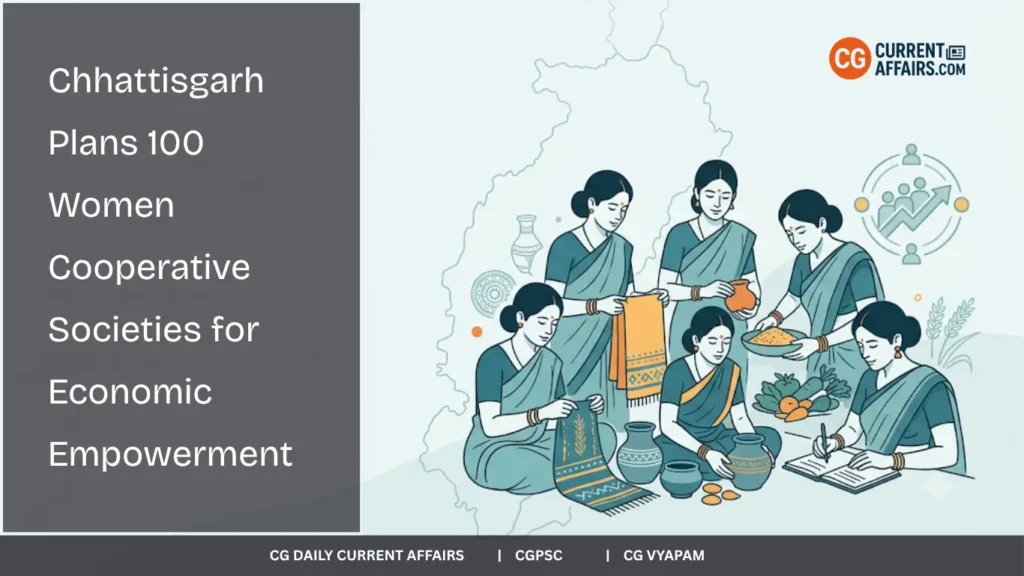
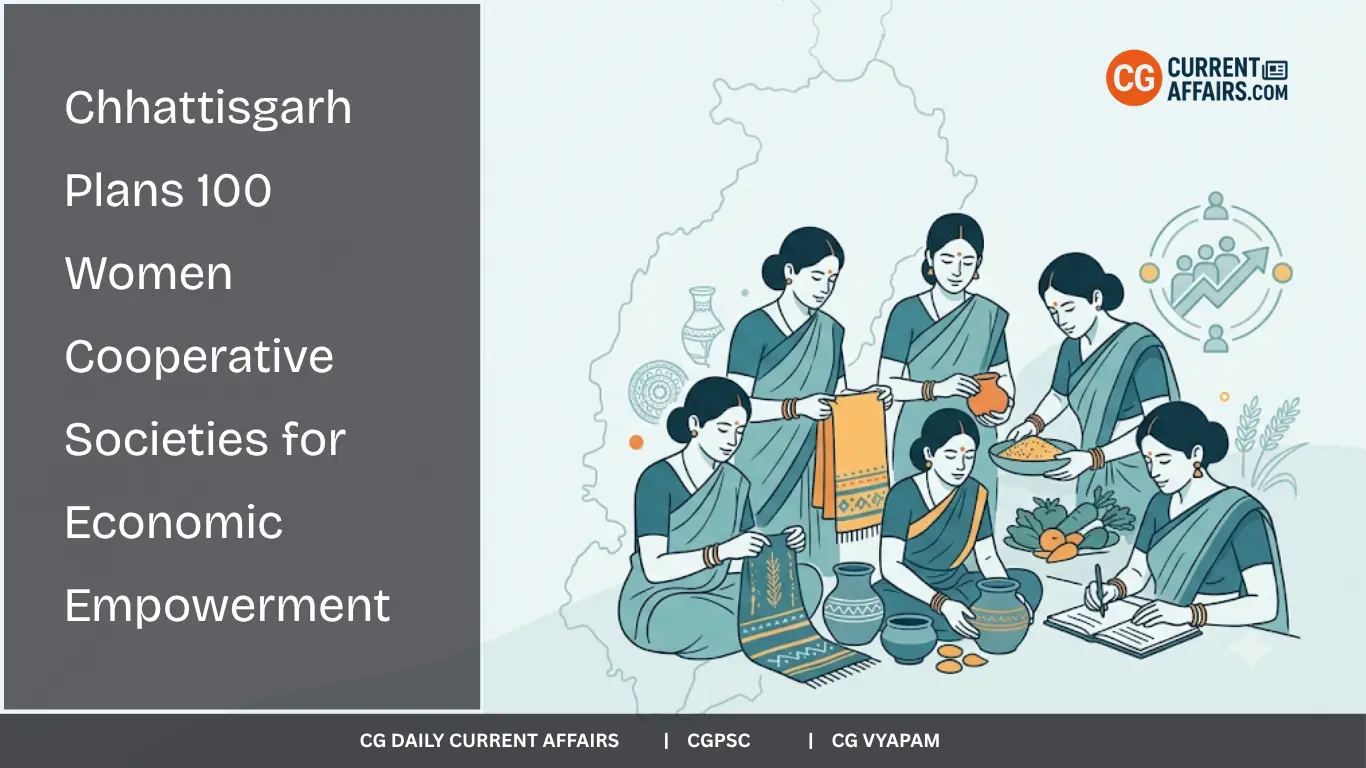
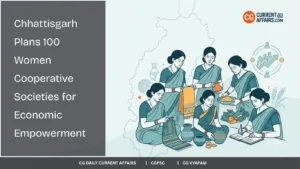
Chhattisgarh is preparing to establish around 100 women cooperative societies as part of its efforts to strengthen women’s economic independence during Mahtari Gaurav Varsh 2026. The initiative is aimed at taking women’s collective economic activities beyond conventional savings and credit-based Self-Help Groups (SHGs).
The proposed Women Cooperative Societies Chhattisgarh initiative seeks to connect women with production, business, institutional finance, entrepreneurship and markets. The broader objective is to transform women from beneficiaries of welfare schemes into active participants and decision-makers in collective enterprises.
Why in News?
- Chhattisgarh’s Cooperation Department is preparing to establish around 100 women cooperative societies.
- The proposed societies will have women as members.
- Cooperation Minister Kedar Kashyap has directed officials to work towards their formation.
- The initiative aims to move beyond savings and credit towards production, business, finance and marketing.
- The initiative is being planned during Mahtari Gaurav Varsh 2026.
Prelims Fact: Chhattisgarh plans around 100 women cooperative societies to strengthen women’s economic participation and entrepreneurship.
What is the Women Cooperative Society Initiative?
The proposed Chhattisgarh women cooperative society model aims to provide women with a stronger institutional platform for collective economic activities.
A large number of women in the state are already associated with Self-Help Groups (SHGs), where they participate in savings, credit and small livelihood activities.
The proposed cooperative structure seeks to build upon these existing activities by providing women with an institutional mechanism through which they can collectively:
- Produce goods
- Access institutional finance
- Develop businesses
- Market products
- Make investment decisions
- Expand production
- Create local employment
The exact structure, membership arrangements and economic activities of the proposed societies are being examined by the Cooperation Department.
From Self-Help Groups to Cooperatives
The Women Cooperative Societies Chhattisgarh initiative represents a potential progression from small-scale group activities towards more organised and market-oriented enterprises.
Self-Help Groups
SHGs generally support women through:
- Savings
- Small loans
- Micro-enterprises
- Livelihood activities
- Collective participation
Proposed Women Cooperatives
The cooperative model aims to take these activities further through:
- Collective production
- Larger-scale business
- Institutional credit
- Branding and marketing
- Market linkages
- Investment and business decisions
Thus, the focus can gradually shift from:
Saving and Borrowing → Producing, Selling and Earning
This transition is important from the perspective of women empowerment in Chhattisgarh, as it can provide women with greater ownership over income-generating activities.
Potential Areas of Activity
The proposed women cooperative societies could explore economic activities based on local resources, skills and market demand.
Potential areas include:
- Agriculture-based products
- Minor forest produce processing
- Dairy
- Animal husbandry
- Handicrafts and embroidery
- Local products
- Food processing
- Product branding and marketing
The exact activities will depend on the final structure and feasibility assessment undertaken by the department.
For Women Entrepreneurship Chhattisgarh, such cooperative enterprises could provide an institutional pathway for women to move from small livelihood activities towards larger market-oriented businesses.
Lessons from Jharkhand and Odisha
Chhattisgarh is also looking at models developed in other states to strengthen women-led collective economic activities.
Jharkhand
Through the Jharkhand State Livelihood Promotion Society (JSLPS), women’s Self-Help Groups have been connected with:
- Clusters
- Federations
- Enterprises
- Livelihood activities
According to the source material, 13,408 new Sakhi Mandals were formed in the first half of 2025–26, taking the number of active Sakhi Mandals to more than 3.05 lakh.
This provides a possible institutional model for strengthening women-led collectives.
Odisha
Odisha has developed a women-led institutional model under Mission Shakti, connecting women SHGs with:
- Federations
- Producer groups
- Livelihood activities
- Market-oriented economic activities
These experiences can provide useful lessons for developing women cooperatives in Chhattisgarh.
Expected Benefits
- 1. Collective Production and Marketing
- Women can move beyond individually operating small businesses and undertake production and sales collectively.
- Collective operations can potentially improve purchasing power, production capacity, branding and access to larger markets.
- 2. Better Access to Finance
- A formal cooperative structure can potentially improve women’s access to bank credit and institutional finance.
- This can help women expand existing enterprises and establish new businesses.
- 3. Reduced Dependence on Intermediaries
- Collective branding, processing and marketing can help women reduce dependence on middlemen and potentially improve their share of the final market value.
- Women-led enterprises can create additional income and employment opportunities in villages and small towns.
- 5. Integration of Government Schemes
- Agriculture, livestock, forest produce, industry, skill development and women empowerment programmes can potentially be connected through a common institutional platform.
- 6. Women’s Decision-Making
- Women members can directly participate in decisions relating to:
- Production
- Investment
- Business operations
- Marketing
- Institutional development
- This makes cooperative institutions relevant not only for income generation but also for women’s economic and social empowerment.
Mahtari Gaurav Varsh 2026
The proposed initiative is being planned during Mahtari Gaurav Varsh 2026–27, reflecting the state’s emphasis on women’s empowerment.
The broader focus includes:
- Economic independence
- Safety
- Health
- Education
- Social dignity
- Financial empowerment
The proposed 100 women cooperative societies can complement these priorities by focusing specifically on women’s participation in production and market-based economic activities.
Mahtari Vandan Yojana
Another major women-focused initiative in Chhattisgarh is Mahtari Vandan Yojana.
Under the scheme, eligible married women receive ₹1,000 per month through Direct Benefit Transfer (DBT).
According to the source material:
- Around 70 lakh married women are covered.
- More than ₹15,595 crore has reportedly been distributed so far.
- Some beneficiaries are using financial support for household needs as well as livelihood and self-employment activities.
Women’s Livelihood Initiatives in Chhattisgarh
The state’s approach towards Women Empowerment Chhattisgarh includes several livelihood and financial initiatives.
According to the source material:
- More than 42,000 SHGs have received concessional loans.
- Digital Sakhi promotes digital skills and financial participation.
- Didi E-Rickshaw provides livelihood opportunities.
- Women are involved in Ready-to-Eat production.
- Women associated with rural livelihood missions such as Bihan are emerging as entrepreneurs.
- Some women are also being trained in modern activities such as drone operations in agriculture.
These initiatives indicate a broader shift towards increasing women’s participation in income-generating and entrepreneurial activities.
Budgetary Support
According to the source material, the state budget provides ₹8,245 crore for Women and Child Development.
The allocation includes provisions related to:
- Anganwadi nutrition programmes
- Various missions
- Anganwadi infrastructure
- Mahtari Sadan infrastructure
Women’s safety mechanisms also include:
- One Stop Centres
- 181 Women Helpline
- Dial-112
The state also provides assistance to widows through schemes such as Sukhad Sahara.
Significance for Chhattisgarh
The proposed Women Cooperative Societies Chhattisgarh initiative can be important for the state’s rural economy because it can connect the existing strength of women’s SHGs with more formal business structures.
The potential economic chain can be represented as:
SHGs → Cooperatives → Production → Branding → Markets → Higher Income
This model can help women move from being primarily recipients of welfare and credit support towards becoming owners, entrepreneurs and decision-makers in collective economic enterprises.
For CGPSC and CG Vyapam, the initiative can be studied under the themes of:
- Women empowerment
- Cooperative movement
- Rural development
- Self-Help Groups
- Livelihood promotion
- Financial inclusion
- Entrepreneurship
- Chhattisgarh government initiatives
Challenges
The success of the proposed cooperative model will depend on more than simply establishing societies.
Major challenges include:
- Selection of economically viable activities
- Access to adequate working capital
- Professional management
- Product quality and standardisation
- Branding and packaging
- Reliable market linkages
- Digital marketing and e-commerce access
- Skill development
- Transparency and accountability
- Sustainable demand for products
Simply creating cooperative societies will not automatically result in sustainable enterprises.
Their long-term success will depend on their ability to produce competitively, access markets and generate regular income.
Way Forward
For the proposed women cooperatives to become sustainable economic institutions, Chhattisgarh can focus on:
- Identifying products with strong local and external demand.
- Providing business and financial-management training.
- Connecting cooperatives with banks and institutional finance.
- Developing common branding and packaging.
- Creating direct market linkages.
- Using digital platforms and e-commerce.
- Connecting cooperatives with government procurement.
- Providing technical support for processing and value addition.
- Learning from successful models in Jharkhand and Odisha.
- Building strong monitoring and accountability mechanisms.
Conclusion
The proposed formation of around 100 women cooperative societies represents a potential shift in Chhattisgarh’s women empowerment strategy—from individual savings and credit activities towards collective production, enterprise development and market participation.
If supported by finance, skills, branding and reliable market linkages, these societies can become important instruments for increasing women’s income, entrepreneurship, employment and decision-making power.
The Women Cooperative Societies Chhattisgarh initiative is therefore significant not only as a cooperative-sector reform but also as a potential rural economic-development model.
CGPSC Prelims Current Affairs 2026
- Initiative: Around 100 women cooperative societies
- State: Chhattisgarh
- Context: Mahtari Gaurav Varsh 2026
- Concerned department: Cooperation Department
- Cooperation Minister: Kedar Kashyap
- Membership: Women
- Focus: Production, business, finance and market linkages
- Existing foundation: Self-Help Groups (SHGs)
- Jharkhand model: JSLPS
- Odisha model: Mission Shakti
- Mahtari Vandan Yojana: ₹1,000 per month through DBT to eligible married women
- Women & Child Development budget provision: ₹8,245 crore
CGPSC Prelims Practice Questions 2026
Q1. Chhattisgarh is preparing to establish approximately how many women cooperative societies?
- 25
B. 50
C. 100
D. 500
Answer: C. 100
Q2. The proposed women cooperative society initiative primarily aims to move beyond:
- Digital payments
B. Savings and credit towards production and market-based activities
C. Agricultural subsidies
D. Government employment
Answer: B. Savings and credit towards production and market-based activities
Q3. Which state initiative is associated with women SHGs and livelihood activities in Odisha?
- Mission Shakti
B. JSLPS
C. Bihan
D. Mahtari Vandan
Answer: A. Mission Shakti
Q4. Mahtari Vandan Yojana provides eligible women with monthly financial assistance of:
- ₹500
B. ₹750
C. ₹1,000
D. ₹2,000
Answer: C. ₹1,000
Q5. Which of the following is a potential activity for the proposed women cooperatives?
- Minor forest produce processing
B. Space research
C. Railway construction
D. Port management
Answer: A. Minor forest produce processing
CGPSC Mains Practice Questions 2026
Q1. Discuss how women-led cooperative societies can strengthen women’s economic empowerment in rural Chhattisgarh.
Q2. “Women’s empowerment requires a shift from welfare-oriented support to economic ownership and decision-making.” Discuss with reference to Chhattisgarh.
Quick Revision
- Chhattisgarh plans around 100 women cooperative societies.
- The initiative is being planned during Mahtari Gaurav Varsh 2026.
- The Cooperation Department is involved.
- Cooperation Minister Kedar Kashyap has directed officials to work towards their formation.
- The proposed societies will have women as members.
- The focus extends beyond conventional savings and credit.
- Key areas include production, business, finance and marketing.
- Potential sectors include agriculture, forest produce, dairy and handicrafts.
- Jharkhand’s JSLPS provides a possible model.
- Odisha’s Mission Shakti provides another institutional model.
- Mahtari Vandan Yojana provides ₹1,000 per month through DBT to eligible married women.
- More than 42,000 SHGs have reportedly received concessional loans.
- Digital Sakhi promotes digital and financial participation.
- Bihan is associated with rural livelihood activities.
- The Women and Child Development budget provision is ₹8,245 crore, according to the source material.
- The broader objective is to increase women’s economic independence, entrepreneurship and decision-making power.
Also Read:
- Launch of “Didi Ke Goth” radio program in CG
- Lakhpati didi Scheme CG