Understanding Child Protection Month
Basic Concept
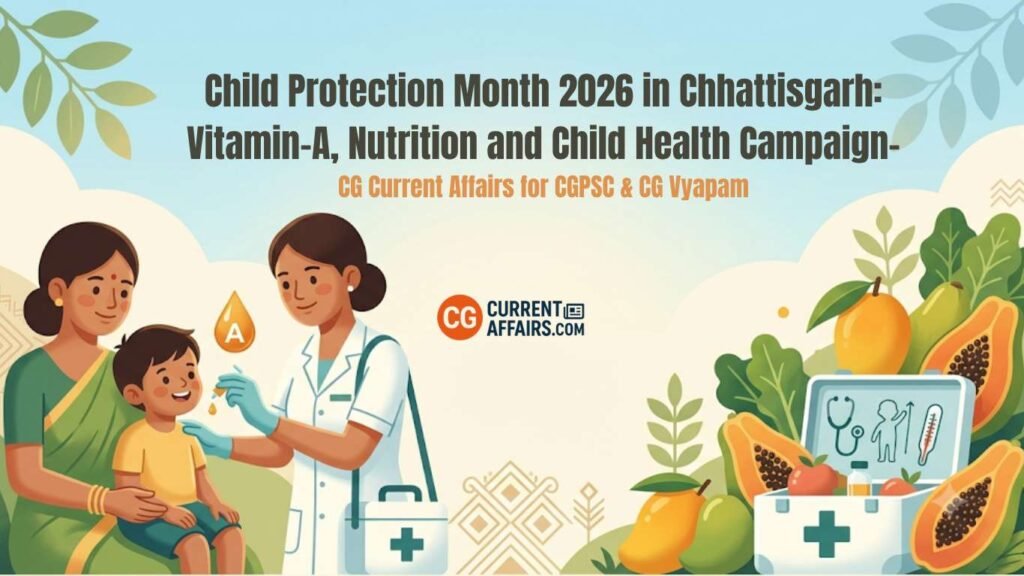
In Chhattisgarh, Shishu Suraksha Maas (Child Protection Month) is a periodic child health and nutrition programme aimed at providing essential preventive and nutritional services to young children.
The programme is conducted twice a year and focuses mainly on Vitamin-A supplementation for children aged 9–59 months and IFA supplementation for children aged 6–59 months, delivered through Gram Health and Nutrition Day (VHND)-type platforms.
The key feature of the programme is service convergence—multiple child-health services are provided together through frontline health and nutrition workers.
- Frequency: Twice a year
- Vitamin-A: 9–59 months
- IFA: 6–59 months
- Platform: VHND / community-level health and nutrition sessions
- Focus: Nutrition, immunization, growth monitoring and prevention of deficiencies.
Key Features
- Vitamin-A supplementation for eligible children.
- Iron and Folic Acid supplementation for children in the specified age group.
- Growth monitoring through weight measurement and assessment.
- Identification of children who may be undernourished or severely malnourished.
- Referral of eligible SAM children to Nutrition Rehabilitation Centres.
- Immunization and identification of children who have missed due vaccines.
- Nutrition counselling for parents and caregivers.
- Promotion of early initiation of breastfeeding and exclusive breastfeeding for the first six months.
- Counselling regarding appropriate complementary feeding after six months.
- Delivery through Anganwadi and community-health platforms.
How Does the Campaign Work?
The programme can be understood through the following sequence:
- Step 1 – Mobilization:
Parents/caregivers are encouraged to bring eligible children to the designated health and nutrition session. - Step 2 – Screening:
The child is weighed and basic health/nutrition status is assessed. - Step 3 – Supplementation:
Eligible children receive Vitamin-A and/or IFA supplementation according to the programme’s age criteria and applicable guidelines. - Step 4 – Immunization Check:
The child’s immunization status is checked and due services are provided as appropriate. - Step 5 – Nutrition Counselling:
Parents receive guidance on breastfeeding, complementary feeding, balanced diets and appropriate child-care practices. - Step 6 – Referral:
Children requiring specialized management, particularly those with severe acute malnutrition or other health concerns, are referred to appropriate health facilities/NRCs.
Why Are Vitamin-A and IFA Important?
Vitamin-A
Vitamin-A is essential for:
- normal vision;
- maintenance of epithelial tissues;
- immune function;
- growth and development.
Vitamin-A deficiency can contribute to impaired immunity and eye-related problems, including night blindness.
Under the national supplementation programme, children aged 9 months to 5 years are covered, with a total of nine prophylactic doses up to five years.
Prelims Fact
Vitamin-A schedule:
- At 9 months: 1,00,000 IU
- From 1–5 years: 2,00,000 IU
- Total: 9 doses up to five years
Iron and Folic Acid
- Iron is important for haemoglobin formation and oxygen transport. Iron deficiency can cause anaemia, which may affect children’s physical and cognitive development.
- Folic acid is important for cell division and blood formation.
- The Government’s anaemia-control framework includes IFA supplementation for young children. Recent national anaemia-management guidance also provides screening and treatment protocols for children aged 6–59 months.
CGPSC Focus: Remember the difference between Vitamin-A supplementation and IFA supplementation:
| Intervention | Age group in the Jashpur campaign |
|---|
| Vitamin-A | 9 months–5 years |
| IFA syrup | 6 months–5 years |
Important Institutions and Stakeholders
- Health Department
- Responsible for public-health implementation, immunization and related child-health services.
- Women and Child Development Department
- Anganwadi-based nutrition services and community-level child development interventions form an important part of the convergence framework.
- Anganwadi Workers
- They help with mobilization, nutrition counselling, growth monitoring and identification/referral of vulnerable children.
- ANMs and Other Frontline Health Workers
- They support supplementation, immunization, screening and health-related services.
- ASHA Workers
- ASHA workers contribute to community mobilization, counselling and follow-up.
- Nutrition Rehabilitation Centres
- NRCs provide facility-based nutritional and medical care to children requiring specialized management.
The national protocol for management of malnourished children emphasizes identification, management, referral and follow-up through Anganwadi centres and health facilities.
Key Facts and Data: Jashpur Child Protection Month 2026
District-Level Target
78,370 children are targeted for Vitamin-A supplementation.
Block-wise Vitamin-A Target
| Block | Target Children |
| Patthalgaon | 19,571 |
| Farsabahar | 8,456 |
| Kansabel | 5,982 |
| Bagicha | 15,848 |
| Kunkuri | 9,294 |
| Duldula | 3,420 |
| Jashpur | 9,580 |
| Manora | 6,219 |
| Total | 78,370 |
Number of Sessions
A total of 2,766 sessions are planned.
| Block | Sessions |
| Patthalgaon | 485 |
| Farsabahar | 360 |
| Kansabel | 288 |
| Bagicha | 630 |
| Kunkuri | 320 |
| Duldula | 129 |
| Lodam | 324 |
| Manora | 230 |
| Total | 2,766 |
Prelims Fact: Among the listed blocks, Bagicha has the highest number of planned sessions (630), while Duldula has the lowest (129).
Scheduled Campaign Dates
The district has scheduled sessions on:
August: 18, 21, 25, 29
September: 1, 5, 8, 11, 16, 18, 21, 24
The campaign therefore creates a repeated service-delivery schedule rather than a one-day supplementation exercise.
Significance of the Campaign
Social Significance
- Improves child nutrition, growth and learning.
- Helps in early identification of malnutrition.
- Supports immunization and disease prevention.
- Promotes better feeding, breastfeeding and hygiene practices.
- Brings essential services closer to rural communities.
- Mains Point: Child nutrition is an investment in human capital, not merely welfare expenditure.
Public Health Significance
- Early identification of malnutrition and vulnerable children.
- Prevention of Vitamin-A deficiency and anaemia.
- Improves immunization coverage.
- Ensures timely referral of severely malnourished children.
- Integrates health and nutrition services through VHNDs.
Governance Significance
- Promotes inter-departmental convergence.
- Links health, nutrition, sanitation, food security and community participation.
- Strengthens community-based preventive healthcare.
- CGPSC Focus: Success depends on coverage + quality + continuity + follow-up.
Major Challenges
- Last-mile delivery: Reaching children in remote and tribal areas.
- Low awareness: Ensuring parents understand the importance of services.
- Malnutrition detection: Proper assessment requires more than weight measurement.
- Follow-up: Ensuring continued care after referral or treatment.
- Anaemia: Requires regular supplementation, screening and dietary improvement.
Major Government Initiatives
- Vitamin-A Supplementation: Vitamin-A supplementation for children aged 9 months–5 years.
- Anaemia Mukt Bharat: Focuses on IFA supplementation, screening and treatment.
- Anganwadi & POSHAN: Provides supplementary nutrition, growth monitoring and counselling.
- Nutrition Rehabilitation Centres (NRCs): Provide specialised care to children with severe acute malnutrition (SAM).
Chhattisgarh Perspective
Why is the Issue Important for Chhattisgarh?
- Rural & Tribal Population: Large rural and tribal populations make last-mile healthcare delivery important.
- Geographical Challenges: Remote and dispersed settlements require outreach-based health services.
- Anganwadi Centres: Important community-level platforms for nutrition, growth monitoring and counselling.
- VHND: Helps bring maternal and child health services closer to villages.
- NRCs: Provide referral and specialised care for children with severe malnutrition.
- Departmental Convergence: Coordination between Health and Women & Child Development departments is essential.
- Nutrition: Outcomes depend not only on supplementation but also on diet diversity, breastfeeding, sanitation and maternal health.
Jashpur: 2026 Case Study
The 2026 Shishu Suraksha Maas campaign in Jashpur demonstrates district-level implementation of child-health priorities:
2,766 sessions → 78,370 targeted children → Vitamin-A + IFA + Immunization + Growth Monitoring + Counselling + Referral
Constitutional Perspective
Several Directive Principles and fundamental-rights interpretations provide a normative foundation for child welfare:
- Article 21 – protection of life and personal liberty; judicial interpretation has expanded its scope to include dignified living.
- Article 39(e) – protection of the health and strength of workers and children from abuse and unsuitable work.
- Article 39(f) – children should be given opportunities and facilities to develop in a healthy manner and in conditions of freedom and dignity.
- Article 45 – provision for early childhood care and education for children below six years.
- Article 47 – duty of the State to raise the level of nutrition and standard of living and improve public health.
International Perspective
Child nutrition is closely associated with the Sustainable Development Goals (SDGs).
- SDG 2 – Zero Hunger: Focuses on ending hunger and improving nutrition.
- SDG 3 – Good Health & Well-being: Promotes child health, immunization and disease prevention.
- Child survival requires a multi-sectoral approach involving:
- Nutrition
- Immunization
- Breastfeeding
- Sanitation
- Food security
Important Reports, Laws and Institutions
| Item | Relevance |
| National Health Mission (NHM) | Implements major public-health interventions including Vitamin-A supplementation |
| Ministry of Health & Family Welfare | Central ministry responsible for national health programmes |
| Ministry of Women & Child Development | Major institutional pillar for child development and nutrition services |
| Anganwadi Centre | Community platform for nutrition and early childhood services |
| VHND | Outreach platform for health and nutrition services |
| Nutrition Rehabilitation Centre | Facility-based management and nutritional rehabilitation of eligible malnourished children |
| POSHAN Abhiyaan | Convergence-oriented approach to improve nutrition outcomes |
| Anaemia Mukt Bharat | National strategy for anaemia prevention, screening and management |
Conclusion
Conclude that child nutrition requires an integrated approach combining healthcare, nutrition, education, sanitation and social protection.
CGPSC Prelims Practice Questions
Question 1
With reference to Child Protection Month/Shishu Suraksha Maas, consider the following statements:
- Vitamin-A supplementation under the programme covers children beginning at 9 months of age.
- IFA supplementation is targeted at children from 6 months of age.
- The programme is restricted exclusively to Vitamin-A administration and does not involve nutrition screening or immunization-related services.
- Nutrition Rehabilitation Centres can play a role in the management of children identified with severe acute malnutrition.
Which of the statements given above are correct?
A. 1 and 2 only
B. 1, 2 and 4 only
C. 2, 3 and 4 only
D. 1, 2, 3 and 4
Correct Answer: B. 1, 2 and 4 only
Question 2
Consider the following pairs:
| Constitutional Provision | Subject |
| 1. Article 39(f) | Healthy development of children |
| 2. Article 45 | Early childhood care and education |
| 3. Article 47 | Nutrition and public health |
| 4. Article 21 | Directive Principle specifically dealing only with Vitamin-A supplementation |
Which of the pairs given above are correctly matched?
A. 1, 2 and 3 only
B. 1 and 4 only
C. 2 and 3 only
D. 1, 2, 3 and 4
Correct Answer: A. 1, 2 and 3 only
CGPSC Mains Practice Questions
Question 1
“Child nutrition programmes should move from a supplementation-centric approach towards an integrated health, nutrition and human-development framework.” Discuss with reference to Chhattisgarh.
Question 2
Evaluate the role of community-based health platforms such as VHNDs and Anganwadi centres in improving child-health outcomes in rural and tribal areas of Chhattisgarh.
Quick Revision / One-Minute Revision
- Topic: Child Protection Month / Shishu Suraksha Maas
- Current Location: Jashpur, Chhattisgarh
- Launch Date: 18 August 2026
- Campaign Period: 18 August–24 September 2026
- Vitamin-A Target: 78,370 children
- Sessions: 2,766
- Vitamin-A Age Group: 9 months–5 years
- IFA Age Group: 6 months–5 years
- National Vitamin-A Schedule: 9 doses up to five years
- Vitamin-A Dose: 1,00,000 IU at 9 months; subsequent doses of 2,00,000 IU according to schedule
- Major Services: Vitamin-A + IFA + immunization + weight monitoring + counselling
- SAM Referral: Nutrition Rehabilitation Centres
- Community Platform: VHND
- Key Constitutional Provision: Article 47 – nutrition and public health
- Chhattisgarh Example: Jashpur district campaign
- Major Policy Concept: Convergence and last-mile healthcare