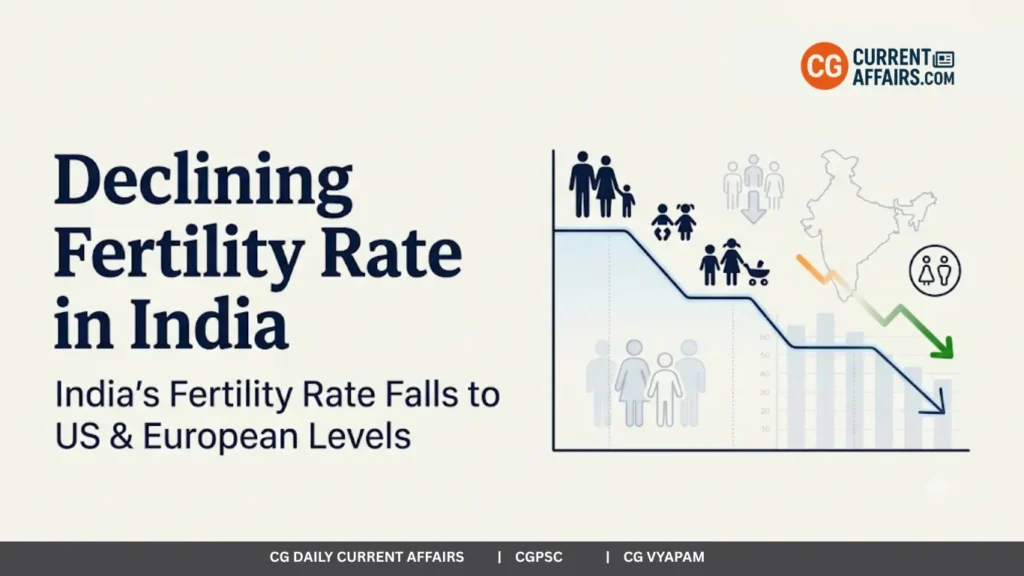
India is undergoing a major demographic transition, with the declining fertility rate in India becoming an increasingly important demographic and economic issue. The issue has gained renewed attention following a recent working paper by the Economic Advisory Council to the Prime Minister (EAC-PM) titled “The Ghost of Population Past: How Population Control Persists in India.”
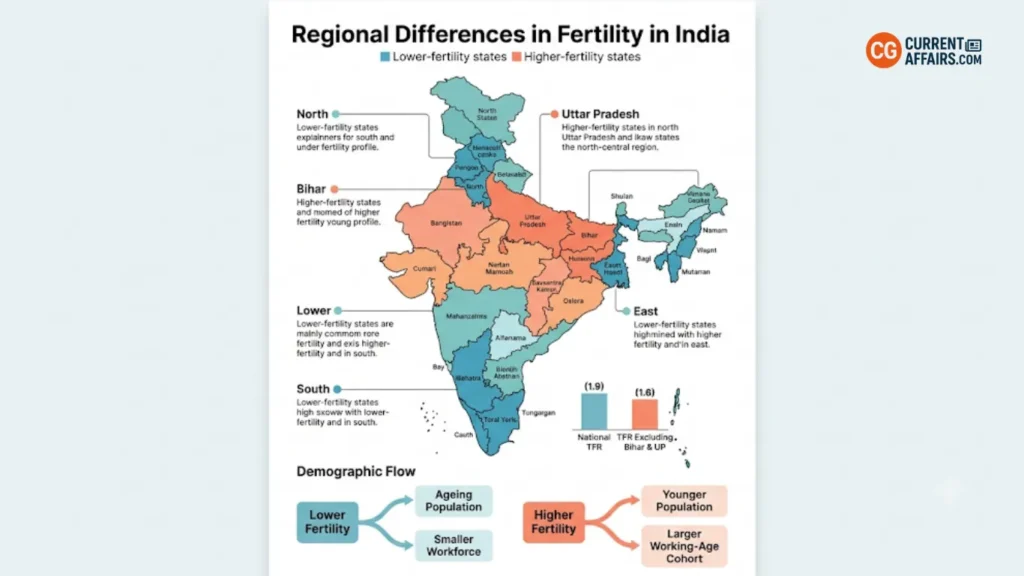
The paper argues that India’s demographic situation has changed substantially from the period when rapid population growth was considered a major policy concern. The India fertility rate is now 1.9, below the generally accepted replacement level of 2.1. Excluding Bihar and Uttar Pradesh, the TFR falls to 1.6, comparable to the United States at 1.6 and Northern Europe at around 1.5.
The declining fertility rate in India has important implications for India’s future workforce, ageing population, migration, healthcare, social security and economic growth. The policy challenge is therefore increasingly shifting from simply controlling population growth to managing demographic transition.
Why in News?
The Economic Advisory Council to the Prime Minister (EAC-PM) has highlighted the India fertility rate falls trend in its working paper “The Ghost of Population Past: How Population Control Persists in India.”
Key Points
- India’s current TFR is 1.9, below the replacement level of 2.1.
- Excluding Bihar and Uttar Pradesh, India’s TFR is around 1.6.
- Several southern, western and northern states have remained below replacement fertility for years.
- The EAC-PM paper highlights the possibility of increasing population ageing in states with persistently low fertility.
- The paper argues that India’s family-planning approach needs to reflect the country’s changing demographic reality.
What is Fertility Rate?
Fertility rate refers to the average number of children a woman is expected to have over her reproductive lifetime, based on prevailing age-specific fertility rates.
The commonly used measure is the Total Fertility Rate (TFR). Understanding the fertility rate in India is important for assessing population growth, demographic change and future workforce trends.
What is Replacement-Level Fertility?
Replacement-level fertility is the level of fertility at which a population can replace itself from one generation to the next, without considering migration.
For India, the replacement-level TFR is generally taken as approximately 2.1 children per woman.
Simple Understanding
- TFR above 2.1: Population tends to grow over the long term.
- TFR around 2.1: Population is approximately at replacement level.
- TFR below 2.1: Population may eventually age and decline if the trend continues for a long period.
However, a fertility rate below replacement does not mean that population immediately starts declining. Population momentum, mortality, migration and the existing age structure continue to influence population size.
India’s Transition from High to Low Fertility
India’s fertility transition has taken place gradually over several decades.
During the early decades after Independence, fertility was considerably higher. Large families were common, while access to modern healthcare, contraception and family-planning services was comparatively limited.
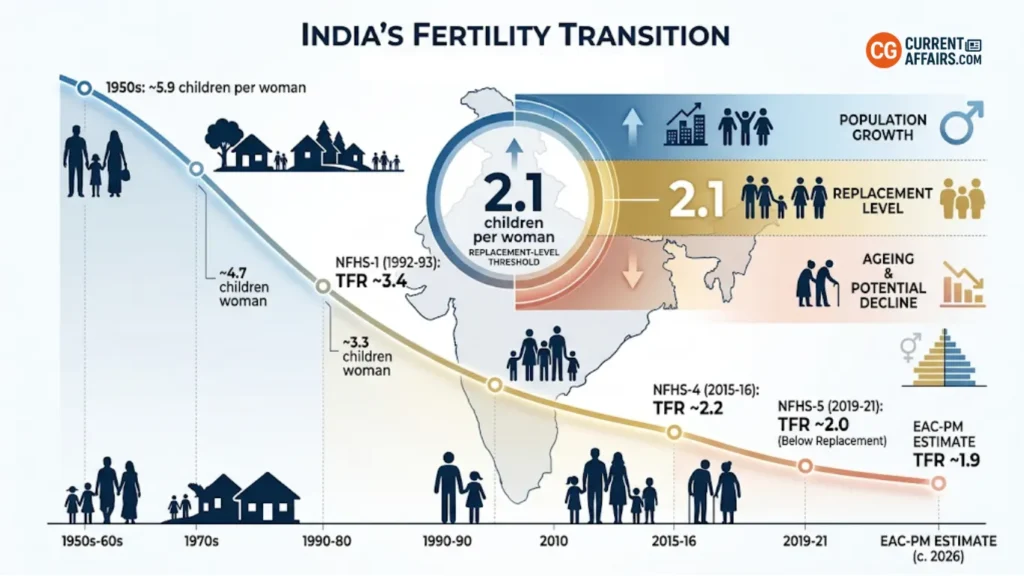
According to the Ministry of Health and Family Welfare, India’s TFR declined to 2.0 in NFHS-5 (2019–21), indicating that the country had reached below-replacement fertility.
Fertility Transition in India
| Period / Survey | Approximate TFR |
|---|
| 1950s–1960s | Around 5.9 |
| NFHS-1 (1992–93) | Around 3.4 |
| NFHS-2 (1998–99) | Around 2.9 |
| NFHS-3 (2005–06) | Around 2.7 |
| NFHS-4 (2015–16) | Around 2.2 |
| NFHS-5 (2019–21) | 2.0 |
| EAC-PM working paper | 1.9 |
The long-term declining fertility in India reflects changes in education, healthcare, urbanisation, women’s participation in education and employment, access to contraception and changing family preferences.
Number of Births is Also Declining
The EAC-PM working paper highlights a substantial decline in the annual number of births.
- According to the paper, the number of children born in India peaked at approximately 2.93 crore in 2001.
- By 2023, annual births had fallen to around 2.32 crore, representing a decline of roughly 20% from the 2001 level.
This means India’s demographic challenge is increasingly changing from concerns about very rapid population growth to the longer-term consequences of lower fertility and population ageing.
Why is Fertility Rate Declining?
The declining fertility rate in India is the result of several interconnected social and economic changes.
1. Rising Female Education
Improvement in female education has played an important role in India’s fertility transition.
Education can influence:
- Age at marriage
- Awareness about reproductive health
- Use of contraception
- Employment opportunities
- Family-size preferences
- Investment in children’s education
Educated families may increasingly prefer having fewer children while investing more resources in each child.
2. Delayed Marriage and Childbearing
Marriage and childbearing are increasingly occurring later than in previous generations.
A later start to family formation generally reduces the length of the reproductive period and can contribute to smaller family sizes.
3. Decline in Child Mortality
Historically, high child mortality encouraged some families to have more children because the survival of every child was uncertain.
Improved:
- Vaccination
- Maternal healthcare
- Institutional deliveries
- Nutrition
- Sanitation
- Child healthcare
have significantly improved child survival.
As child survival improves, families generally have less need to have additional births as a precaution.
4. Urbanisation
Urban living has changed family structures and economic calculations.
Urban families often face:
- Higher housing costs
- Higher education expenses
- Higher childcare costs
- Greater career pressures
- Limited living space
These factors can encourage couples to prefer smaller families.
5. Changing Aspirations
The concept of family size has changed.
The preference is increasingly shifting from:
“More children” → “Better opportunities for fewer children.”
Parents may choose to have fewer children so they can invest more in education, healthcare, nutrition and overall development.
6. Greater Access to Family Planning
India was the first country in the world to launch a national family planning programme, in 1952. Over time, the programme has expanded from population stabilisation towards a broader reproductive-health and family-planning approach.
According to NFHS-5, India’s modern contraceptive prevalence rate was 56.5%.
Greater access to contraception allows couples to make informed decisions about the timing and number of children.
From Population Control to Demographic Management
The EAC-PM working paper raises an important policy question: Should policies designed during a period of high population growth continue unchanged when fertility has already fallen below replacement level?
The demographic situation today is different from the situation several decades ago.
India now needs to simultaneously manage:
- Low fertility
- Regional demographic differences
- Population ageing
- Labour-force requirements
- Internal migration
- Women’s workforce participation
- Social security
- Healthcare for the elderly
Therefore, the policy conversation is gradually moving from simply population control towards broader demographic management.
Implications of Declining Fertility
A falling fertility rate can have both opportunities and challenges depending on the stage of demographic transition.
1. Demographic Dividend
Lower fertility initially increases the proportion of the population in the working-age group.
This can create a demographic dividend if the country can provide:
- Quality education
- Skills
- Jobs
- Healthcare
- Higher female labour-force participation
- Productive employment
The demographic dividend is therefore not automatic. It depends on whether the working-age population is productively employed.
2. Population Ageing
If fertility remains below replacement for a prolonged period, the proportion of elderly people gradually increases.
This can increase demand for:
- Geriatric healthcare
- Pensions
- Social security
- Long-term care
- Assisted living facilities
- Elder-friendly infrastructure
The EAC-PM has separately highlighted how declining fertility, rising elderly populations and urbanisation are changing India’s care requirements.
3. Labour Shortages
Low-fertility states may eventually experience slower growth in their working-age population.
This can create labour shortages in sectors such as:
- Manufacturing
- Construction
- Healthcare
- Agriculture
- Services
- Care economy
4. Internal Migration
- India already has substantial interstate migration.
- Differences in demographic structure may strengthen migration from relatively younger and higher-fertility regions towards states with ageing populations and greater demand for workers.
- This can make internal migration an increasingly important part of India’s economic structure.
5. Changing Dependency Ratio
- When fertility declines, the child-dependent population initially falls.
- This can improve the dependency ratio and create an opportunity for economic growth.
- However, as the population ages, old-age dependency begins to rise.
- Thus, the demographic advantage can eventually transform into a challenge if the country is not prepared for ageing.
Population Ageing and the Care Economy
One of the major long-term consequences of sustained low fertility is the growth of the elderly population.
Traditionally, Indian families have provided much of the care for elderly members through joint and extended family systems.
However, urbanisation and changing family structures are weakening some traditional care arrangements.
This creates a need for stronger public and private systems for:
- Elderly healthcare
- Home-based care
- Assisted care
- Pension coverage
- Social security
- Community-based support
The EAC-PM’s work on the care economy highlights the need to view care not merely as a private family responsibility but increasingly as an important social and economic infrastructure requirement.
Regional Demographic Imbalance
India’s fertility transition also has an important regional dimension.
Low-fertility states and high-fertility states may face different challenges.
Low-Fertility States
Likely concerns include:
Relatively Higher-Fertility States
These states may have:
Larger young populations
Greater demand for education
Higher need for employment creation
Potentially larger future labour supply
This difference can increase the importance of interstate migration and balanced regional development.
Fertility Rate in Chhattisgarh
For CGPSC, this topic is particularly important because Chhattisgarh is part of India’s broader demographic transition but has historically had a fertility profile different from the lowest-fertility southern states.
An older Ministry of Health and Family Welfare report showed that Chhattisgarh’s TFR had already declined from 2.6 in NFHS-3 to 2.2 in NFHS-4, illustrating the state’s longer-term fertility decline.
Fertility rate in Chhattisgarh can therefore be studied through the following themes:
- Fertility transition
- Tribal and rural demography
- Maternal and child health
- Family planning
- Women’s education
- Migration
- Working-age population
- Ageing
- Human capital
Why Chhattisgarh Matters
Chhattisgarh has a significant rural and tribal population, making access to healthcare, reproductive health services, women’s education and employment important demographic factors.
The state’s future demographic profile will influence:
- Workforce availability
- Urbanisation
- Migration
- Healthcare demand
- Education requirements
- Social welfare expenditure
Therefore, demographic policy in Chhattisgarh needs to consider both population quality and population structure, rather than focusing only on population size.
Challenges
India’s changing fertility pattern creates several policy challenges.
- 1. Unequal Demographic Transition
- Different states are moving through the fertility transition at different speeds.
- 2. Ageing
- States with persistently low fertility may face a rapidly increasing elderly population.
- 3. Employment
- A large working-age population creates an advantage only when adequate productive employment is available.
- 4. Migration Management
- Increasing interstate migration may require better portability of welfare benefits, housing, healthcare and labour protections.
- 5. Women’s Workforce Participation
- Lower fertility does not automatically translate into higher female employment. India needs policies that enable women to participate more fully in the labour market.
- 6. Healthcare and Social Security
- An ageing society requires greater investment in preventive healthcare, geriatric services and pension systems.
- 7. Policy Transition
- Population policies designed for a high-fertility environment may need to be reassessed as states move towards low fertility.
Way Forward
India’s demographic transition requires a balanced approach rather than a single focus on either population growth or population decline.
Invest in Human Capital
Improve:
- Education
- Skills
- Healthcare
- Nutrition
- Women’s empowerment
A smaller population can become an economic advantage only when its human capital is strong.
Create Quality Employment
India needs sufficient productive employment to absorb its working-age population and realise the demographic dividend.
Labour-intensive manufacturing, services and emerging sectors can play an important role.
Prepare for Ageing
India should strengthen:
- Pension systems
- Geriatric healthcare
- Health insurance
- Long-term care
- Elder-friendly infrastructure
- Social security programmes
Support Families
Policies should also recognise the economic costs associated with raising children.
Supportive measures can include:
- Affordable childcare
- Maternity and parental benefits
- Flexible workplaces
- Housing support
- Better work-life balance
Address Regional Imbalances
India needs balanced regional development while facilitating safe and productive internal migration.
States with labour shortages may increasingly depend on workers from relatively younger states.
Strengthen Women’s Participation
Greater female participation in education and employment should remain central to demographic policy.
Women should have the freedom and support to make informed choices regarding education, employment, marriage and family size.
Conclusion
India has moved a long way from the era of very high fertility towards a low-fertility demographic regime. The national TFR is now below replacement level, while several states have remained below replacement fertility for decades.
The India fertility rate falls trend makes the demographic challenge increasingly complex. India needs to benefit from its working-age population while simultaneously preparing for population ageing, changing family structures, regional demographic differences and future labour requirements.
The key policy question is no longer simply how to reduce population growth, but how to ensure that India’s changing population structure contributes to economic growth, social security and human development.
CGPSC Prelims 2026
- TFR: Total Fertility Rate.
- Replacement-level fertility: Approximately 2.1 children per woman.
- India’s TFR was 2.0 in NFHS-5 (2019–21).
- EAC-PM’s recent working paper puts India’s TFR at 1.9.
- Excluding Bihar and Uttar Pradesh, TFR is 1.6.
- The EAC-PM paper compares 1.6 with the United States (1.6) and Northern Europe (1.5).
- India’s national family planning programme was launched in 1952.
- NFHS-5 reported a 56.5% modern contraceptive prevalence rate.
- Lower fertility can initially support a demographic dividend.
- Persistently low fertility can eventually contribute to population ageing.
CGPSC Prelims Practice Questions
MCQ 1
According to the recent EAC-PM working paper, what is India’s Total Fertility Rate (TFR)?
A. 2.7
B. 2.3
C. 1.9
D. 1.5
Answer: C. 1.9
MCQ 2
What is generally considered the replacement-level fertility rate?
A. 1.5 children per woman
B. 1.8 children per woman
C. 2.1 children per woman
D. 2.5 children per woman
Answer: C. 2.1 children per woman
MCQ 3
According to the EAC-PM working paper, India’s TFR excluding Bihar and Uttar Pradesh is approximately:
A. 1.2
B. 1.4
C. 1.6
D. 2.1
Answer: C. 1.6
MCQ 4
India launched its national family planning programme in which year?
A. 1947
B. 1950
C. 1952
D. 1961
Answer: C. 1952
CGPSC Mains Practice Questions
Question 1
India’s demographic challenge is gradually shifting from population growth to population ageing. Discuss.
Also Read: Surajpur district in CG declared child marriage free