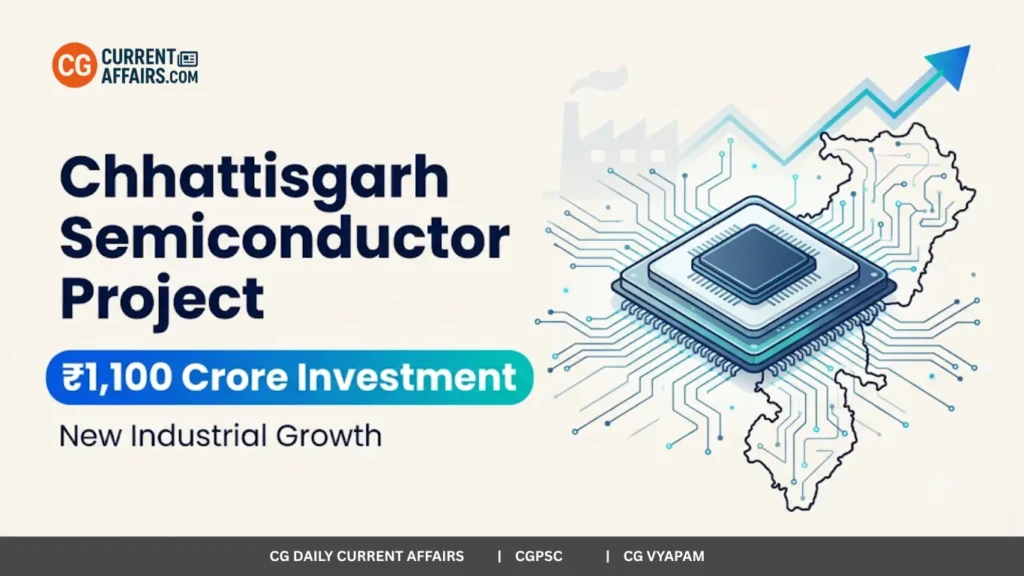
Chhattisgarh is moving beyond its traditional industrial base of coal, steel and cement towards emerging technology-driven sectors. A major step in this direction is the beginning of work on a Chhattisgarh semiconductor project worth around ₹1,100 crore in the state.
The development is part of the state’s broader industrial strategy under the Chhattisgarh Industrial Development Policy 2024–30, which gives priority to new and emerging sectors such as IT, pharmaceuticals, textiles and green energy, along with technology-based industries.
The semiconductor initiative is significant because semiconductors are essential components of modern products such as smartphones, automobiles, medical equipment, communication systems and artificial intelligence-enabled technologies.
Why in News?
Work has started on a ₹1,100 crore semiconductor project in Chhattisgarh, signalling a shift towards high-technology industries.
Key Points
- Around ₹1,100 crore semiconductor project has started in Chhattisgarh.
- The state is seeking to diversify beyond traditional industries such as coal, steel and cement.
- IT, pharma, textiles and green energy have been identified as emerging sectors for investment.
- Chief Minister Vishnu Deo Sai highlighted the development during the India Industrial Fair 2026 in Raipur.
- The government is working to develop Nava Raipur as a modern technology hub.
- The state is also focusing on developing Technology Hubs and Industry Excellence Hubs.
- The Chhattisgarh Industrial Development Policy 2024–30 gives priority to local employment.
- Industries generating more employment for local youth are eligible for special incentives under the policy.
Also Read: CG Semiconductor Mission 2030 Launched
What is a Semiconductor?
A semiconductor is a material whose electrical conductivity lies between that of a conductor and an insulator.
Semiconductors are the fundamental building blocks of modern electronic devices.
The most commonly used semiconductor materials include:
- Silicon
- Germanium
- Gallium compounds and other advanced materials
Why are Semiconductors Important?
Semiconductors are used in:
- Smartphones
- Computers
- Automobiles
- Medical equipment
- Telecommunication systems
- Artificial intelligence systems
- Drones
- Industrial machinery
- Energy-management systems
- Internet of Things (IoT) devices
They are often described as the “brains” of modern electronic devices because semiconductor chips process, store and control information.
Why is the Chhattisgarh Semiconductor Project is important?
The ₹1,100 crore Chhattisgarh semiconductor project can contribute to the diversification of Chhattisgarh’s industrial economy.
Traditionally, the state’s industrial development has been strongly associated with:
- Coal
- Steel
- Cement
- Power
- Mineral-based industries
The Chhattisgarh semiconductor project represents movement towards technology-intensive manufacturing.
Potential Benefits
- 1. Industrial Diversification
- It can help expand the state’s industrial base beyond mineral-based industries.
- 2. High-Skilled Employment
- Semiconductor-related activities require engineers, technicians, designers, researchers and other skilled professionals.
- 3. Technology Ecosystem
- The project can contribute to the development of a wider technology ecosystem around semiconductor and electronics industries.
- 4. Investment Attraction
- The emergence of a technology ecosystem may help attract other technology-based companies.
- 5. Local Employment
- The state’s Industrial Policy 2024–30 places emphasis on industries that create employment for local youth.
Chhattisgarh Industrial Development Policy 2024–30
The Chhattisgarh Industrial Development Policy 2024–30 is an important framework for the state’s industrial growth.
The policy aims to create a favourable environment for investment, industrial expansion and employment generation.
A major feature is the emphasis on new and emerging sectors.
Emerging Sectors Highlighted
- Information Technology
- Pharmaceuticals
- Textiles
- Green Energy
- Technology-based industries
- Startups and emerging technologies
The policy also focuses on encouraging industries that generate more employment opportunities for local people.
Nava Raipur as a Technology Hub
The government is working to develop Nava Raipur as a modern technology hub.
The objective is to create an environment where technology companies and new industries can establish and expand their operations.
Focus Areas
- Technology Hub
- Industry Excellence Hub
- Technology-based companies
- New-age industries
- Skilled workforce
- Innovation and entrepreneurship
The development of technology infrastructure in Nava Raipur can complement the state’s efforts to attract emerging industries.
Semiconductor and Employment
The semiconductor industry requires a highly skilled workforce.
Unlike some traditional industries, the sector creates demand for specialised skills in areas such as:
- Electronics
- Semiconductor design
- Computer engineering
- Artificial intelligence
- Embedded systems
- Chip manufacturing
- Testing and packaging
- Research and development
Therefore, the development of a semiconductor ecosystem can create opportunities for skilling and high-value employment.
Semicon India 2026
The broader development of India’s semiconductor ecosystem was showcased at Semicon India 2026, held from 17 to 19 September 2026 at Yashobhoomi, New Delhi.
The fifth edition was organised around the theme:
“Silicon to System: Building the Ecosystem”
The event brought together:
- Semiconductor companies
- Startups
- Policymakers
- Investors
- Academics
- Researchers
- Technology institutions
More than 600 exhibiting companies from different countries participated in the 2026 edition.
The event demonstrated that India’s semiconductor ambitions extend beyond chip design to manufacturing, advanced packaging, materials, equipment, research, talent and system-level applications.
From Chip Design to Complete Ecosystem
A semiconductor ecosystem is much larger than the production of individual chips.
It includes:
Chip Design → Fabrication → Materials → Equipment → Packaging → Testing → System Integration → End Applications
Semicon India 2026 highlighted this complete value chain.
This is important because a strong semiconductor industry requires coordination between manufacturing companies, design firms, research institutions, startups, suppliers and skilled workers.
India’s Indigenous Semiconductor Capabilities
Semicon India 2026 showcased several indigenous technologies.
C-DAC and High-Performance Computing
The Centre for Development of Advanced Computing (C-DAC) demonstrated its work in:
- High-performance computing
- Artificial intelligence
- AUM HPC-AI processor
- Rudra-AUM compute node
This reflects India’s effort to build indigenous capabilities not only at the chip level but also at the broader computing-system level.
RISC-V and Indigenous Processor Design
An important area highlighted during Semicon India 2026 was RISC-V-based processor technology.
C-DAC showcased an indigenous 64-bit RISC-V processor.
What is RISC-V?
RISC-V is an open instruction set architecture that can be used to design processors.
Its open nature provides flexibility for developing processors for different applications.
Applications
RISC-V-based technologies can support:
- High-performance computing
- Embedded systems
- Artificial intelligence
- Connectivity
- Digital infrastructure
- Edge computing
The development of indigenous processor capabilities is important for strengthening India’s domestic semiconductor design ecosystem.
Semiconductor Applications in Everyday Life
Semiconductors are increasingly integrated into everyday products and services.
Indian semiconductor companies and startups showcased solutions for:
- Smart devices
- Connectivity
- Industrial systems
- Energy management
- Automotive technology
- Surveillance
- Electric mobility
- Drones
This demonstrates that semiconductor technology is not limited to computers and smartphones.
Artificial Intelligence and Semiconductor Technology
The semiconductor industry is closely connected with the growth of Artificial Intelligence (AI).
AI systems require specialised computing hardware capable of processing large amounts of data efficiently.
Semicon India 2026 showcased AI-enabled System-on-Chip (SoC) technologies for applications including:
- Smart surveillance
- Robotics
- Drones
- Smart sensors
- Mobility
- Machine vision
The growing integration of AI and semiconductors is creating new opportunities for advanced electronics and computing systems.
Semicon 2.0
The semiconductor ecosystem received another major policy push through Semicon 2.0.
According to the source, the Union Cabinet approved Semicon 2.0 in July 2026 with an outlay of ₹1,27,500 crore.
The programme builds upon the foundation created by Semicon 1.0.
Six Strategic Pillars
Semicon 2.0 focuses on:
- Design
- Machines and Materials
- More Fabrication Units
- Advanced Packaging
- Research and Development
- Talent Development
Exam Fact
Semicon 2.0 → ₹1,27,500 crore → 6 strategic pillars
Design Linked Incentive Scheme
The Design Linked Incentive (DLI) Scheme supports domestic semiconductor design.
It has supported chip-design projects in areas such as:
- Video surveillance
- Drones
- Energy meters
- Microprocessors
- Satellite communication
- Broadband
- IoT System-on-Chip solutions
The scheme aims to strengthen India’s domestic chip-design capabilities.
Chips to Startup Programme
The Chips to Startup (C2S) programme focuses on developing semiconductor design capabilities among:
- Students
- Researchers
- Academic institutions
- Startups
The programme seeks to create a larger pool of skilled chip designers and strengthen India’s electronic system design capabilities.
According to the source, more than 500 organisations, including around 400 educational institutions and 100 startups, are connected with the C2S programme and DLI-supported ChipIN ecosystem.
More than one lakh engineers have been connected with advanced chip-design tools, design and fabrication services and specialised training.
India’s Semiconductor Projects
India’s semiconductor development is moving from policy support towards manufacturing and commercial production.
According to the source:
- 12 semiconductor projects have been approved across six states.
- The projects represent investment commitments of more than ₹1.64 lakh crore.
- Commercial production has already begun at three plants.
This indicates a transition from semiconductor planning and design towards actual manufacturing and production capabilities.
Chhattisgarh and New-Age Industries
The Chhattisgarh semiconductor project is part of a broader transformation in Chhattisgarh’s industrial strategy.
The state is seeking investment in sectors beyond conventional mineral-based industries.
New-Age Industrial Sectors
| Sector | Potential Focus |
|---|
| Semiconductor | Chip and electronics ecosystem |
| IT | Technology and digital services |
| Pharmaceuticals | Healthcare and drug manufacturing |
| Textiles | Manufacturing and employment |
| Green Energy | Sustainable energy development |
| Startups | Innovation and entrepreneurship |
This diversification can help create different types of employment and reduce excessive dependence on a limited number of traditional industries.
MSMEs and Industrial Development
Micro, Small and Medium Enterprises (MSMEs) are another important component of the state’s industrial strategy.
According to the source, more than 1,200 MSME units are expected to expand.
MSMEs can play an important role in:
- Employment generation
- Entrepreneurship
- Local manufacturing
- Supply chains
- Regional industrial development
The expansion of MSMEs can also create opportunities for young people to become entrepreneurs and job creators, rather than only job seekers.
Investment and Employment in Chhattisgarh
According to the state government information included in the source, Chhattisgarh has received investment proposals worth more than ₹8.23 lakh crore under the Industrial Policy 2024–30.
If these proposals are implemented, they could contribute to:
- Expansion of industrial activity
- New investments
- Employment generation
- Development of supporting industries
- Greater opportunities for local entrepreneurs
The state has also approved the Chhattisgarh Export Promotion Policy 2026–30 to connect local products and value-added agricultural and industrial products with larger domestic and international markets.
Chief Minister Startup and Nipun Mission
The state government has approved the Chief Minister Startup and Nipun Mission to promote entrepreneurship and skill development.
Key Facts
- Provision: ₹500 crore
- Period: Five years
- Coverage: All 33 districts
- Planned infrastructure: Entrepreneurship Development Centres
- Emerging Technology Labs: 100
- Industry Centres of Excellence: 5
The mission aims to provide young people with opportunities in:
- New technologies
- Skills
- Innovation
- Entrepreneurship
- Startups
Importance of Chhattisgarh Semiconductor Project
The semiconductor project and emerging technology initiatives are significant for Chhattisgarh because they can contribute to a transition from a primarily resource-based industrial economy towards a more diversified and technology-oriented economy.
Major Significance
- Industrial Diversification:
Reduces excessive dependence on traditional mineral-based industries. - Employment:
Creates opportunities in technology, electronics and specialised skills. - Investment:
Can attract technology-oriented companies and supporting industries. - Skill Development:
Creates demand for specialised technical and digital skills. - Entrepreneurship:
Provides opportunities for startups and MSMEs. - Technology Ecosystem:
Can support the development of technology and industry hubs around Nava Raipur.
Challenges
The development of a semiconductor ecosystem also presents several challenges.
- Skilled Workforce
- Semiconductor manufacturing and design require highly specialised talent.
- Infrastructure
- The sector requires reliable electricity, water, transportation, advanced manufacturing facilities and strong digital infrastructure.
- High Capital Requirement
- Semiconductor manufacturing is highly capital-intensive.
- Global Competition
- India competes with established semiconductor manufacturing and design ecosystems around the world.
- Complex Supply Chain
- Semiconductor production depends on a wide network of materials, equipment, technology and specialised suppliers.
- Research and Innovation
- Long-term competitiveness requires continuous investment in research, design and advanced technologies.
Way Forward
- Develop Skilled Talent
- Universities, technical institutions and industries should work together to develop semiconductor-specific skills.
- Strengthen Research
- Greater investment in semiconductor research, processor design, AI hardware and advanced packaging can strengthen domestic capabilities.
- Support Startups
- Technology startups should receive access to design tools, testing facilities, funding and mentorship.
- Build Industrial Clusters
- Technology hubs and industry excellence centres can create linkages between companies, universities and research institutions.
- Strengthen MSME Participation
- Local MSMEs should be integrated into semiconductor and electronics supply chains wherever possible.
- Focus on Local Employment
- Industrial incentives should continue to encourage industries that provide meaningful employment opportunities to local youth.
Conclusion
The beginning of work on the ₹1,100 crore semiconductor project in Chhattisgarh marks an important step in the state’s transition towards emerging technology-driven industries.
The development is aligned with the broader objectives of the Industrial Development Policy 2024–30, which seeks to promote new sectors such as IT, pharmaceuticals, textiles, green energy and technology-based industries.
At the national level, initiatives such as Semicon India 2026, Semicon 2.0, the Design Linked Incentive Scheme and the Chips to Startup programme are building India’s semiconductor ecosystem from chip design to manufacturing and system-level applications.
MCQ 1
What is the approximate investment involved in the semiconductor project that has started in Chhattisgarh?
A. ₹500 crore
B. ₹750 crore
C. ₹1,100 crore
D. ₹2,500 crore
Answer: C. ₹1,100 crore
MCQ 2
Which policy is associated with Chhattisgarh’s current industrial development strategy?
A. Industrial Policy 2015–20
B. Industrial Development Policy 2024–30
C. Industrial Policy 2020–25
D. Export Policy 2020–25
Answer: B. Industrial Development Policy 2024–30
MCQ 3
What was the theme of Semicon India 2026?
A. Digital India to Semiconductor India
B. Silicon to System: Building the Ecosystem
C. Make in India: Chips for the World
D. Semiconductor India: Design to Export
Answer: B. Silicon to System: Building the Ecosystem
MCQ 4
Which architecture is associated with the indigenous 64-bit processor showcased by C-DAC?
A. ARM
B. x86
C. RISC-V
D. MIPS
Answer: C. RISC-V
Mains Perspective
Question 1
Discuss the significance of the semiconductor project for the industrial transformation of Chhattisgarh.
Question 2
Explain the importance of India’s semiconductor ecosystem for technological and economic development.
Conclusion
India’s semiconductor strategy needs to focus not only on manufacturing chips but on building a complete ecosystem of design, research, manufacturing, talent and supporting industries.
Also Read:
- Chhattisgarh Green Steel Initiative: ₹13,840 crore investment
- Chhattisgarh AI Mission: ₹500 crore mission for AI Development in CG