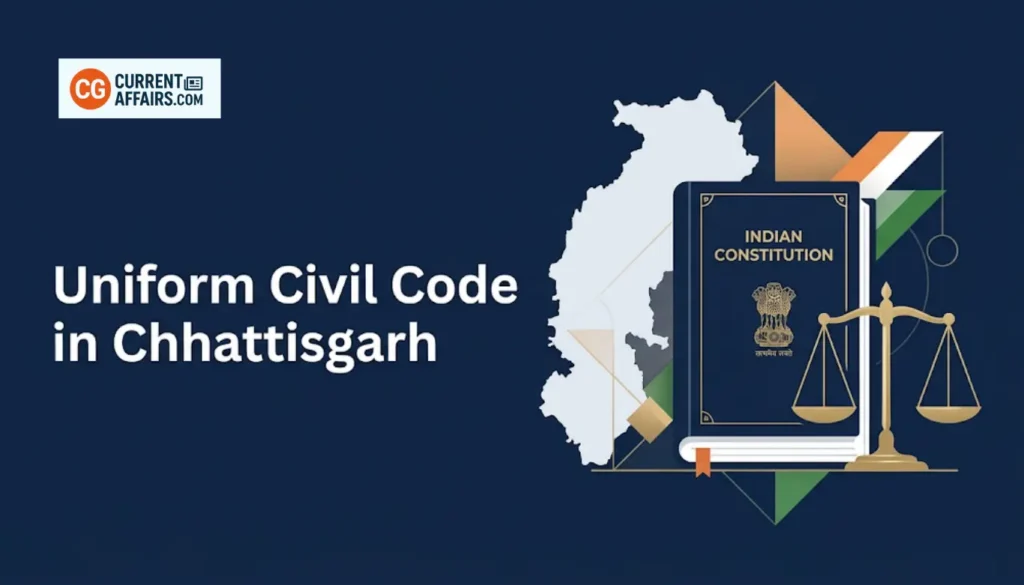
The Uniform Civil Code (UCC) seeks to establish a common set of civil laws for citizens, irrespective of religion, particularly in matters such as marriage, divorce, inheritance, adoption and maintenance.
The issue has gained renewed importance of Uniform Civil Code in Chhattisgarh as the state government has initiated the process of preparing a framework for implementing the UCC in Chhattisgarh. A high-level committee headed by retired Supreme Court Justice Ranjana Prakash Desai has been constituted to examine existing personal laws and provide recommendations.
A state-level introductory meeting is scheduled for 27 August 2026 at New Circuit House, Civil Lines, Raipur, where around 200 citizens, public representatives and experts are expected to participate. The government has also invited suggestions from citizens and organisations until 30 September 2026.
Why in News?
The Chhattisgarh government is accelerating preparations for introducing a Uniform Civil Code in the state.
Key developments
- A state-level introductory meeting will be held on 27 August 2026.
- Venue: New Circuit House, Civil Lines, Raipur
- Around 200 citizens, representatives and experts have been invited.
- Public suggestions are being invited until 30 September 2026.
- The state government plans to introduce a UCC Bill during the upcoming winter session of the Chhattisgarh Legislative Assembly.
- A high-level committee headed by retired Supreme Court Justice Ranjana Prakash Desai has already been constituted.
- The committee will examine existing laws and practices relating to personal civil matters.
CGPSC Focus: The most important constitutional provision associated with UCC is Article 44, which forms part of the Directive Principles of State Policy.
What is the Uniform Civil Code?
The Uniform Civil Code refers to a common framework of civil laws applicable to citizens irrespective of their religious identity.
The objective is to create greater uniformity in areas such as:
- Marriage
- Divorce
- Inheritance
- Adoption
- Maintenance
- Other personal civil matters
At present, India follows a combination of religion-based personal laws and secular civil laws.
Uniform Civil Code (UCC) in Indian States — Chronological Order
| Rank | State | UCC Development | Year / Date | Status |
|---|
| 1 | Uttarakhand | UCC Bill passed by State Assembly | 7 February 2024 | Implemented on 27 January 2025 |
| 2 | Gujarat | Gujarat Uniform Civil Code Bill, 2026 passed | 24 March 2026 | Bill passed |
| 3 | Assam | Uniform Civil Code, Assam Bill, 2026 passed | 27 May 2026 | Bill passed |
Quick exam fact:
- Uttarakhand → Gujarat → Assam
1st → 2nd → 3rd state to pass UCC legislation. - Uttarakhand is therefore the first state in independent India to enact and implement a new comprehensive UCC through state legislation.
- Assam is also the first state in Northeast India to pass such legislation.
Constitutional Basis of UCC
Article 44
- Article 44 of the Constitution states that the State shall endeavour to secure a Uniform Civil Code for the citizens throughout the territory of India.
- It is included in the Directive Principles of State Policy (DPSP).
Important Point
- Article 44 is not directly enforceable by courts. However, it provides a constitutional policy direction to the State.
Prelims Fact:
Article 44 → Uniform Civil Code → Directive Principles of State Policy
Background and Historical Context
The debate around uniform civil laws predates the Constitution.
During the colonial period, different communities continued to follow distinct personal laws in family-related matters. The question of legal uniformity subsequently became part of India’s constitutional debate.
During the framing of the Constitution, the UCC question generated considerable discussion between:
- Equality
- Secularism
- Individual rights
- Religious freedom
- Cultural diversity
The compromise was to place UCC under Article 44, rather than make it an immediately enforceable fundamental right.
Post-Independence Development
The Hindu Code Bills of 1955–56 brought major aspects of Hindu personal law into statutory form.
The debate over UCC subsequently gained renewed attention through important judicial cases dealing with:
- Maintenance
- Marriage
- Conversion
- Inheritance
- Gender equality
- Personal laws
Present Civil-Law Framework in India
India does not currently have one common personal law governing all citizens.
Different communities are governed by different personal-law frameworks, while certain secular laws apply irrespective of religion.
Hindu Personal Laws
Major statutes include:
- Hindu Marriage Act, 1955
- Hindu Succession Act, 1956
- Hindu Minority and Guardianship Act, 1956
- Hindu Adoptions and Maintenance Act, 1956
For these laws, the term “Hindu” also covers Sikhs, Jains and Buddhists within the statutory framework.
Muslim Personal Law
Muslim personal law is based substantially on religious principles and has also been recognised through legislation such as:
Christian Personal Law
Christian marriages are governed by the Indian Christian Marriage Act, 1872, along with other applicable laws governing matrimonial matters.
Secular Civil Laws
Some laws apply irrespective of religion.
An important example is the:
- Special Marriage Act, 1954
- It provides a legal framework for civil marriages, including inter-religious marriages.
Prelims Fact: The Special Marriage Act is an important example of a religion-neutral civil law.
UCC and Special Constitutional Provisions
The implementation of uniform civil laws also intersects with India’s federal and cultural diversity.
Certain constitutional provisions provide special protections to particular regions and communities.
The supplied material specifically refers to Article 371 and special provisions concerning states such as Assam, Nagaland and Mizoram in the context of protecting distinct regional identities.
Important Supreme Court Judgments on UCC
The Supreme Court has addressed questions relating to personal laws, gender equality and the need for greater legal uniformity in several important cases.
1. Shah Bano Case, 1985
- The Shah Bano case concerned the right of a divorced Muslim woman to claim maintenance.
- The Supreme Court’s decision brought the question of gender justice and personal laws into national debate and renewed discussion around Article 44.
Shah Bano → Maintenance → Personal Law → UCC Debate
2. Sarla Mudgal v. Union of India, 1995
- The case involved questions relating to conversion, marriage and polygamy.
- The judgment contributed significantly to the debate about the need for greater uniformity in personal laws.
3. John Vallamattom v. Union of India, 2003
- The Supreme Court examined discriminatory aspects of personal-law provisions and highlighted questions concerning equality and legal uniformity.
4. Shayara Bano Case, 2017
The Supreme Court declared the practice of instant triple talaq (talaq-e-biddat) unconstitutional.
The judgment became an important development in the discussion on:
- Gender equality
- Personal laws
- Constitutional rights
- Reform of discriminatory practices
Prelims Fact:
Shayara Bano case, 2017 → Instant Triple Talaq
Uniform Civil Code in Chhattisgarh
The Chhattisgarh government’s present initiative focuses on developing a framework suited to the state’s circumstances.
The committee headed by Justice Ranjana Prakash Desai will review existing legal arrangements concerning personal civil matters and provide recommendations.
The consultation process is significant because the government has chosen to seek inputs from:
- Citizens
- Experts
- Public representatives
- Different social groups
- Other stakeholders
Three Important Dates/Developments
| Development | Detail |
|---|
| Committee | Headed by Justice Ranjana Prakash Desai |
| State-level meeting | 27 August 2026 |
| Public suggestions | Until 30 September 2026 |
| Proposed legislation | Winter session of State Assembly |
Chhattisgarh Focus: The consultation process is an important example of stakeholder participation in policy and law-making.
Significance of UCC
- Gender Justice
- One of the major arguments in favour of UCC is that common civil rules could help ensure greater equality in matters such as:
- Marriage
- Divorce
- Maintenance
- Inheritance
- Equality Before Law
- A common framework could strengthen the principle that similarly situated citizens should receive equal legal treatment in civil matters.
- Legal Simplification
- Multiple personal-law systems can create complexity. A common framework could potentially make certain civil-law procedures easier to understand.
- National Integration
- Supporters argue that common civil rules can strengthen a shared civic identity.
- Constitutional Goal
- UCC has an explicit constitutional reference under Article 44, making it a significant issue for constitutional governance.
Major Concerns and Challenges
UCC is also a highly sensitive and debated issue.
- Religious Freedom
- India’s Constitution protects freedom of religion. Therefore, any reform of personal laws must be carefully balanced with religious freedom.
- Cultural Diversity
- India contains diverse communities with different traditions and customary practices.
- Tribal and Regional Customs
- Any uniform framework must carefully examine customary practices, particularly in areas where constitutional provisions protect distinctive social and cultural practices.
- Uniformity vs Equality
- Uniformity does not automatically guarantee substantive equality.
- A well-designed UCC in CG would need to ensure that the law is fair and non-discriminatory, rather than simply identical in every situation.
- Implementation
- Even after legislation is enacted, effective implementation would require:
- Administrative preparedness
- Public awareness
- Legal clarity
- Training of officials
- Appropriate institutional mechanisms
Government’s Approach in Chhattisgarh
The current Chhattisgarh process places considerable emphasis on consultation and drafting.
The proposed approach includes:
- Expert committee review
- Stakeholder consultations
- Public suggestions
- Examination of existing personal laws
- Preparation of a draft framework
- Legislative consideration
This indicates that the government is attempting to examine the issue before bringing legislation before the Assembly.
India Perspective
At the national level, UCC sits at the intersection of several constitutional principles.
Important Constitutional Dimensions
Article 14: Equality before law
Article 15: Prohibition of discrimination
Article 21: Protection of life and personal liberty
Article 25: Freedom of conscience and religion
Article 26: Freedom to manage religious affairs
Article 44: Uniform Civil Code
States and UCC
The material provided states that Goa and Uttarakhand have UCC frameworks in place, while several other states have taken steps towards considering or legislating on the issue.
The source material also identifies Gujarat, Assam and Madhya Pradesh as states that have taken steps towards UCC legislation.
Prelims Perspective
- UCC constitutional provision: Article 44
- Part of Constitution: Directive Principles of State Policy
- Article 44: Not directly enforceable
- Shah Bano: 1985
- Sarla Mudgal: 1995
- John Vallamattom: 2003
- Shayara Bano: 2017
- Shayara Bano issue: Instant triple talaq
- Special Marriage Act: 1954
- Hindu Marriage Act: 1955
- Hindu Succession Act: 1956
- Muslim Personal Law (Shariat) Application Act: 1937
- Christian Marriage law mentioned: Indian Christian Marriage Act, 1872
- Chhattisgarh UCC committee chairperson: Justice Ranjana Prakash Desai
- Chhattisgarh consultation meeting: 27 August 2026
- Public suggestions deadline: 30 September 2026
Conclusion
The debate over the Uniform Civil Code reflects one of India’s most important constitutional questions: how to reconcile equality and common civil rights with religious freedom and cultural diversity.
For UCC in CG, the ongoing committee process, stakeholder consultation and proposed introduction of a UCC Bill represent an important development in state-level legal and governance policy. The success of any such framework will depend not only on legislative action but also on careful consultation, constitutional safeguards, legal clarity and effective implementation.
CGPSC Prelims Practice Questions
Question 1
Consider the following statements regarding the Uniform Civil Code:
- Article 44 of the Constitution deals with the Uniform Civil Code.
- Article 44 is part of the Directive Principles of State Policy.
- Article 44 is directly enforceable by courts.
Which of the statements given above is/are correct?
A. 1 and 2 only
B. 2 and 3 only
C. 1 and 3 only
D. 1, 2 and 3
Answer: A
Explanation: Article 44 directs the State to endeavour to secure a Uniform Civil Code. It is part of the DPSPs and is not directly enforceable by courts.
Question 2
Which of the following pairs is correctly matched?
A. Shah Bano — 1985 — Maintenance
B. Sarla Mudgal — 2017 — Triple Talaq
C. Shayara Bano — 1995 — Conversion and polygamy
D. John Vallamattom — 1955 — Hindu Marriage
Answer: A
Explanation: The Shah Bano case of 1985 concerned maintenance of a divorced Muslim woman and became an important part of the national UCC debate. Shayara Bano (2017) is associated with instant triple talaq, while Sarla Mudgal (1995) concerned issues including conversion and marriage.
CGPSC Mains Practice Questions
1. “Uniform Civil Code involves a constitutional balance between equality and India’s pluralistic character.” Discuss.
2. Examine the significance of Chhattisgarh’s ongoing consultation process for the proposed Uniform Civil Code.
One-Minute Revision
- Topic: UCC in CG
- Constitutional provision: Article 44
- Constitutional part: DPSP
- Nature: Not directly enforceable
- Chhattisgarh committee: Headed by Justice Ranjana Prakash Desai
- State-level meeting: 27 August 2026
- Venue: New Circuit House, Civil Lines, Raipur
- Public suggestions: Until 30 September 2026
- Proposed Bill: Winter session of Chhattisgarh Assembly
- Shah Bano: 1985
- Sarla Mudgal: 1995
- John Vallamattom: 2003
- Shayara Bano: 2017
- Shayara Bano: Instant triple talaq
- Special Marriage Act: 1954
- Core debate: Equality vs religious/cultural diversity
- Key Mains themes: Gender justice, secularism, constitutionalism, personal laws and federalism