
Election Commission of India: Gyanesh Kumar Controversy, SIR, Article 324 and Electoral Reforms
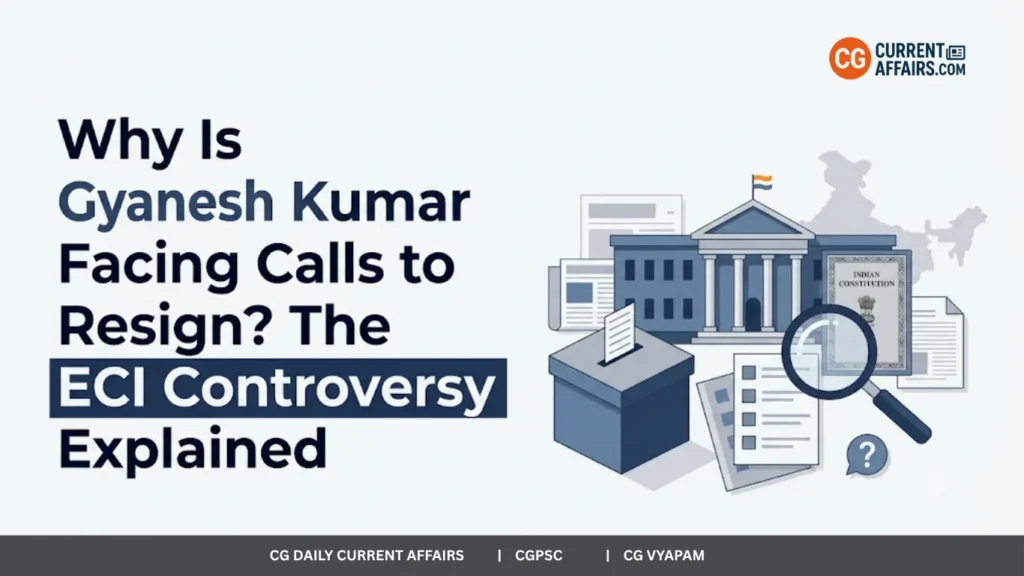
14 objections in 10 months: What does the Election Commission controversy reveal?
The Election Commission of India (ECI) occupies a unique position in India’s constitutional architecture. Entrusted under Article 324 of the Constitution with the superintendence, direction and control of elections, its credibility is inseparable from the credibility of the electoral process itself.
Recent reports concerning the Special Intensive Revision (SIR) of electoral rolls have therefore raised important questions about the functioning and institutional independence of the ECI. An investigation by The Indian Express reported that Election Commissioners Sukhbir Singh Sandhu and Vivek Joshi recorded objections at least 14 times over a period of 10 months concerning decisions relating to electoral-roll management, voter registration, deletion of names and the Commission’s IT systems.
The Election Commission of India (ECI), however, has maintained that decisions relating to SIR and other matters were taken unanimously and that observations or objections by individual Commissioners are part of the deliberative process.
What is Gyanesh Kumar Controversy?
The Gyanesh Kumar controversy concerns renewed scrutiny of the Election Commission of India following reports that two Election Commissioners, Sukhbir Singh Sandhu and Vivek Joshi, raised formal objections to several decisions concerning electoral-roll management.
According to an investigation by The Indian Express, the two Commissioners reportedly recorded objections at least 14 times over 10 months.
The concerns reportedly related to:
- Addition and deletion of voters
- Changes concerning new-voter registration
- Access to electoral-roll databases
- Centralisation of electoral-roll management
- Appeals concerning deleted voters
- Functioning of electoral software
- Internal decision-making within the Commission
The ECI, however, has maintained that its decisions relating to the Special Intensive Revision (SIR) were taken unanimously.
What is the Election Commission of India (ECI) controversy?
The Election Commission controversy centres on reported differences within the three-member Election Commission over the management of electoral rolls during the Special Intensive Revision (SIR).
According to The Indian Express, Election Commissioners Sukhbir Singh Sandhu and Vivek Joshi reportedly raised formal objections at least 14 times over 10 months regarding certain decisions, including changes related to new-voter registration, voter deletions, access to electoral-roll databases and the functioning of election software.
What are the main concerns?
- Voter registration: Questions were reportedly raised over changes connected with Form 6 and requirements for new voters.
- Voter deletion: The large-scale revision of electoral rolls has raised concerns about ensuring that genuine voters are not wrongly excluded.
- Centralisation of data: The two Commissioners reportedly questioned increasing centralisation of electoral-roll databases and restrictions on access for State-level officials.
- Role of technology: The Goa episode highlighted concerns about whether software systems can properly implement decisions taken by Electoral Registration Officers.
- Internal functioning: The reported objections have raised questions about whether major decisions within a multi-member constitutional body are being taken through the required collegial process.
- Institutional independence: The Election Commission controversy has renewed the wider debate over the independence and credibility of the ECI.
What is the key constitutional issue?
Under Article 324 of the Constitution, the ECI has the superintendence, direction and control of elections in India. Since the Commission is a multi-member body, its functioning requires institutional and procedural safeguards.
What is the Special Intensive Revision (SIR)?
The Special Intensive Revision (SIR) is an exercise to comprehensively revise and verify electoral rolls.
The objective of electoral-roll revision is to ensure that:
- Eligible citizens are included.
- Ineligible entries are removed.
- Duplicate entries are identified.
- Incorrect information is corrected.
- Electoral rolls remain accurate and updated.
The SIR began in Bihar in June 2025 and was subsequently expanded to other States and Union Territories.
According to the material cited in the report, the exercise has involved more than 13 crore names in draft electoral rolls across 30 States and Union Territories.
Why is SIR controversial?
- The central concern is not whether electoral rolls should be revised.
- They need periodic revision.
- The concern is whether the process provides sufficient safeguards to ensure that genuine voters are not wrongly excluded.
The Gyanesh Kumar controversy is therefore discussed in the wider context of the SIR process, electoral-roll management and institutional functioning.
What did the two Election Commissioners reportedly object to?
The 14 objections: What happened?
The most significant feature of the controversy is that the reported concerns came from within the Election Commission itself.
According to The Indian Express, Sandhu and Joshi repeatedly objected to certain decisions which they said had been taken without their knowledge.
Some objections reportedly concerned:
- Voter registration
- Voter deletion
- Restoration of names
- Appeals against restoration orders
- Electoral-roll database access
- Security of voter data
- Changes in administrative responsibilities
- Election IT systems
Four objections were reportedly recorded on a single day.
The objections were also reportedly copied to Chief Election Commissioner Gyanesh Kumar and, in some cases, concerned Deputy Election Commissioners.
1. New voters and Form 6
What is Form 6?
- Form 6 is used by an eligible citizen to apply for inclusion of their name in the electoral roll.
- During the SIR process, a new question related to the previous electoral roll was reportedly introduced into the online voter-registration process.
- The question sought information about whether the applicant or their parents/grandparents were present in the electoral roll of the previous SIR.
- According to the investigation, Election Commissioner Vivek Joshi had earlier raised concerns about changing Form 6, and Sandhu had agreed with those concerns.
- Later, Sandhu reportedly described the change as “unauthorised and illegal” and called for its removal.
Why does this matter?
It raises a basic question of legal authority:
Can a new substantive requirement for voters be introduced through administrative instructions or changes to an online system without following the prescribed legal procedure?
This issue is relevant to the broader Election Commission controversy and to questions concerning electoral-roll safeguards.
2. Who should have access to electoral-roll data?
- This is one of the most important issues in the controversy.
- Electoral-roll preparation in India traditionally involves decentralised administration.
- An Electoral Registration Officer (ERO) is the statutory authority responsible for electoral-roll functions in a constituency.
- Electoral-roll management is supported by digital systems such as ERONet and ECINet.
- According to the report, Election Commissioner Vivek Joshi raised concerns about what he described as the “gradual centralisation” of the electoral-roll database.
- He reportedly proposed an audit to ensure that only the legally authorised officials had credentials to modify voter data.
- Election Commissioner Sandhu later reportedly raised similar concerns about access available to State-level election officials.
Why is decentralisation important?
Imagine a voter record is incorrect.
A local statutory authority should be able to:
- Examine the voter record.
- Verify the documents.
- Hear the concerned person where required.
- Correct the record.
- Record the decision.
If the local authority does not have adequate access to the system, a gap can develop between:
Legal authority → Administrative decision → Digital implementation
That is the core governance concern.
Centralisation: Is it always bad?
No.
Centralisation can provide:
- Uniform standards
- Better coordination
- Faster data processing
- Easier identification of duplicates
- Stronger cybersecurity controls
Decentralisation can provide:
- Local verification
- Ground-level accountability
- Greater accessibility
- Multiple layers of oversight
- Faster resolution of local errors
3. West Bengal: Who authorised the appeals?
- West Bengal became one of the most closely scrutinised States during the SIR process.
- The controversy there also raised questions regarding the handling of appeals involving voters.
- According to the material provided, a large number of cases were sent through judicial and tribunal mechanisms following the Supreme Court’s intervention in the process.
The reported issue raised by Sandhu was:
Who authorised appeals filed on behalf of the ECI against voters whose inclusion had been ordered?
He reportedly sought clarification about:
- Who authorised the appeals?
- Who actually filed them?
- What was the basis for filing them?
- Whether all relevant authorities had been informed.
What is the governance principle here?
Every major administrative action should have a clear:
Authority + Responsibility + Reason + Record
This is known as decision-making traceability.
4. Goa: When software becomes a problem
The Goa episode highlights another important issue — the relationship between technology and administrative authority.
A “logical discrepancy” can arise when the software detects a mismatch while trying to link a voter with a parent or relative in an earlier electoral roll.
For example:
- Name does not match.
- Date/age relationship appears inconsistent.
- Family linkage cannot be established.
Such a technological flag does not necessarily prove that a person is ineligible to vote.
According to the report, Goa’s Electoral Registration Officers examined cases and reportedly found 97 voters eligible.
However, the software reportedly did not provide a mechanism to properly record the reversal of their earlier deletion before the final roll was published.
Technology and Governance
The Election Commission of India controversy therefore provides an excellent example of both the advantages and risks of digital governance.
Advantages of digitisation
- Speed
- Accuracy
- Data integration
- Easier record management
- Detection of duplicate entries
- Better auditability
Risks
- Software errors
- Incorrect data matching
- Centralised points of failure
- Cybersecurity concerns
- Lack of correction mechanisms
- Excessive dependence on technology
Why is internal dissent within the ECI important?
The Election Commission is a multi-member constitutional body.
It consists of:
- Chief Election Commissioner
- Two Election Commissioners
The Commissioners are equal in rank for the Commission’s decision-making, while the CEC is generally described as first among equals.
Therefore, the CEC does not simply function as a single-person authority over the other Commissioners.
Under Section 18 of the 2023 Act, the Commission’s business should, as far as possible, be transacted unanimously.
If the Commissioners disagree, the matter is decided according to the majority opinion.
What does Article 324 say?
Article 324 Election Commission provides the constitutional foundation of the Election Commission.
It gives the ECI:
- Superintendence
- Overall supervisory responsibility.
- Direction
- Power to provide directions for election administration.
- Control
- Authority over the conduct and management of elections within its constitutional sphere.
The ECI conducts elections to:
- Lok Sabha
- Rajya Sabha
- State Legislative Assemblies
- State Legislative Councils
- President
- Vice-President
Constitutional Framework
Article 324
- Article 324 provides the ECI with the superintendence, direction and control of elections to Parliament, State Legislatures, and the offices of President and Vice-President.
Article 326
- Article 326 provides for elections to the Lok Sabha and State Legislative Assemblies on the basis of adult suffrage, subject to constitutional and statutory qualifications.
Representation of the People Act, 1950
Important provisions include:
- Section 16: Disqualifications for registration in electoral rolls.
- Section 19: Conditions relating to age and ordinary residence.
- Section 21: Preparation and revision of electoral rolls.
- Section 21(3): Power to order special revision.
2023 Act
Parliament subsequently enacted the Chief Election Commissioner and Other Election Commissioners (Appointment, Conditions of Service and Term of Office) Act, 2023.
Under the Act, the Selection Committee consists of:
- Prime Minister — Chairperson
- Union Cabinet Minister nominated by the Prime Minister
- Leader of Opposition in Lok Sabha
The replacement of the CJI with a Union Cabinet Minister has generated debate regarding executive influence and institutional independence.
Why Does ECI Independence Matter?
The ECI’s independence is essential because it administers the electoral process through which citizens exercise democratic choice.
- Institutional Independence
- The ECI should be able to take decisions without undue external influence.
- Procedural Transparency
- Major decisions concerning electoral rolls should follow clear and legally established procedures.
- Public Confidence
- Electoral legitimacy depends not only on election outcomes but also on confidence in the process of voter registration and electoral administration.
- Accountability
- Independence does not mean absence of accountability. A constitutional body must remain subject to the Constitution, law and appropriate institutional scrutiny.
Don’t confuse ECI with State Election Commission
This is a common Prelims mistake.
Institution | Constitutional provision | Elections |
Election Commission of India | Article 324 | Parliament, State Legislatures, President & Vice-President |
State Election Commission | Article 243K | Panchayats |
State Election Commission | Article 243ZA | Municipalities |
Election Commission of India: Key Officials
1. Gyanesh Kumar — Chief Election Commissioner of India
Gyanesh Kumar took charge as the 26th Chief Election Commissioner of India on 19 February 2025. He is a 1988-batch Indian Administrative Service (IAS) officer of the Kerala cadre.
Educational Qualifications
- B.Tech in Civil Engineering — IIT Kanpur
- Business Finance — ICFAI, India
- Environmental Economics — Harvard University, USA
Experience in the Government of Kerala
He has held several important administrative positions in Kerala, including:
- Sub Collector, Adoor
- Managing Director, Kerala State Development Corporation for SC/ST
- Municipal Commissioner, Corporation of Cochin
- Managing Director, Kerala State Cooperative Bank
- District Collector, Ernakulam
- Secretary, Goshree Islands Development Authority
- Managing Director, Trivandrum Airport Development Society
- Resident Commissioner, Kerala House, New Delhi
As Secretary to the Government of Kerala, he handled departments and programmes including:
- Finance Resources
- Fast Track Projects
- Public Works Department
- Modernising Government Programme
- Food, Civil Supplies & Consumer Affairs
Experience in the Government of India
At the Union level, Gyanesh Kumar served as:
- Joint Secretary, Ministry of Defence
- Joint Secretary & Additional Secretary, Ministry of Home Affairs
- Secretary, Ministry of Parliamentary Affairs
- Secretary, Ministry of Cooperation
He superannuated on 31 January 2024 and was subsequently appointed Election Commissioner in the Election Commission of India on 15 March 2024.
2. Sukhbir Singh Sandhu — Election Commissioner
Sukhbir Singh Sandhu joined the Election Commission as an Election Commissioner on 15 March 2024. He is a 1988-batch IAS officer of the Uttarakhand cadre.
Administrative Experience
He served as:
- Chief Secretary of Uttarakhand — July 2021 to January 2024
- Chairman, National Highways Authority of India (NHAI) — 2019 to 2021
- Secretary to the Lokpal — briefly in February 2024
He has also served as Collector of:
- Haridwar
- Gautam Buddha Nagar (Noida)
- Udham Singh Nagar
Between 2007 and 2014, he served as Principal Secretary to four Chief Ministers across three political parties.
Educational Qualifications
- MBBS — Government Medical College, Amritsar
- Master’s in History — Guru Nanak Dev University, Amritsar
- Law Degree
3. Vivek Joshi — Election Commissioner
Vivek Joshi joined the Election Commission as an Election Commissioner on 19 February 2025. He is a 1989-batch IAS officer of the Haryana cadre.
Administrative Experience
He served as:
- Chief Secretary of Haryana
- Senior positions in the Ministry of Textiles
- Senior positions in the Ministry of Women and Child Development
- Senior positions in the Ministry of Finance
In Haryana, he served as Deputy Commissioner of:
- Jind
- Hisar
- Panchkula
He also served as Divisional Commissioner, Ambala.
Other Positions
- Board member, Reserve Bank of India
- Board member, State Bank of India
Educational Qualifications
- PhD in International Economics — Graduate Institute, Geneva
- B.E. in Mechanical Engineering (1987) — Roorkee University, now IIT Roorkee
Quick Revision
Official | Position | IAS Batch | Cadre | Joined ECI |
Gyanesh Kumar | Chief Election Commissioner | 1988 | Kerala | 15 March 2024 as EC; became CEC on 19 Feb 2025 |
Sukhbir Singh Sandhu | Election Commissioner | 1988 | Uttarakhand | 15 March 2024 |
Vivek Joshi | Election Commissioner | 1989 | Haryana | 19 February 2025 |
How are Election Commissioners appointed?
The Chief Election Commissioner selection process is governed by Article 324 and the Chief Election Commissioner and Other Election Commissioners Act, 2023.
Under the 2023 Act, the selection committee consists of:
- Prime Minister — Chairperson
- Leader of Opposition in Lok Sabha — Member
- Union Cabinet Minister nominated by the Prime Minister — Member
The President formally appoints the CEC and Election Commissioners under the constitutional framework.
What was the Anoop Baranwal case?
The Anoop Baranwal case — Anoop Baranwal v. Union of India (2023) judgment — is important for understanding the appointment of Election Commissioners.
The Supreme Court prescribed an interim arrangement under which appointments were to be recommended by a committee consisting of:
- Prime Minister
- Leader of Opposition
- Chief Justice of India
This arrangement was intended to operate until Parliament enacted a law governing appointments.
Parliament subsequently enacted the 2023 Act, which changed the composition of the selection committee.
Why does ECI independence matter?
The Election Commission plays a central role in India’s democratic system.
Its independence has two dimensions.
Structural independence
This includes:
- Appointment process
- Tenure
- Removal mechanism
- Financial autonomy
- Secretariat and personnel
Functional independence
This includes:
- Independent decision-making
- Transparent procedures
- Operational autonomy
- Control over election administration
- Institutional accountability
A constitutional institution must not only be independent in law; its procedures should also inspire public confidence in its impartial functioning.
CEC Gyanesh Kumar Removal Issue: What You Need to Know
Why is the CEC facing a removal motion?
The reported internal disagreements within the Election Commission have also led to renewed political demands for action against Chief Election Commissioner Gyanesh Kumar.
The issue is connected with the wider Gyanesh Kumar controversy surrounding the Special Intensive Revision (SIR) of electoral rolls and reports that Election Commissioners Sukhbir Singh Sandhu and Vivek Joshi raised objections to certain decisions and procedures.
However, students should clearly distinguish between:
- Political demand for removal
- and
- Actual constitutional removal of a CEC
- A demand or motion does not mean that the CEC has been removed.
How is the CEC removed?
The Constitution provides the CEC with a high degree of protection from arbitrary removal.
Article 324(5)
The Chief Election Commissioner can be removed from office only:
- “in like manner and on the like grounds as a Judge of the Supreme Court.”
- In practical terms, this means removal requires the parliamentary process applicable to removal of a Supreme Court judge.
- The 2023 Act also contains provisions relating to resignation and removal.
- This makes removal of Chief Election Commissioner an important constitutional and Polity topic for competitive examinations.
What are the grounds for removal?
The grounds are:
- Proved misbehaviour
- This refers to serious misconduct established through the prescribed process.
- Incapacity
- This refers to an inability to discharge the functions of the office.
A government, opposition party or group of MPs cannot simply remove a CEC because they disagree with an ECI decision.
The prescribed constitutional process has to be followed.
What about the other Election Commissioners?
There is an important distinction.
- Chief Election Commissioner
- The CEC has protection similar to that provided to a Supreme Court judge regarding removal.
- Other Election Commissioners
- Under Article 324(5), an Election Commissioner or Regional Commissioner can be removed by the President on the recommendation of the Chief Election Commissioner.
Step-by-step: How does removal of the CEC work?
The process can be simplified as follows:
- Step 1: Notice of motion
- Members of Parliament initiate a removal motion alleging proved misbehaviour or incapacity.
- Step 2: Required signatures
- The motion must satisfy the prescribed minimum number of MPs required for admission.
- Step 3: Admission
- The Speaker of the Lok Sabha or Chairman of the Rajya Sabha considers whether the motion should be admitted under the applicable procedure.
- Step 4: Inquiry
- If admitted, an inquiry is conducted according to the statutory parliamentary procedure.
- The allegations have to be examined rather than being treated as automatically established.
- Step 5: Parliamentary approval
- For removal of a Supreme Court judge-type constitutional officeholder, the required special majority applies.
- Step 6: President’s order
- If Parliament passes the removal address with the required majority in both Houses, the President issues the removal order.
Has any CEC ever been removed?
- No Chief Election Commissioner has ever been removed from office through this constitutional removal process.
- This makes the protection given to the office particularly significant when studying the independence of constitutional institutions.
Key challenges highlighted by the controversy
Issue | Constitutional/Governance Concern |
Voter deletion | Risk of wrongful exclusion |
New voter registration | Legal and procedural safeguards |
Centralised databases | Institutional accountability |
Electoral software | Human oversight and auditability |
Internal dissent | Collegial decision-making |
Appointment mechanism | Institutional independence |
Electoral-roll revision | Transparency and due process |
The issues above form an important part of the wider Election Commission controversy and can be useful for CGPSC Mains answers.
What reforms are needed?
1. Strengthen internal decision-making
Major decisions concerning electoral rolls and election administration should have:
- Clear approval procedures
- Written records
- Proper circulation among Commissioners
- Institutional audit trails
2. Strengthen electoral-roll safeguards
Before deletion, eligible voters should have:
Notice + Verification + Hearing + Appeal
This can reduce the possibility of wrongful exclusion.
3. Improve digital accountability
Electoral software should provide:
- Audit trails
- Role-based access
- Independent security audits
- Data-change logs
- Reversal/correction mechanisms
- Clear responsibility for each modification
4. Protect decentralised statutory authority
Technology should not unnecessarily weaken the role of Electoral Registration Officers and other legally designated authorities.
5. Strengthen institutional independence
Reforms can be considered regarding:
- Appointment procedures
- Financial autonomy
- Independent secretariat
- Personnel management
- Post-retirement safeguards
6. Follow statutory procedures
Changes affecting voter registration or electoral administration should have a clear legal basis and follow the prescribed statutory and regulatory process.
The bigger lesson: Constitutional morality
The Gyanesh Kumar controversy is ultimately about more than one electoral-roll revision exercise.
It raises a broader question:
How should constitutional institutions function in a democracy?
The answer lies in:
Transparency + Accountability + Institutional autonomy + Rule of law + Due process
A strong constitutional institution is not one where disagreement never occurs.
Rather, it is one where:
- Decisions have a clear legal basis.
- Dissent can be recorded.
- Procedures are transparent.
- Technology remains accountable to law.
- Citizens have effective remedies.
- Institutional independence is maintained.
Challenges
The present debate highlights several challenges:
- Maintaining accurate electoral rolls at very large scale
- Preventing wrongful deletion
- Handling migration and change of residence
- Addressing documentation difficulties
- Ensuring reliable digital systems
- Balancing centralised technology with local statutory authority
- Maintaining transparency in institutional decision-making
- Preserving public confidence in the ECI
Way Forward
- Strengthen Electoral-Roll Transparency
- The ECI should ensure clear procedures for addition, deletion and restoration of voter names.
- Ensure Human Oversight
- Automated or software-generated discrepancies should not result in final exclusion without appropriate human verification.
- Improve Digital Accountability
- Electoral databases should have:
- Role-based access
- Audit trails
- Independent technical audits
- Backup mechanisms
- Clear responsibility for changes
- Electoral databases should have:
- Strengthen Institutional Procedures
- Major decisions should follow clearly documented transaction-of-business procedures, ensuring meaningful participation of all Commissioners.
- Protect the Right to Appeal
- Citizens affected by deletion should receive accessible, time-bound and effective opportunities to challenge the decision.
Conclusion
The controversy surrounding internal objections within the ECI highlights the importance of institutional transparency and procedural integrity in electoral administration.
The Special Intensive Revision (SIR) can help improve the accuracy of electoral rolls, but large-scale revision must be accompanied by effective verification, accessible appeals, reliable technology and protection against wrongful exclusion.
The broader objective should be to create an electoral system that is accurate, inclusive, transparent and institutionally accountable.
Also Read:
📚 Free Monthly Current Affairs Magazine for CGPSC & CG Vyapam
Get the latest CGPSC Current Affairs Magazine covering important topics for Prelims and Mains.
📩 Daily CG Current Affairs for CGPSC, CG Vyapam & Other Exams
Read the latest Chhattisgarh, India & World current affairs with exam-focused analysis for CGPSC Prelims and Mains.
📰 Read Daily Chhattisgarh Current Affairs in English
Project Rahat, Project Dhwast & Takat Hai MY AI Launched in Raipur

Chhattisgarh Rakshak Course Gets SKOCH Gold Award
Ramnami Documentary Wins Best Documentary National Film Award


African Swine Fever Vaccine in CG: India’s First Indigenous Shot

Hembati Nag: Chhattisgarh Judo Player at World School Games

Chhattisgarh AI Mission: ₹500 Crore Mission for AI Development in CG

Vinayak Kohli Wins Best Teacher Award 2026


Yuvoday 2.0: Youth to drive development in Bastar
📰 Read Daily Chhattisgarh Current Affairs in Hindi
हेमबती नाग: विश्व स्कूल खेलों में छत्तीसगढ़ की पहली खिलाड़ी

छत्तीसगढ़ AI मिशन: CG में AI विकास के लिए ₹500 करोड़ का मिशन

बस्तर से वैश्विक बाजारों तक: जिलों को निर्यात केंद्र छत्तीसगढ़

स्वच्छ वायु सर्वेक्षण 2026: कोरबा 10वें स्थान पर

सेवा संकल्प अभियान छत्तीसगढ़ 2026, 17 सितंबर से शुरू

कृषक उन्नति योजना छत्तीसगढ़ 2026: वैकल्पिक फसलों पर ₹15,000 प्रोत्साहन
नमस्ते योजना छत्तीसगढ़: राष्ट्रीय स्तर पर संयुक्त प्रथम

छत्तीसगढ़ में क्रिटिकल मिनरल्स: 5 ब्लॉक होंगे नीलाम
छत्तीसगढ़ जल संरक्षण में प्रथम, जल संचय अभियान में अव्वल
न्यायमूर्ति के.आर. मोहापात्रा कौन हैं? छत्तीसगढ़ HC के अगले CJ
🔗 Found This Helpful? Share It!
📣 Follow CGCurrentAffairs





Frequently Asked Questions
Learn more about CGPSC preparation, exam strategy, syllabus, study plans, and other important preparation-related questions.
Gyanesh Kumar is the Chief Election Commissioner of India. He took charge as the 26th Chief Election Commissioner on 19 February 2025. He is a 1988-batch Kerala-cadre IAS officer.
The Gyanesh Kumar controversy relates to reported differences within the Election Commission concerning decisions and procedures connected with electoral-roll management and the Special Intensive Revision (SIR). Reports said Election Commissioners Sukhbir Singh Sandhu and Vivek Joshi raised objections to several decisions. The ECI has also issued clarifications regarding the reported differences.
The current controversy concerns decisions and procedures of the Election Commission during the SIR process and reported internal objections by other Election Commissioners. Claims about specific actions or responsibility should be distinguished from allegations and from the ECI’s own explanations.
Special Intensive Revision (SIR) is an exercise for comprehensive revision and verification of electoral rolls. It is intended to help ensure that eligible voters are included and electoral-roll information remains accurate.
Article 324 provides the constitutional basis of the Election Commission of India. It vests the Commission with the superintendence, direction and control of the preparation of electoral rolls and the conduct of elections to Parliament, State Legislatures, and the offices of President and Vice-President.
Gyanesh Kumar is the Chief Election Commissioner of India. He assumed office on 19 February 2025. The official Election Commission website identifies him as the 26th CEC.
The President of India formally appoints the Chief Election Commissioner and other Election Commissioners under the constitutional framework. Under the 2023 law, recommendations are made by a selection committee comprising the Prime Minister, Leader of Opposition in the Lok Sabha and a Union Cabinet Minister nominated by the Prime Minister.
Under Article 324(5), the CEC can be removed only in the same manner and on the same grounds as a Judge of the Supreme Court. The 2023 Act also contains provisions concerning the CEC’s removal
The Constitution provides a special parliamentary removal mechanism for the CEC. A removal motion must follow the applicable constitutional and statutory procedure; merely submitting a notice or making a political demand does not itself remove the CEC. In March 2026, a Lok Sabha notice concerning Gyanesh Kumar’s removal was reported as having been refused admission by the Speaker.
There is no indication in the official ECI information that Gyanesh Kumar has resigned; the Election Commission’s current official page identifies him as Chief Election Commissioner.
The Chief Election Commissioner is removed by the President of India, but only through the same manner and on the same grounds as a Supreme Court judge, under Article 324(5).
Yes. The CEC can be removed by the President of India only through the same procedure and on the same grounds as a Supreme Court Judge, under Article 324(5).