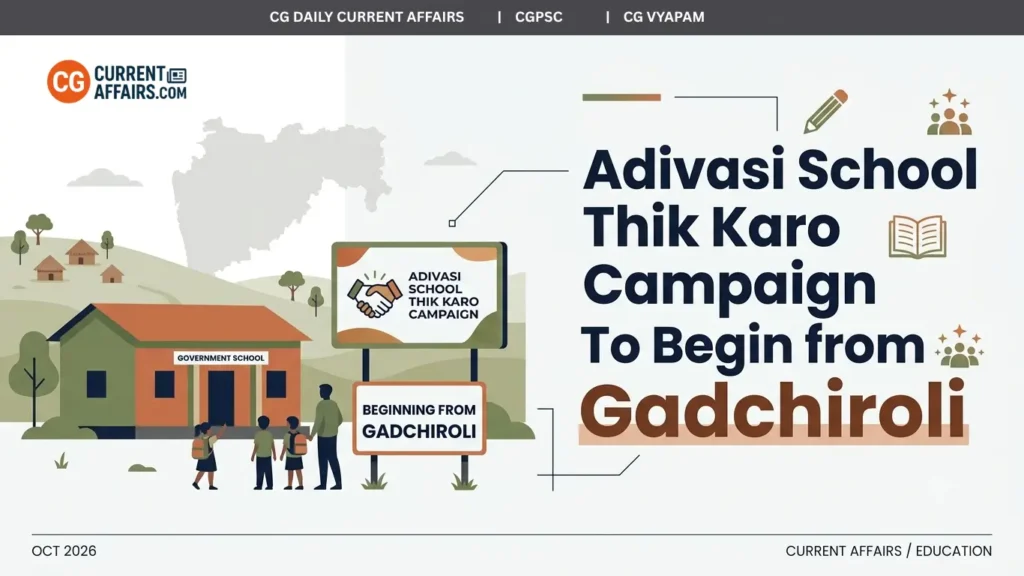
The Cockroach Janta Party (CJP) has announced the launch of the “Adivasi School Thik Karo” (Fix Tribal Schools) campaign from Gadchiroli district of Maharashtra.
The campaign, announced by CJP founder Abhijeet Dipke, aims to draw attention to infrastructure, safety and living-condition concerns in schools serving tribal students. CJP representatives will conduct ground-level inspections of selected tribal educational institutions.
Why in News?
- CJP announced the ‘Adivasi School Thik Karo’ campaign on 17 September 2026.
- The campaign will begin in tribal-dominated Gadchiroli district, Maharashtra.
- It will inspect school infrastructure, safety standards and living conditions.
- The initiative is an extension of the ‘School Thik Karo’ movement launched by CJP in August 2026.
What is the ‘Adivasi School Thik Karo’ Campaign?
The campaign focuses specifically on schools and residential institutions serving tribal students, particularly those located in remote areas.
According to CJP founder Abhijeet Dipke, the campaign will:
- Conduct ground-level inspections of tribal schools.
- Examine basic infrastructure and safety conditions.
- Assess living conditions in residential institutions.
- Highlight issues affecting the education and welfare of tribal students.
- Bring attention to alleged gaps in government response and school facilities.
Why Gadchiroli?
Gadchiroli is a predominantly tribal district in eastern Maharashtra and has a significant number of remote and residential educational institutions for tribal students.
The campaign’s first phase will therefore focus on the district’s tribal schools and ashramshalas (tribal residential schools).
Background of the Campaign
The ‘Adivasi School Thik Karo’ campaign is described as an extension of the ‘School Thik Karo’ movement, which CJP launched in August 2026 to highlight the condition of government schools.
The new campaign specifically focuses on tribal education following reports of deaths and safety concerns involving students in tribal residential institutions.
Recent Concerns Highlighted in the Report
The report refers to:
- The deaths of three children reportedly due to snakebites at a state-run tribal residential school in Gadchiroli in August 2026.
- Reports of student deaths in Balaghat, Madhya Pradesh.
- Hunger strikes by students in parts of Maharashtra’s tribal belt.
- Intervention by the Bombay High Court concerning the safety of tribal students.
Important: Several of the broader casualty figures mentioned in the report are claims made by CJP founder Abhijeet Dipke and should be treated as attributed claims unless independently verified through official records.
Claims Regarding Tribal Student Deaths
According to Dipke, more than 590 tribal students died in Maharashtra over the previous two years. He also referred to reported deaths in neighbouring states, including Madhya Pradesh, Chhattisgarh, Jharkhand, Odisha, Andhra Pradesh and Uttarakhand.
These figures were presented by the CJP founder while announcing the campaign and are therefore relevant as part of the political organisation’s stated claims, rather than as independently established national statistics.
Eklavya Model Residential Schools
The campaign also raised concerns about the functioning of Eklavya Model Residential Schools (EMRS).
According to Dipke’s statement reported in the article, 477 of 720 sanctioned facilities were claimed to be non-functional.
What are EMRS?
Eklavya Model Residential Schools are residential schools intended primarily to provide quality education to Scheduled Tribe (ST) students, particularly in areas with significant tribal populations.
The broader objective is to improve educational access and outcomes among tribal communities while providing residential facilities.
Importance of Tribal Education
Tribal education is important for improving human development, social inclusion and economic opportunities in Scheduled Tribe communities.
Key Issues in Remote Tribal Education
- Inadequate school infrastructure
- Difficult geographical accessibility
- Shortage of teachers and other personnel
- Residential safety concerns
- Limited healthcare and emergency facilities
- Poor sanitation and living conditions
- Difficulties in retaining students
- Digital and connectivity gaps
Addressing these issues requires coordination between education, tribal welfare, health, infrastructure and local administration.
Chhattisgarh Perspective
The issue is particularly relevant to Chhattisgarh, which has a substantial Scheduled Tribe population and numerous tribal and residential educational institutions.
For CGPSC preparation, the topic can be linked with:
- Tribal welfare and development
- Education among Scheduled Tribes
- Residential schools
- Government schemes for tribal students
- Educational infrastructure in remote areas
- Social justice and inclusive development
Candidates should also connect tribal education with the broader constitutional framework for Scheduled Tribes and weaker sections.
Constitutional Perspective
The Constitution provides several safeguards and provisions relating to the educational and economic interests of weaker sections and Scheduled Tribes.
Important Articles
- Article 15(4): Permits special provisions for the advancement of socially and educationally backward classes and SCs/STs.
- Article 46: Directs the State to promote the educational and economic interests of weaker sections, particularly SCs and STs.
- Article 275(1): Provides for grants-in-aid to states for promoting the welfare of Scheduled Tribes and raising the level of administration in Scheduled Areas.
Significance
The campaign highlights a broader development question: access to education must be accompanied by safe and adequate learning and residential conditions.
For tribal students living in remote areas, residential schools can be especially important because they provide both education and accommodation.
Therefore, monitoring infrastructure, food, sanitation, healthcare and safety is an important part of ensuring effective educational access.
Challenges
Improving tribal residential education faces several challenges:
- Geographical isolation – Remote schools can be difficult to monitor and access.
- Infrastructure gaps – Buildings, sanitation, electricity and water facilities may require continuous maintenance.
- Student safety – Remote residential institutions require effective emergency and healthcare arrangements.
- Human resources – Adequate teachers, wardens and support staff are essential.
- Monitoring – Regular inspections and grievance-redressal mechanisms are necessary.
- Coordination – Education, tribal welfare and health departments need to work together.
Way Forward
A comprehensive approach to tribal education should include:
- Regular third-party and government inspections of residential schools.
- Strong emergency medical and disaster-response systems.
- Adequate sanitation, drinking water and electricity.
- Proper staffing of teachers, wardens and healthcare personnel.
- Digital monitoring of infrastructure and student safety.
- Accessible grievance-redressal mechanisms for students.
- Greater participation of tribal communities in monitoring local institutions.
- Time-bound repair and maintenance of school infrastructure.
CGPSC Prelims Current Affairs 2026
Remember:
- Adivasi School Thik Karo → Campaign focused on tribal schools.
- Launch location → Gadchiroli, Maharashtra.
- Announced by → CJP founder Abhijeet Dipke.
- Main focus → Infrastructure, safety and living conditions.
- Ashramshala → Residential school for tribal students.
- EMRS → Eklavya Model Residential Schools.
- Article 46 → Educational and economic interests of weaker sections, particularly SCs/STs.
- Article 275(1) → Grants-in-aid for tribal welfare and Scheduled Areas.
CGPSC Prelims Practice Questions 2026
Q1. The ‘Adivasi School Thik Karo’ campaign, recently in the news, is primarily related to:
A. Tribal healthcare
B. Tribal school infrastructure and student safety
C. Tribal forest rights
D. Tribal employment
Answer: B. Tribal school infrastructure and student safety
Q2. Consider the following pairs:
| Constitutional Provision | Subject |
|---|
| Article 15(4) | Special provisions for advancement of certain socially and educationally backward groups, SCs and STs |
| Article 46 | Educational and economic interests of weaker sections |
| Article 275(1) | Grants-in-aid for tribal welfare |
Which of the above pairs is/are correctly matched?
Answer: All three
CGPSC Mains Practice Question 2026
Q1. Discuss the major challenges in providing quality and safe education to tribal students living in remote areas.
Q2. Explain the constitutional framework for promoting the educational and economic interests of Scheduled Tribes in India.
Quick Revision
- Campaign: Adivasi School Thik Karo
- Meaning: Fix Tribal Schools
- Announced: September 2026
- Starting point: Gadchiroli, Maharashtra
- Organisation: Cockroach Janta Party (CJP)
- Founder: Abhijeet Dipke
- Focus: Tribal school conditions
- Inspections: Infrastructure, safety and living conditions
- Related movement: School Thik Karo
- Residential tribal school: Ashramshala
- EMRS: Eklavya Model Residential Schools
- Article 46: Educational and economic interests of weaker sections
- Article 275(1): Grants-in-aid for tribal welfare
- CGPSC relevance: Tribal welfare, education and social justice
Conclusion
The ‘Adivasi School Thik Karo’ campaign has brought renewed attention to the conditions of tribal residential schools and the safety and welfare of students in remote areas. For competitive examinations, the issue is relevant not only as a current-affairs development but also in the context of tribal education, inclusive development, constitutional safeguards and government initiatives for Scheduled Tribes.
Also Read:
- CG becomes first state to admit 100 children of laborers in elite schools
- Chhattisgarhi language to be introduced in primary schools