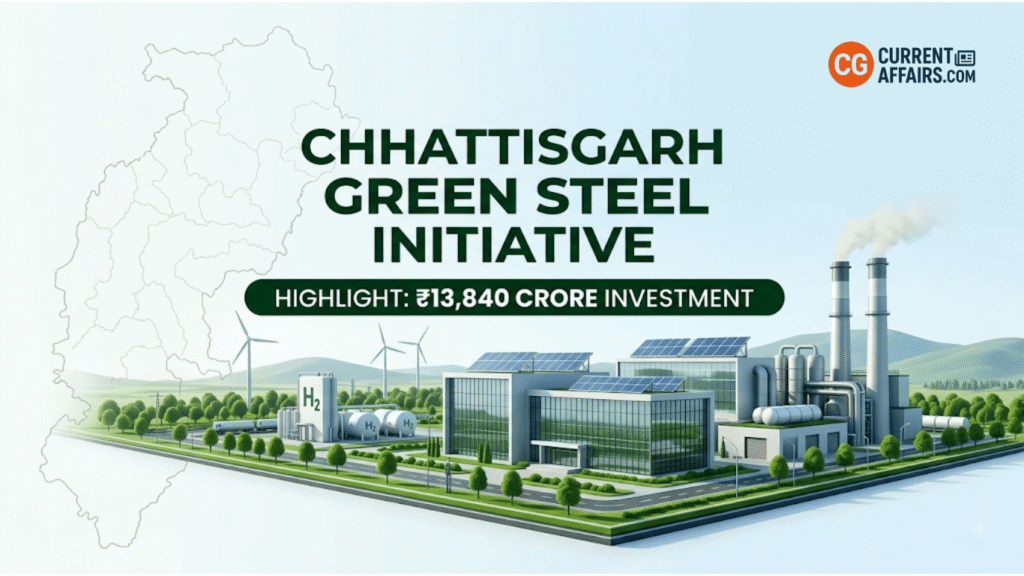
Chhattisgarh Green Steel Initiative: ₹13,840 Crore Investment
Introduction
Chhattisgarh is strengthening its position as a major steel-producing state while focusing on green steel, value addition and sustainable industrial development. The state recently organised the ‘Chhattisgarh Industry Dialogue on Green Steel’ in collaboration with the Confederation of Indian Industry (CII).
The event received investment proposals worth ₹13,840 crore, with the potential to generate 10,921 direct and indirect employment opportunities.
Why in News?
The Chhattisgarh Industry Dialogue on Green Steel was organised by the Government of Chhattisgarh in association with CII.
Key developments
- Investment proposals worth ₹13,840 crore were received.
- These proposals are expected to create 10,921 direct and indirect employment opportunities.
- Chief Minister Vishnu Deo Sai participated in the programme.
- The state highlighted the need to increase value addition within Chhattisgarh.
- The government wants steel produced in the state to increasingly be converted into downstream and specialised products within the state.
- The event focused on the transition towards green steel and sustainable industrial development.
CGPSC Focus: Remember the figures ₹13,840 crore and 10,921 employment opportunities.
Background: Chhattisgarh and the Steel Industry
Chhattisgarh is one of India’s important mineral and steel-producing states. Its industrial development is strongly associated with:
- Iron ore
- Coal
- Steel
- Power
- Mining
- Engineering industries
The availability of mineral resources and energy has supported the development of a strong metal and manufacturing ecosystem.
However, producing raw or primary steel alone provides limited opportunities for higher-value economic activity. A major policy objective is therefore to encourage downstream industries.
What is downstream industry?
Downstream industries use basic or primary materials to manufacture products with greater economic value.
For example:
Iron ore → Steel → Engineering products → Auto components / machinery / specialised products
This process creates additional:
- Employment
- Investment
- Industrial diversification
- Skill development
- Tax revenue
- Local economic activity
What is Green Steel?
Green steel refers broadly to steel produced with significantly lower greenhouse-gas emissions than conventional steelmaking.
Traditional steel production, particularly through coal-intensive processes, is highly energy-intensive and contributes substantially to carbon emissions.
Green steel aims to reduce this environmental footprint through technologies and cleaner energy sources.
Important approaches
Green steel production can involve:
- Greater use of renewable energy
- Energy-efficient technologies
- Increased use of scrap
- Hydrogen-based production
- Low-carbon ironmaking
- Carbon capture and related technologies
Why is Green Steel Important?
The steel sector faces a difficult challenge:
How can steel production increase while emissions decrease?
Steel remains essential for:
- Infrastructure
- Railways
- Construction
- Renewable-energy equipment
- Automobiles
- Defence
- Engineering
Therefore, completely eliminating steel production is not realistic. The focus is on making steel production cleaner and more efficient.
Prelims Fact: Green steel is primarily associated with decarbonisation of steel production, rather than simply increasing steel output.
Why It Matters for Chhattisgarh
The Chief Minister emphasised that steel produced in Chhattisgarh should undergo maximum value addition within the state.
Instead of exporting or sending primary steel outside the state, it can be used to manufacture:
- Auto components
- Engineering products
- Railway equipment
- Defence products
- Solar-energy equipment
- Specialised steel products
Economic significance
This approach can help Chhattisgarh:
Increase industrial value → create jobs → develop MSMEs → improve skills → diversify the economy
It can also reduce dependence on the export of relatively low-value primary commodities.
Chhattisgarh Focus: This is particularly relevant to a resource-rich state because the objective is to capture a greater share of the value chain within the state.
Chhattisgarh Industrial Development Policy 2024–30
The state’s Industrial Development Policy 2024–30 is an important policy framework for attracting investment and promoting industrial growth.
According to the reported announcement, Chhattisgarh received investment proposals worth approximately ₹8 lakh crore during the preceding 18 months.
The proposals cover both traditional and emerging sectors.
Traditional sectors
- Steel
- Mining
Emerging sectors
- Artificial Intelligence
- Data centres
- Semiconductors
- Pharmaceuticals
- Textiles
- Agro-processing
This indicates an attempt to diversify the state’s industrial base beyond mining and primary metal production.
Ease of Doing Business in Chhattisgarh
Investment does not depend only on the availability of natural resources.
Businesses also consider:
- Regulatory procedures
- Approval time
- Infrastructure
- Land availability
- Power supply
- Logistics
- Labour availability
- Policy stability
The state has therefore highlighted reforms aimed at improving the Ease of Doing Business.
According to the report, Chhattisgarh has implemented an Ease of Doing Business Act.
Reported measures include:
- Self-certification
- Low-risk enterprises can use self-certification mechanisms, reducing unnecessary regulatory burden.
- Risk-based regulation
- Regulatory scrutiny can be differentiated according to the level of risk associated with an enterprise.
- Deemed approval
- Where applications are not disposed of within the prescribed time, provisions for deemed approval can reduce uncertainty for businesses.
Mains Point: Regulatory simplification can improve investment attractiveness, but it must be balanced with environmental, labour and public-safety safeguards.
Investment and Employment Linkage
The ₹13,840 crore investment proposals have an expected employment potential of 10,921 direct and indirect jobs.
This demonstrates an important relationship:
Investment → Industrial capacity → Ancillary industries → Employment → Local economic development
The employment impact may extend beyond large industries to:
- MSMEs
- Transport
- Logistics
- Maintenance
- Construction
- Engineering services
- Local suppliers
Therefore, industrial investment should be assessed not only by the amount of capital attracted but also by its employment intensity and local value creation.
Significance for Chhattisgarh
- Industrial diversification
- The focus on sectors such as semiconductors, AI, pharmaceuticals and agro-processing can reduce excessive dependence on traditional mineral-based industries.
- Employment generation
- New investments can create both direct industrial employment and indirect employment through supply chains.
- Value-chain development
- Downstream industries can allow Chhattisgarh to capture a larger portion of the economic value generated from its mineral resources.
- MSME development
- Large industries can create demand for local suppliers and service providers.
- Technology adoption
- Green steel requires modern technologies, encouraging technological upgrading in the industrial sector.
- Sustainable industrialisation
- Green steel links industrial growth with environmental sustainability.
Chhattisgarh Focus: The challenge is to combine the state’s traditional strength in minerals and metals with cleaner production and higher-value manufacturing.
Environmental Dimensions
The steel sector is energy-intensive and traditionally dependent on fossil fuels.
A transition towards greener steel can help address:
- Carbon emissions
- Energy efficiency
- Air pollution
- Resource efficiency
- Climate-change concerns
Circular economy and steel
Steel has an important advantage: it can be recycled.
Greater use of steel scrap can support a circular economy, in which materials remain in productive use for longer rather than being discarded.
This can reduce:
- Dependence on virgin raw materials
- Energy requirements in some production pathways
- Waste generation
However, the environmental benefits depend on the technology, energy source and overall production process.
Challenges
- High cost of green technologies
- Green steel technologies can require significant capital investment.
- Technology availability
- Hydrogen-based and other low-carbon technologies are still developing and require large-scale commercial deployment.
- Availability of renewable energy
- Large-scale decarbonisation of steel requires reliable access to affordable low-carbon electricity.
- Existing industrial infrastructure
- Existing steel plants may require substantial investment to transition towards cleaner technologies.
- Skilled workforce
- Green manufacturing requires workers with new technical and engineering skills.
- Balancing development and environment
- Industrial expansion must comply with environmental safeguards and avoid shifting pollution burdens to local communities.
Mains Point: Green industrialisation should follow the principle of “growth with environmental responsibility”, rather than treating economic growth and environmental protection as mutually exclusive.
Government Response and Policy Direction
The state’s approach can broadly be understood through four priorities:
- Attract investment
- Industrial policies are being used to attract domestic and external investment.
- Improve business regulations
- Simplification and time-bound approvals aim to reduce regulatory barriers.
- Promote value addition
- The government wants more downstream manufacturing to occur within Chhattisgarh.
- Encourage emerging industries
- New sectors such as AI, semiconductors, pharmaceuticals and data centres are being encouraged alongside traditional industries.
Chhattisgarh Connection
The topic has direct relevance to the state’s economic geography and development model.
Chhattisgarh possesses substantial mineral resources and has developed a strong industrial base around iron, steel, coal and power.
The next stage of development can focus on:
Resource availability → primary production → downstream manufacturing → green technology → high-value employment
This transition can help the state move towards a more diversified and technology-oriented industrial economy.
Important Reports, Indices and Institutions
| Item | Organisation/Institution | Importance |
|---|---|---|
| Industrial Development Policy 2024–30 | Government of Chhattisgarh | Industrial investment and development |
| Chhattisgarh Industry Dialogue on Green Steel | Chhattisgarh Government + CII | Green steel and industrial investment |
| CII | Confederation of Indian Industry | Industry association and policy engagement |
| NITI Aayog | Government of India | Policy and development institution |
| CRISIL | Financial/analytical institution | Economic and investment-related assessments |
| Government e-Marketplace | Government of India | Digital public procurement platform |
The content guidelines recommend including only relevant reports and institutions, with their issuing body, purpose, important facts and CGPSC relevance.
Prelims Perspective
Important Facts
- Event: Chhattisgarh Industry Dialogue on Green Steel
- Organisers: Government of Chhattisgarh and CII
- Investment proposals: ₹13,840 crore
- Potential employment: 10,921 direct and indirect opportunities
- Industrial policy: Chhattisgarh Industrial Development Policy 2024–30
- Reported investment proposals over 18 months: Approximately ₹8 lakh crore
- Chief Minister: Vishnu Deo Sai
- Major traditional sectors: Steel and mining
- Emerging sectors: AI, data centres, semiconductors, pharmaceuticals, textiles and agro-processing
- Green steel: Focuses on reducing emissions associated with steel production.
- Downstream industries: Convert primary steel into higher-value products.
- CII: Confederation of Indian Industry
- Important objective: Increase value addition within Chhattisgarh.
- Industrial challenge: Balancing economic growth with environmental sustainability.
The guidelines specifically require a factual Prelims section covering dates, organisations, schemes, reports, Chhattisgarh-specific facts and other objective-question material.
Mains Perspective
This topic can be used in questions related to:
- Industrialisation in Chhattisgarh
- Mineral-based economy
- Green growth
- Employment generation
- Sustainable development
- Ease of Doing Business
- Industrial diversification
- Value-chain development
Suggested Mains Structure
Introduction → Current Development → Economic Significance → Environmental Dimensions → Challenges → Government Measures → Way Forward → Conclusion
This follows the recommended Mains answer framework in your guidelines.
Way Forward
- Promote green technologies in existing steel plants through technology upgradation and cleaner production methods.
- Develop downstream manufacturing clusters around major steel-producing regions to increase local value addition.
- Strengthen renewable-energy availability for energy-intensive industries.
- Develop specialised skills in green manufacturing, engineering, automation and clean technologies.
- Support MSMEs so that local enterprises can become suppliers to large industries.
- Balance ease of doing business with environmental regulation through transparent, risk-based regulatory systems.
- Promote circular economy practices, particularly greater recycling and efficient resource utilisation.
- Diversify the industrial base by encouraging pharmaceuticals, electronics, semiconductors, agro-processing and other emerging sectors.
The guidelines recommend practical, policy-oriented and sustainable recommendations rather than generic statements.
Conclusion
The Chhattisgarh Industry Dialogue on Green Steel reflects a broader shift in the state’s industrial strategy—from simply producing mineral-based commodities towards value-added, technology-oriented and environmentally sustainable manufacturing.
For Chhattisgarh, the opportunity lies in using its existing strengths in minerals, steel and energy while developing downstream industries and cleaner production technologies. This can simultaneously support employment generation, industrial diversification and sustainable development.
CGPSC Prelims Practice Questions
Question 1
Consider the following statements regarding the Chhattisgarh Green Steel initiative:
- The Chhattisgarh Industry Dialogue on Green Steel was organised in collaboration with CII.
- Investment proposals worth ₹13,840 crore were received during the event.
- The proposed investments are expected to generate 10,921 direct and indirect employment opportunities.
- The primary objective is to increase the export of primary steel without promoting downstream industries.
Which of the statements given above are correct?
A. 1, 2 and 3 only
B. 1 and 4 only
C. 2 and 3 only
D. 1, 2, 3 and 4
Correct Answer: A
Explanation: Statements 1, 2 and 3 are correct. The initiative emphasises increasing value addition within Chhattisgarh and promoting downstream industries. Therefore, statement 4 is incorrect.
Question 2
Which of the following best explains the economic significance of promoting downstream steel industries in Chhattisgarh?
A. It eliminates the need for mineral extraction.
B. It increases value addition, employment and industrial diversification within the state.
C. It restricts the use of steel to government projects.
D. It primarily reduces the state’s dependence on agriculture.
Correct Answer: B
Explanation: Downstream industries convert primary steel into higher-value products such as engineering goods, auto components and railway equipment. This can increase local value addition, employment, MSME opportunities and industrial diversification.
CGPSC Mains Practice Questions
Question 1
“Chhattisgarh needs to move from mineral-based industrialisation towards value-added and sustainable manufacturing.” Discuss in the context of the state’s green steel initiative.
Answer Framework
Introduction
- Chhattisgarh’s mineral and steel-based industrial economy.
- Recent green steel dialogue and ₹13,840 crore investment proposals.
Body
- Importance of downstream industries
- Employment generation
- MSME development
- Industrial diversification
- Green steel and decarbonisation
- Technology adoption
Challenges
- High cost of green technologies
- Infrastructure requirements
- Skilled workforce
- Renewable-energy availability
- Environmental concerns
Way Forward
- Green technology
- Industrial clusters
- Skill development
- Renewable energy
- Circular economy
Conclusion
- Shift from resource extraction to sustainable, high-value manufacturing.
Question 2
Examine the role of Ease of Doing Business reforms in attracting industrial investment to Chhattisgarh. Also discuss the need to balance regulatory simplification with environmental safeguards.
Answer Framework
Introduction
- Investment climate as a determinant of industrial development.
Body
- Simplification of approvals
- Self-certification
- Risk-based regulation
- Time-bound decision-making
- Investment attraction
- Employment generation
Challenges/Counterargument
- Possibility of weak regulatory oversight
- Environmental risks
- Labour and public-safety concerns
Way Forward
- Digital monitoring
- Transparent regulatory systems
- Risk-based inspections
- Strong environmental compliance
- Periodic audits
Conclusion
- Ease of doing business should mean ease of responsible and sustainable business, not deregulation without safeguards.
Quick Revision: One-Minute Revision
- Event: Chhattisgarh Industry Dialogue on Green Steel.
- Organisers: Chhattisgarh Government + CII.
- Investment proposals: ₹13,840 crore.
- Expected employment: 10,921 direct and indirect opportunities.
- CM: Vishnu Deo Sai.
- Industrial policy: Chhattisgarh Industrial Development Policy 2024–30.
- Reported investment proposals in 18 months: Approximately ₹8 lakh crore.
- Major traditional sectors: Steel and mining.
- Emerging sectors: AI, data centres, semiconductors, pharmaceuticals, textiles and agro-processing.
- Green steel: Low-emission/decarbonised steel production.
- Key objective: Maximum value addition of Chhattisgarh-produced steel within the state.
- Downstream products: Auto components, engineering products, railway and defence equipment, solar-energy equipment.
- Ease of Doing Business: Includes measures such as self-certification and risk-based regulation.
- Core CGPSC theme: Industrialisation + employment + value addition + green growth.
Read in hindi
छत्तीसगढ़ ग्रीन स्टील पहल: ₹13,840 करोड़ के निवेश प्रस्ताव
परिचय
छत्तीसगढ़ अपने मजबूत इस्पात एवं खनन क्षेत्र को आगे बढ़ाते हुए अब ग्रीन स्टील, मूल्य संवर्धन और सतत औद्योगिक विकास पर जोर दे रहा है।
राज्य सरकार ने भारतीय उद्योग परिसंघ (CII) के सहयोग से ‘छत्तीसगढ़ इंडस्ट्री डायलॉग ऑन ग्रीन स्टील’ का आयोजन किया। इस कार्यक्रम में ₹13,840 करोड़ के निवेश प्रस्ताव प्राप्त हुए। इन परियोजनाओं से 10,921 प्रत्यक्ष एवं अप्रत्यक्ष रोजगार के अवसर सृजित होने की संभावना है।
खबरों में क्यों?
छत्तीसगढ़ सरकार ने CII के सहयोग से ‘छत्तीसगढ़ इंडस्ट्री डायलॉग ऑन ग्रीन स्टील’ आयोजित किया।
प्रमुख बिंदु
- कार्यक्रम में ₹13,840 करोड़ के निवेश प्रस्ताव प्राप्त हुए।
- इनसे 10,921 प्रत्यक्ष एवं अप्रत्यक्ष रोजगार मिलने की संभावना है।
- मुख्यमंत्री विष्णुदेव साय कार्यक्रम में शामिल हुए।
- सरकार ने छत्तीसगढ़ में अधिकतम मूल्य संवर्धन पर जोर दिया।
- राज्य में उत्पादित स्टील को अधिक से अधिक यहीं डाउनस्ट्रीम एवं विशेष उत्पादों में परिवर्तित करने पर बल दिया गया।
- कार्यक्रम में ग्रीन स्टील और सतत औद्योगिक विकास पर विशेष जोर रहा।
CGPSC Focus
याद रखें:
₹13,840 करोड़ → निवेश प्रस्ताव
10,921 → संभावित रोजगार
पृष्ठभूमि: छत्तीसगढ़ और इस्पात उद्योग
छत्तीसगढ़ भारत के प्रमुख खनिज एवं इस्पात उत्पादक राज्यों में से एक है। राज्य का औद्योगिक विकास मुख्य रूप से निम्न संसाधनों से जुड़ा रहा है:
- लौह अयस्क
- कोयला
- इस्पात
- विद्युत
- खनन
- इंजीनियरिंग उद्योग
खनिज संसाधनों और ऊर्जा की उपलब्धता ने राज्य में मजबूत धातु एवं विनिर्माण औद्योगिक आधार विकसित करने में मदद की है।
हालांकि केवल कच्चे या प्राथमिक इस्पात का उत्पादन पर्याप्त नहीं है। अधिक आर्थिक लाभ प्राप्त करने के लिए डाउनस्ट्रीम उद्योगों और मूल्य संवर्धन को बढ़ावा देना आवश्यक है।
डाउनस्ट्रीम उद्योग क्या हैं?
डाउनस्ट्रीम उद्योग वे उद्योग हैं जो प्राथमिक उत्पादों का उपयोग करके अधिक मूल्य वाले उत्पाद तैयार करते हैं।
उदाहरण:
लौह अयस्क → इस्पात → इंजीनियरिंग उत्पाद → ऑटो कंपोनेंट्स/विशेष उत्पाद
इससे:
- रोजगार बढ़ता है
- निवेश बढ़ता है
- औद्योगिक विविधीकरण होता है
- कौशल विकास होता है
- स्थानीय अर्थव्यवस्था मजबूत होती है
- राज्य में अधिक मूल्य का सृजन होता है
Mains Point
छत्तीसगढ़ के लिए भविष्य की औद्योगिक रणनीति केवल संसाधन आधारित अर्थव्यवस्था तक सीमित न रहकर मूल्य संवर्धित विनिर्माण की ओर बढ़ सकती है।
ग्रीन स्टील क्या है?
ग्रीन स्टील से आशय ऐसे इस्पात उत्पादन से है जिसमें पारंपरिक इस्पात उत्पादन की तुलना में ग्रीनहाउस गैस उत्सर्जन को काफी कम करने का प्रयास किया जाता है।
पारंपरिक इस्पात उत्पादन में बड़ी मात्रा में ऊर्जा की आवश्यकता होती है और इसमें कोयले जैसे जीवाश्म ईंधनों की महत्वपूर्ण भूमिका होती है।
ग्रीन स्टील का उद्देश्य इस पर्यावरणीय प्रभाव को कम करना है।
ग्रीन स्टील के लिए प्रमुख उपाय
- नवीकरणीय ऊर्जा का अधिक उपयोग
- ऊर्जा-कुशल तकनीक
- स्क्रैप का अधिक उपयोग
- हाइड्रोजन आधारित उत्पादन
- कम-कार्बन आयरनमेकिंग
- कार्बन कैप्चर जैसी तकनीक
ग्रीन स्टील क्यों महत्वपूर्ण है?
इस्पात की आवश्यकता बनी रहेगी क्योंकि इसका उपयोग:
- आधारभूत संरचना
- रेलवे
- निर्माण
- ऑटोमोबाइल
- रक्षा
- इंजीनियरिंग
- नवीकरणीय ऊर्जा उपकरणों
में होता है।
इसलिए लक्ष्य इस्पात उत्पादन को रोकना नहीं, बल्कि उसे कम कार्बन और अधिक टिकाऊ बनाना है।
Prelims Fact
ग्रीन स्टील का प्रमुख संबंध इस्पात उत्पादन के डीकार्बोनाइजेशन/उत्सर्जन में कमी से है।
छत्तीसगढ़ के लिए मूल्य संवर्धन का महत्व
मुख्यमंत्री ने इस बात पर जोर दिया कि छत्तीसगढ़ में उत्पादित इस्पात का अधिकतम मूल्य संवर्धन प्रदेश के भीतर ही होना चाहिए।
प्राथमिक इस्पात को बाहर भेजने के बजाय राज्य में ही इसका उपयोग करके बनाए जा सकते हैं:
- ऑटो कंपोनेंट्स
- इंजीनियरिंग उत्पाद
- रेलवे उपकरण
- रक्षा उत्पाद
- सौर ऊर्जा उपकरण
- विशेष प्रकार के इस्पात उत्पाद
आर्थिक प्रभाव
मूल्य संवर्धन → रोजगार → MSME विकास → कौशल विकास → औद्योगिक विविधीकरण
इससे राज्य अपने खनिज संसाधनों से उत्पन्न आर्थिक मूल्य की अधिक हिस्सेदारी अपने भीतर रख सकता है।
छत्तीसगढ़ औद्योगिक विकास नीति 2024–30
छत्तीसगढ़ की औद्योगिक विकास नीति 2024–30 राज्य में निवेश और औद्योगिक विकास को बढ़ावा देने के लिए महत्वपूर्ण नीति है।
रिपोर्ट के अनुसार, पिछले 18 महीनों में राज्य को लगभग ₹8 लाख करोड़ के निवेश प्रस्ताव प्राप्त हुए हैं।
इनमें पारंपरिक और उभरते दोनों क्षेत्र शामिल हैं।
पारंपरिक क्षेत्र
- इस्पात
- खनन
उभरते क्षेत्र
- आर्टिफिशियल इंटेलिजेंस
- डेटा सेंटर
- सेमीकंडक्टर
- फार्मास्यूटिकल
- टेक्सटाइल
- एग्रो-प्रोसेसिंग
यह राज्य की अर्थव्यवस्था को केवल खनन और प्राथमिक धातु उत्पादन पर निर्भर रहने से आगे ले जाने की दिशा को दर्शाता है।
Ease of Doing Business में सुधार
निवेश आकर्षित करने के लिए केवल प्राकृतिक संसाधन पर्याप्त नहीं होते। निवेशक कई अन्य कारकों को भी देखते हैं:
- नियामकीय प्रक्रियाएं
- अनुमति मिलने में लगने वाला समय
- आधारभूत संरचना
- भूमि
- बिजली
- लॉजिस्टिक्स
- श्रम
- नीति की स्थिरता
राज्य सरकार ने निवेशकों के लिए कारोबारी प्रक्रियाओं को आसान बनाने पर जोर दिया है।
रिपोर्ट के अनुसार, छत्तीसगढ़ ने ‘Ease of Doing Business Act’ लागू किया है।
प्रमुख व्यवस्थाएं
1. स्व-प्रमाणीकरण
कम जोखिम वाले उद्योगों के लिए Self-Certification की व्यवस्था।
2. जोखिम आधारित नियमन
उद्योग के जोखिम के आधार पर नियामकीय प्रक्रिया तय करना।
3. डीम्ड अप्रूवल
निर्धारित समय-सीमा में आवेदन का निपटारा नहीं होने पर प्रावधानों के अनुसार Deemed Approval की व्यवस्था।
Mains Point
कारोबारी प्रक्रियाओं को आसान बनाना निवेश को बढ़ावा दे सकता है, लेकिन इसके साथ पर्यावरण, श्रम और सार्वजनिक सुरक्षा से संबंधित नियमों का प्रभावी पालन भी जरूरी है।
निवेश और रोजगार का संबंध
कार्यक्रम में प्राप्त ₹13,840 करोड़ के निवेश प्रस्तावों से 10,921 प्रत्यक्ष एवं अप्रत्यक्ष रोजगार के अवसर मिलने की संभावना है।
इसे इस प्रकार समझ सकते हैं:
निवेश → औद्योगिक क्षमता → सहायक उद्योग → रोजगार → स्थानीय आर्थिक विकास
इसका प्रभाव केवल बड़े उद्योगों तक सीमित नहीं रहता बल्कि इससे:
- MSME
- परिवहन
- लॉजिस्टिक्स
- रखरखाव
- निर्माण
- इंजीनियरिंग सेवाएं
- स्थानीय सप्लायर
भी लाभान्वित हो सकते हैं।
छत्तीसगढ़ के लिए महत्व
- औद्योगिक विविधीकरण
- AI, सेमीकंडक्टर, फार्मास्यूटिकल और एग्रो-प्रोसेसिंग जैसे क्षेत्रों को बढ़ावा देने से खनिज आधारित उद्योगों पर अत्यधिक निर्भरता कम हो सकती है।
- रोजगार सृजन
- नए निवेश से प्रत्यक्ष और अप्रत्यक्ष दोनों प्रकार के रोजगार उत्पन्न हो सकते हैं।
- मूल्य श्रृंखला का विकास
- डाउनस्ट्रीम उद्योग राज्य को अपने खनिज संसाधनों से उत्पन्न आर्थिक मूल्य का अधिक हिस्सा अपने भीतर रखने में मदद कर सकते हैं।
- MSME विकास
- बड़े उद्योग स्थानीय छोटे और मध्यम उद्यमों के लिए सप्लाई एवं सर्विस के अवसर पैदा कर सकते हैं।
- तकनीकी विकास
- ग्रीन स्टील के लिए आधुनिक और स्वच्छ तकनीकों की आवश्यकता होगी।
- सतत औद्योगिकीकरण
- ग्रीन स्टील आर्थिक विकास को पर्यावरणीय स्थिरता के साथ जोड़ता है।
पर्यावरणीय महत्व
इस्पात उद्योग ऊर्जा-गहन उद्योग है और पारंपरिक तकनीकों में जीवाश्म ईंधनों का उपयोग अधिक होता है।
ग्रीन स्टील की दिशा में परिवर्तन से निम्न क्षेत्रों में मदद मिल सकती है:
- कार्बन उत्सर्जन में कमी
- ऊर्जा दक्षता
- वायु प्रदूषण में कमी
- संसाधन दक्षता
- जलवायु परिवर्तन से निपटना
सर्कुलर इकोनॉमी और स्टील
स्टील का एक महत्वपूर्ण गुण यह है कि इसे रीसायकल किया जा सकता है।
स्क्रैप आधारित उत्पादन और संसाधनों के बेहतर उपयोग से Circular Economy को बढ़ावा दिया जा सकता है।
प्रमुख चुनौतियां
- ग्रीन तकनीक की उच्च लागत
- ग्रीन स्टील तकनीकों में प्रारंभिक निवेश काफी अधिक हो सकता है।
- तकनीकी चुनौतियां
- हाइड्रोजन आधारित और अन्य कम-कार्बन तकनीकों को बड़े स्तर पर अपनाने के लिए तकनीकी एवं वित्तीय निवेश आवश्यक है।
- नवीकरणीय ऊर्जा की उपलब्धता
- ग्रीन स्टील के लिए पर्याप्त और सस्ती स्वच्छ ऊर्जा आवश्यक है।
- मौजूदा संयंत्रों का रूपांतरण
- पुराने इस्पात संयंत्रों को नई स्वच्छ तकनीकों में बदलने में बड़ी लागत आ सकती है।
- कुशल मानव संसाधन
- ग्रीन मैन्युफैक्चरिंग के लिए नई तकनीकी और इंजीनियरिंग क्षमताओं वाले कर्मचारियों की आवश्यकता होगी।
- विकास और पर्यावरण के बीच संतुलन
- औद्योगिक विस्तार के साथ पर्यावरणीय मानकों और स्थानीय समुदायों के हितों की रक्षा भी आवश्यक है।
सरकारी प्रतिक्रिया एवं नीति दिशा
राज्य की औद्योगिक रणनीति को चार प्रमुख बिंदुओं में समझा जा सकता है:
- निवेश आकर्षित करना
- औद्योगिक नीतियों के माध्यम से निवेश को बढ़ावा देना।
- कारोबारी प्रक्रियाओं को आसान बनाना
- अनुमोदन एवं नियामकीय प्रक्रियाओं को सरल और समयबद्ध बनाना।
- मूल्य संवर्धन को बढ़ावा देना
- राज्य में ही डाउनस्ट्रीम विनिर्माण को बढ़ावा देना।
- उभरते क्षेत्रों को प्रोत्साहन
- AI, सेमीकंडक्टर, फार्मास्यूटिकल और डेटा सेंटर जैसे क्षेत्रों को बढ़ावा देना।
छत्तीसगढ़ कनेक्शन
छत्तीसगढ़ की अर्थव्यवस्था में खनिज, इस्पात, कोयला और ऊर्जा की महत्वपूर्ण भूमिका है।
अब राज्य के लिए अगला चरण हो सकता है:
संसाधन उपलब्धता → प्राथमिक उत्पादन → डाउनस्ट्रीम विनिर्माण → ग्रीन तकनीक → उच्च मूल्य वाले रोजगार
यह परिवर्तन राज्य को अधिक विविध और तकनीक आधारित औद्योगिक अर्थव्यवस्था की ओर ले जा सकता है।
CGPSC Focus
Mains में इस विषय को निम्नलिखित से जोड़ें:
खनिज आधारित उद्योग + औद्योगिकीकरण + रोजगार + मूल्य संवर्धन + पर्यावरणीय स्थिरता
महत्वपूर्ण संस्थाएं एवं नीतियां
| विषय | संस्था/संगठन | महत्व |
|---|---|---|
| औद्योगिक विकास नीति 2024–30 | छत्तीसगढ़ सरकार | औद्योगिक निवेश एवं विकास |
| छत्तीसगढ़ इंडस्ट्री डायलॉग ऑन ग्रीन स्टील | छत्तीसगढ़ सरकार + CII | ग्रीन स्टील एवं निवेश |
| CII | Confederation of Indian Industry | उद्योग जगत एवं नीति संवाद |
| NITI Aayog | भारत सरकार | नीति एवं विकास संबंधी संस्था |
| CRISIL | वित्तीय/विश्लेषणात्मक संस्था | आर्थिक एवं निवेश संबंधी विश्लेषण |
| Government e-Marketplace | भारत सरकार | डिजिटल सरकारी खरीद मंच |
CGPSC Prelims Perspective
महत्वपूर्ण तथ्य
- कार्यक्रम: छत्तीसगढ़ इंडस्ट्री डायलॉग ऑन ग्रीन स्टील
- आयोजक: छत्तीसगढ़ सरकार एवं CII
- निवेश प्रस्ताव: ₹13,840 करोड़
- संभावित रोजगार: 10,921 प्रत्यक्ष एवं अप्रत्यक्ष
- औद्योगिक नीति: छत्तीसगढ़ औद्योगिक विकास नीति 2024–30
- 18 महीनों में निवेश प्रस्ताव: लगभग ₹8 लाख करोड़
- मुख्यमंत्री: विष्णुदेव साय
- प्रमुख पारंपरिक क्षेत्र: इस्पात एवं खनन
- उभरते क्षेत्र: AI, डेटा सेंटर, सेमीकंडक्टर, फार्मास्यूटिकल, टेक्सटाइल एवं एग्रो-प्रोसेसिंग
- ग्रीन स्टील: इस्पात उत्पादन से होने वाले उत्सर्जन को कम करने पर केंद्रित
- डाउनस्ट्रीम उद्योग: प्राथमिक इस्पात से उच्च मूल्य वाले उत्पाद तैयार करना
- CII: Confederation of Indian Industry
- मुख्य उद्देश्य: छत्तीसगढ़ में उत्पादित इस्पात का अधिकतम मूल्य संवर्धन प्रदेश में करना
- मुख्य चुनौती: आर्थिक विकास और पर्यावरणीय स्थिरता के बीच संतुलन
CGPSC Prelims Practice Questions
प्रश्न 1
छत्तीसगढ़ की ग्रीन स्टील पहल के संबंध में निम्नलिखित कथनों पर विचार कीजिए:
- छत्तीसगढ़ इंडस्ट्री डायलॉग ऑन ग्रीन स्टील का आयोजन CII के सहयोग से किया गया।
- कार्यक्रम में ₹13,840 करोड़ के निवेश प्रस्ताव प्राप्त हुए।
- प्रस्तावित निवेश से 10,921 प्रत्यक्ष एवं अप्रत्यक्ष रोजगार के अवसर मिलने की संभावना है।
- पहल का मुख्य उद्देश्य केवल प्राथमिक इस्पात का निर्यात बढ़ाना है।
उपरोक्त में से कौन-से कथन सही हैं?
A. केवल 1, 2 और 3
B. केवल 1 और 4
C. केवल 2 और 3
D. 1, 2, 3 और 4
सही उत्तर: A
व्याख्या: कथन 1, 2 और 3 सही हैं। पहल का उद्देश्य राज्य में मूल्य संवर्धन और डाउनस्ट्रीम उद्योगों को बढ़ावा देना है। इसलिए कथन 4 गलत है।
प्रश्न 2
छत्तीसगढ़ में डाउनस्ट्रीम इस्पात उद्योगों को बढ़ावा देने का सबसे महत्वपूर्ण आर्थिक लाभ क्या है?
A. इससे खनिज उत्खनन की आवश्यकता समाप्त हो जाएगी।
B. इससे राज्य में मूल्य संवर्धन, रोजगार और औद्योगिक विविधीकरण बढ़ेगा।
C. इससे इस्पात का उपयोग केवल सरकारी परियोजनाओं तक सीमित हो जाएगा।
D. इससे राज्य की कृषि पर निर्भरता पूरी तरह समाप्त हो जाएगी।
सही उत्तर: B
व्याख्या: डाउनस्ट्रीम उद्योग प्राथमिक इस्पात को उच्च मूल्य वाले उत्पादों में बदलते हैं। इससे स्थानीय मूल्य संवर्धन, रोजगार, MSME अवसर और औद्योगिक विविधीकरण बढ़ सकता है।
CGPSC Mains Perspective
प्रश्न 1
“छत्तीसगढ़ को खनिज आधारित औद्योगिकीकरण से मूल्य संवर्धित एवं सतत विनिर्माण की ओर बढ़ने की आवश्यकता है।” ग्रीन स्टील पहल के संदर्भ में चर्चा कीजिए।
उत्तर रूपरेखा
परिचय
- छत्तीसगढ़ की खनिज एवं इस्पात आधारित अर्थव्यवस्था।
- ग्रीन स्टील संवाद और ₹13,840 करोड़ के निवेश प्रस्ताव।
मुख्य भाग
- डाउनस्ट्रीम उद्योग
- रोजगार सृजन
- MSME विकास
- औद्योगिक विविधीकरण
- ग्रीन स्टील
- तकनीकी विकास
चुनौतियां
- ग्रीन तकनीक की लागत
- आधारभूत संरचना
- कुशल मानव संसाधन
- नवीकरणीय ऊर्जा
- पर्यावरणीय चिंताएं
Way Forward
- स्वच्छ तकनीक
- औद्योगिक क्लस्टर
- कौशल विकास
- नवीकरणीय ऊर्जा
- सर्कुलर इकोनॉमी
निष्कर्ष
- संसाधन आधारित अर्थव्यवस्था से सतत एवं उच्च मूल्य वाले विनिर्माण की ओर संक्रमण।
प्रश्न 2
छत्तीसगढ़ में औद्योगिक निवेश आकर्षित करने में Ease of Doing Business सुधारों की भूमिका का परीक्षण कीजिए। साथ ही नियामकीय सरलीकरण और पर्यावरणीय सुरक्षा के बीच संतुलन की आवश्यकता पर चर्चा कीजिए।
उत्तर रूपरेखा
परिचय
- औद्योगिक विकास में निवेश माहौल का महत्व।
मुख्य भाग
- अनुमति प्रक्रियाओं का सरलीकरण
- स्व-प्रमाणीकरण
- जोखिम आधारित नियमन
- समयबद्ध निर्णय
- निवेश आकर्षण
- रोजगार सृजन
चुनौतियां
- कमजोर नियामकीय निगरानी की संभावना
- पर्यावरणीय जोखिम
- श्रम एवं सार्वजनिक सुरक्षा
Way Forward
- डिजिटल निगरानी
- पारदर्शी नियामकीय व्यवस्था
- जोखिम आधारित निरीक्षण
- मजबूत पर्यावरणीय अनुपालन
- नियमित ऑडिट
निष्कर्ष
- Ease of Doing Business का अर्थ केवल आसान व्यापार नहीं, बल्कि जिम्मेदार और सतत व्यापार को आसान बनाना होना चाहिए।
Way Forward
- मौजूदा इस्पात संयंत्रों में ग्रीन तकनीकों को बढ़ावा दिया जाए।
- प्रमुख इस्पात क्षेत्रों के आसपास डाउनस्ट्रीम मैन्युफैक्चरिंग क्लस्टर विकसित किए जाएं।
- उद्योगों के लिए नवीकरणीय ऊर्जा की उपलब्धता बढ़ाई जाए।
- ग्रीन मैन्युफैक्चरिंग और क्लीन टेक्नोलॉजी के लिए कुशल मानव संसाधन तैयार किया जाए।
- बड़े उद्योगों से जुड़े स्थानीय MSME सप्लायर नेटवर्क को मजबूत किया जाए।
- Ease of Doing Business के साथ पर्यावरणीय नियमों का प्रभावी पालन सुनिश्चित किया जाए।
- स्क्रैप रीसाइक्लिंग और संसाधन दक्षता के माध्यम से Circular Economy को बढ़ावा दिया जाए।
- फार्मास्यूटिकल, इलेक्ट्रॉनिक्स, सेमीकंडक्टर और एग्रो-प्रोसेसिंग जैसे क्षेत्रों में औद्योगिक विविधीकरण किया जाए।
निष्कर्ष
‘छत्तीसगढ़ इंडस्ट्री डायलॉग ऑन ग्रीन स्टील’ राज्य की औद्योगिक रणनीति में एक महत्वपूर्ण दिशा को दर्शाता है—यानी केवल खनिज आधारित उत्पादन से आगे बढ़कर मूल्य संवर्धित, तकनीक आधारित और पर्यावरणीय रूप से टिकाऊ विनिर्माण को बढ़ावा देना।
छत्तीसगढ़ के लिए अवसर यह है कि वह अपनी खनिज, इस्पात और ऊर्जा संबंधी ताकत का उपयोग करते हुए डाउनस्ट्रीम उद्योगों और स्वच्छ तकनीकों को विकसित करे।
इससे एक साथ रोजगार, औद्योगिक विविधीकरण, स्थानीय मूल्य संवर्धन और सतत विकास को बढ़ावा दिया जा सकता है।
Quick Revision – One-Minute Revision
- कार्यक्रम: छत्तीसगढ़ इंडस्ट्री डायलॉग ऑन ग्रीन स्टील।
- आयोजक: छत्तीसगढ़ सरकार + CII।
- निवेश प्रस्ताव: ₹13,840 करोड़।
- संभावित रोजगार: 10,921 प्रत्यक्ष एवं अप्रत्यक्ष।
- मुख्यमंत्री: विष्णुदेव साय।
- औद्योगिक नीति: छत्तीसगढ़ औद्योगिक विकास नीति 2024–30।
- 18 महीनों में निवेश प्रस्ताव: लगभग ₹8 लाख करोड़।
- प्रमुख पारंपरिक क्षेत्र: इस्पात एवं खनन।
- उभरते क्षेत्र: AI, डेटा सेंटर, सेमीकंडक्टर, फार्मास्यूटिकल, टेक्सटाइल और एग्रो-प्रोसेसिंग।
- ग्रीन स्टील: कम उत्सर्जन वाला/डीकार्बोनाइज्ड इस्पात उत्पादन।
- मुख्य उद्देश्य: राज्य में उत्पादित इस्पात का अधिकतम मूल्य संवर्धन।
- डाउनस्ट्रीम उत्पाद: ऑटो कंपोनेंट्स, इंजीनियरिंग, रेलवे, रक्षा और सौर ऊर्जा उपकरण।
- Ease of Doing Business: स्व-प्रमाणीकरण एवं जोखिम आधारित नियमन जैसी व्यवस्थाएं।
Latest CGPSC Current Affairs
Chhattisgarh Literacy Initiative: ULLAS & CGPSC
India’s First Digital Tribal Museum to be Inaugurated in Naya Raipur on November 1
Mega Survey of OBCs in Chhattisgarh: Digital Census 2025
Rajnandgaon District becomes a National Model in Green Energy
Ramnami Community of Chhattisgarh: Faith Beyond Temples
India Ranks 9th Globally in Total Forest Area: GFRA 2025
Jashpur Jamboree 2025 to be held from 6 to 9 Nov 2025
BALCO Produces First Metal from India’s Largest Smelter
Mohla-Manpur-Ambagarh Chowki Wins National Nutrition Award
Free Monthly Current Affairs Magazine
Get the latest CGPSC Current Affairs Magazine covering important topics for Prelims and Mains.
Chhattisgarh Daily Current Affairs for CGPSC
Read the latest Chhattisgarh, India & World current affairs with exam-focused analysis for CGPSC Prelims and Mains.
📩 Get Free Monthly Magazine
Enter your details to receive the latest CGPSC Current Affairs Magazine.