100 Women Cooperative Societies in Chhattisgarh 2026
Chhattisgarh plans 100 women cooperative societies in 2026 to boost women’s income, entrepreneurship, production, finance and market access
Read More →

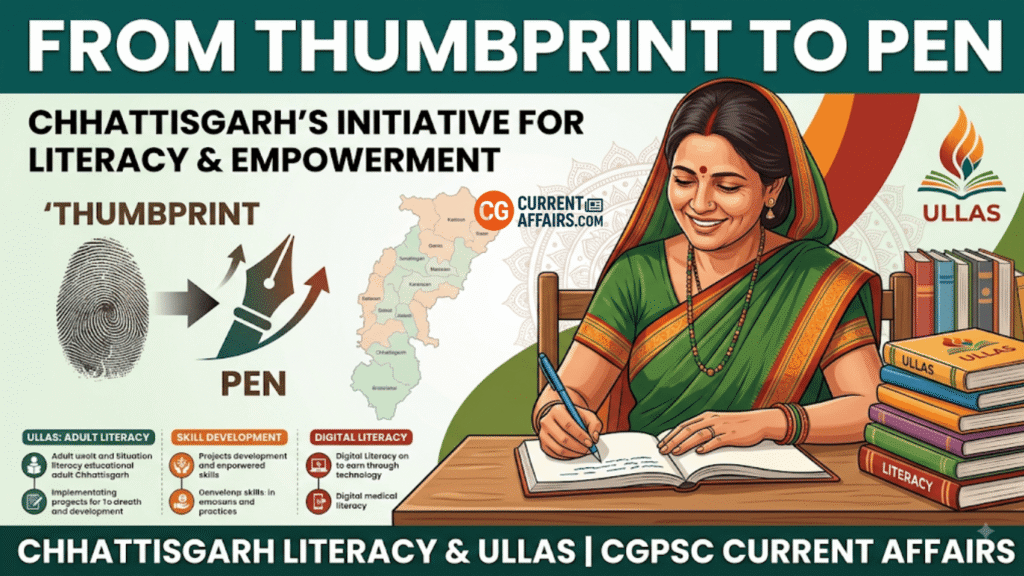
The Government of Chhattisgarh has launched a new literacy-focused initiative aimed at moving communities from basic illiteracy towards functional literacy and greater social participation. According to the reported initiative, Panchayats and wards that become free of illiteracy will be recognised through an “Angutha Mukt Panchayat/Ward” (Thumbprint-Free Panchayat/Ward) certificate.
The initiative is linked with the broader objective of making Chhattisgarh fully literate by 2026–27. It also seeks to make literacy a community movement rather than limiting it to classroom-based education. Activities such as the “Ullas Wall,” “Ullas Bell,” “Ullas Diary” and recognition of high-performing young volunteers as “Super-30” are intended to publicly celebrate the achievement of newly literate citizens.
The initiative is particularly relevant for CGPSC aspirants because it connects adult education, literacy, local governance, community participation, women’s empowerment, NEP 2020 and the ULLAS–Nav Bharat Saaksharta Karyakram.
The issue came into focus around Independence Day 2026 following a reported Chhattisgarh government initiative to recognise Panchayats and wards where surveys find no remaining illiterate persons.
According to the report:
CGPSC Focus: The important conceptual link is between this state initiative and the ULLAS–Nav Bharat Saaksharta Karyakram, the Union Government’s centrally sponsored adult-literacy programme.
From Adult Education to Lifelong Learning
India’s literacy policy has gradually moved beyond simply teaching adults to read and write. Modern adult education increasingly incorporates:
This broader understanding is reflected in the National Education Policy (NEP) 2020, which emphasises adult education and lifelong learning.
The Government of India launched ULLAS – Nav Bharat Saaksharta Karyakram, also known as the New India Literacy Programme (NILP), for the period 2022–2027. It targets non-literate persons aged 15 years and above who missed opportunities for formal schooling.
The programme is built around the vision of “Jan Jan Saakshar” and relies significantly on community participation and volunteerism.
The Chhattisgarh initiative represents several important principles:
ULLAS uses both online and offline approaches.
The programme can function through Samajik Chetna Kendras, which may operate through schools, Panchayat offices, community halls, libraries and other community spaces. Volunteers can help learners acquire foundational literacy, numeracy and life skills.
The ULLAS Mobile App also supports registration and learning activities.
Prelims Fact:
Mains Point: Literacy must therefore be viewed not only as an education issue but also as a question of social inclusion, gender equality and human capital formation.
Social Significance
Literacy can significantly improve a person’s ability to participate independently in society.
Important benefits include:
The symbolic transition from “thumbprint to signature” therefore represents more than a change in the method of authentication. It represents greater independence and agency.
Economic Significance
Functional literacy can contribute to economic empowerment by helping people:
Governance Significance
Literacy strengthens the effectiveness of welfare-oriented governance.
A literate citizen is better positioned to:
CGPSC Focus: Adult literacy and local governance can be connected to the broader principle of participatory democracy.
Gender Significance
Women often face greater barriers to formal education and adult literacy.
Improving female literacy can support:
1. Reaching Remote Communities
Chhattisgarh has substantial rural and tribal populations, including communities living in geographically difficult areas.
Literacy programmes therefore have to overcome:
2. Gender Gap
The available literacy data show a substantial rural gender gap. This means simply increasing the number of enrolled learners is insufficient; programmes must ensure that women actually complete learning and assessment.
3. Tribal and Linguistic Diversity
Adult learners may speak tribal or regional languages that differ from the dominant language used in educational materials.
Therefore, locally appropriate teaching-learning materials are important.
4. Sustaining Literacy
A person becoming literate is not the end of the process.
There is a risk of loss of literacy skills if newly literate citizens do not regularly use reading, writing and numeracy.
This is why ULLAS includes continuing education alongside foundational literacy.
5. Digital Divide
Digital platforms can expand access but may exclude learners who lack:
Therefore, online learning must be complemented by offline community-based support.
1. ULLAS – Nav Bharat Saaksharta Karyakram
Objective: Provide literacy and lifelong-learning opportunities to adults aged 15 years and above who missed formal education.
Five Major Components
Critical life skills under ULLAS include areas such as financial, legal and digital literacy, along with health, disaster-management and other practical skills.
2. Foundational Literacy and Numeracy Assessment Test
FLNAT evaluates whether learners have acquired foundational reading, writing and numeracy skills.
This is important because literacy programmes require measurable learning outcomes, not merely enrolment numbers.
3. Volunteerism
ULLAS is designed around the principle of Kartavya Bodh, or a sense of duty.
The programme encourages literate citizens, students and other volunteers to support adult learners.
Q.1 Why is Literacy Particularly Important for Chhattisgarh?
Chhattisgarh has a significant rural and tribal population. According to state government data based on Census 2011, the state’s literacy rate was 70.28%, with female literacy at 59.58%. The same source records tribal literacy at 59.09%.
More recent PLFS estimates show considerable improvement, but differences between rural and urban areas and between men and women continue to matter.
Therefore, achieving universal functional literacy requires targeted intervention rather than a one-size-fits-all approach.
Key Chhattisgarh dimensions
India’s literacy strategy has shifted from a narrow focus on adult education towards functional literacy and lifelong learning.
The approach is closely linked with:
The Government has also set broader national ambitions for achieving full literacy. ULLAS is one of the principal programmes supporting this objective.
The programme has already produced measurable results nationally. By early 2025, more than 1.11 crore learners had appeared for FLNAT, with more than 88 lakh declared certified literates in the reported assessment cycle.
The issue also connects with Sustainable Development Goal 4, particularly SDG 4.6, which calls for ensuring that by 2030 all young people and a substantial proportion of adults achieve literacy and numeracy.
Thus, adult literacy is not simply a domestic education issue; it is part of the global sustainable-development agenda.
| Item | Key Information | CGPSC Relevance |
|---|---|---|
| ULLAS | Understanding of Lifelong Learning for All in Society | Major current-affairs topic |
| NILP | New India Literacy Programme | ULLAS’s official programme identity |
| NEP 2020 | National policy framework for education | Policy background |
| FLNAT | Functional Literacy and Numeracy Assessment Test | Prelims fact |
| NCERT | Provides academic/resource support | Institutional question |
| Ministry of Education | Nodal Union ministry | Prelims |
| Samajik Chetna Kendra | Community-based learning centre | Conceptual/current affairs |
| SDG 4.6 | Global literacy and numeracy goal | Mains/international dimension |
Prelims Fact:
How can this topic be used in a CGPSC Mains answer?
A question on literacy can be structured as:
Introduction
Define literacy and briefly introduce ULLAS and the Chhattisgarh initiative.
Body
Discuss:
Challenges
Government Measures
Way Forward
Conclusion
Universal literacy should be treated as a foundation for inclusive development, effective governance and empowered citizenship.
The reported “From Thumbprint to Pen” initiative gives literacy a visible community identity by celebrating the transition from dependence on thumb impressions to the ability to read, write and sign independently. The proposed recognition of literacy-ready Panchayats and wards also brings local governance into the literacy movement.
For Chhattisgarh, the larger challenge is to ensure that literacy reaches rural, tribal, remote and economically vulnerable communities while narrowing gender disparities. The ULLAS framework provides a national structure, but successful implementation ultimately depends on effective state-level and community-level participation.
For CGPSC aspirants, the topic should therefore be studied not merely as a literacy campaign but as an intersection of education policy, local governance, social empowerment, gender equality, tribal development, digital inclusion and sustainable development.
Question 1
Consider the following statements regarding ULLAS–Nav Bharat Saaksharta Karyakram:
Which of the statements given above is/are correct?
A. 1, 2 and 3 only
B. 1 and 4 only
C. 2 and 3 only
D. 1, 2, 3 and 4
Correct Answer: A
Explanation: ULLAS targets non-literate persons aged 15 years and above, is aligned with NEP 2020 and includes Foundational Literacy and Numeracy. Volunteerism is an important part of the programme, so Statement 4 is incorrect.
Question 2
Which of the following best explains the significance of the “From Thumbprint to Pen” concept in the reported Chhattisgarh literacy initiative?
A. It refers exclusively to digitisation of biometric authentication.
B. It symbolises the transition from illiteracy and dependence on thumb impressions towards functional literacy and independent participation.
C. It is a vocational training programme for government employees.
D. It refers to replacing Aadhaar-based authentication with handwritten documents.
Correct Answer: B
Explanation: The phrase is used symbolically to represent the empowerment that comes with literacy. It is connected with the ability to read, write and participate more independently in social, economic and governance processes.
Question 1
“Adult literacy is not merely an educational objective but an instrument of social and economic empowerment.” Discuss with reference to ULLAS and Chhattisgarh.
Question 2
Evaluate the role of Panchayati Raj Institutions and community participation in achieving universal functional literacy in Chhattisgarh.
छत्तीसगढ़ सरकार ने राज्य को पूर्ण साक्षर बनाने के उद्देश्य से साक्षरता को जनभागीदारी से जोड़ने वाली एक नई पहल शुरू की है। इस पहल के तहत ऐसे पंचायतों और वार्डों को ‘अंगूठा मुक्त पंचायत/वार्ड’ प्रमाण-पत्र देने की योजना है, जहां सर्वेक्षण में कोई भी निरक्षर व्यक्ति नहीं पाया जाएगा।
यह पहल वर्ष 2026-27 तक छत्तीसगढ़ को पूर्ण साक्षर बनाने के लक्ष्य से जुड़ी है। इसका उद्देश्य केवल लोगों को पढ़ना-लिखना सिखाना नहीं, बल्कि साक्षरता को सामाजिक सम्मान और सामुदायिक उपलब्धि के रूप में स्थापित करना भी है।
इस पहल के अंतर्गत ‘उल्लास दीवार’, ‘उल्लास घंटी’, ‘उल्लास डायरी’ और ‘सुपर-30’ जैसी गतिविधियों के माध्यम से नवसाक्षर लोगों और साक्षरता अभियान में योगदान देने वाले युवाओं को प्रोत्साहित किया जाएगा।
CGPSC Focus: यह विषय वयस्क शिक्षा, साक्षरता, पंचायती राज, महिला सशक्तिकरण, जनभागीदारी, NEP 2020 तथा ULLAS–नव भारत साक्षरता कार्यक्रम से जुड़ा हुआ है।
यह पहल स्वतंत्रता दिवस 2026 के आसपास चर्चा में आई। रिपोर्ट के अनुसार, छत्तीसगढ़ सरकार उन पंचायतों और वार्डों को सम्मानित करेगी, जहां सर्वेक्षण के बाद कोई निरक्षर व्यक्ति नहीं बचता।
पहल की प्रमुख बातें:
वयस्क शिक्षा से आजीवन सीखने तक
भारत में साक्षरता की अवधारणा समय के साथ व्यापक हुई है। पहले वयस्क शिक्षा का मुख्य उद्देश्य लोगों को पढ़ना और लिखना सिखाना था। वर्तमान में साक्षरता को कार्यात्मक साक्षरता (Functional Literacy) और आजीवन सीखने (Lifelong Learning) से जोड़ा जाता है।
इसमें शामिल हैं:
राष्ट्रीय शिक्षा नीति (NEP) 2020 ने भी वयस्क शिक्षा और आजीवन सीखने पर विशेष जोर दिया है।
इसी व्यापक दृष्टिकोण के तहत केंद्र सरकार ने ULLAS–नव भारत साक्षरता कार्यक्रम शुरू किया, जो वर्ष 2022–2027 की अवधि के लिए है। इसका लक्ष्य 15 वर्ष और उससे अधिक आयु के ऐसे गैर-साक्षर लोगों को शिक्षा प्रदान करना है, जो औपचारिक शिक्षा से वंचित रह गए।
छत्तीसगढ़ की इस पहल में निम्नलिखित तत्व महत्वपूर्ण हैं:
ULLAS में ऑनलाइन और ऑफलाइन दोनों माध्यमों का उपयोग किया जाता है।
सामाजिक चेतना केंद्र (Samajik Chetna Kendra) जैसे सामुदायिक शिक्षण केंद्र स्कूलों, पंचायत कार्यालयों, सामुदायिक भवनों, पुस्तकालयों आदि में संचालित किए जा सकते हैं।
इन केंद्रों के माध्यम से स्वयंसेवक वयस्क शिक्षार्थियों को:
सीखने में सहायता कर सकते हैं।
Prelims Fact: ULLAS का पूरा नाम Understanding of Lifelong Learning for All in Society है।
Prelims Fact
सामाजिक महत्व
साक्षरता व्यक्ति को समाज में अधिक स्वतंत्र रूप से भाग लेने में सक्षम बनाती है।
इसके प्रमुख लाभ हैं:
इस दृष्टि से ‘अंगूठे से कलम तक’ केवल हस्ताक्षर करने की क्षमता का प्रतीक नहीं है, बल्कि यह व्यक्ति की स्वतंत्रता, आत्मनिर्भरता और सामाजिक भागीदारी का प्रतीक है।
आर्थिक महत्व
कार्यात्मक साक्षरता व्यक्ति को आर्थिक गतिविधियों में अधिक प्रभावी ढंग से भाग लेने में मदद कर सकती है।
इससे व्यक्ति:
शासन एवं प्रशासन में महत्व
साक्षरता सुशासन को मजबूत करने में महत्वपूर्ण भूमिका निभाती है।
एक साक्षर नागरिक:
CGPSC Focus: साक्षरता को भागीदारीपूर्ण लोकतंत्र और जमीनी सुशासन से जोड़ा जा सकता है।
महिला सशक्तिकरण
महिलाओं की साक्षरता बढ़ाना सामाजिक विकास का महत्वपूर्ण आधार है।
महिला साक्षरता से:
1. दूरस्थ क्षेत्रों तक पहुंच
छत्तीसगढ़ में अनेक ग्रामीण और आदिवासी क्षेत्र भौगोलिक रूप से कठिन क्षेत्रों में स्थित हैं।
इन क्षेत्रों में चुनौतियां हो सकती हैं:
2. लैंगिक अंतर
साक्षरता के क्षेत्र में पुरुषों और महिलाओं के बीच अंतर अभी भी एक महत्वपूर्ण नीति चुनौती है।
इसलिए केवल नामांकन बढ़ाना पर्याप्त नहीं है। महिलाओं को सीखने की प्रक्रिया पूरी करने और वास्तविक साक्षरता प्राप्त करने के अवसर भी मिलने चाहिए।
3. आदिवासी एवं भाषाई विविधता
छत्तीसगढ़ के कई समुदायों की अपनी क्षेत्रीय और जनजातीय भाषाएं हैं।
इसलिए स्थानीय भाषाओं और सांस्कृतिक संदर्भों के अनुरूप शिक्षण सामग्री तैयार करना उपयोगी होगा।
4. साक्षरता को बनाए रखना
सिर्फ साक्षर बनना पर्याप्त नहीं है।
यदि नवसाक्षर व्यक्ति पढ़ने-लिखने का नियमित उपयोग नहीं करता, तो उसके कौशल में कमी आ सकती है।
इसीलिए सतत शिक्षा (Continuing Education) महत्वपूर्ण है।
5. डिजिटल विभाजन
डिजिटल माध्यम साक्षरता को बढ़ाने में मदद कर सकते हैं, लेकिन स्मार्टफोन, इंटरनेट या डिजिटल कौशल की कमी वाले लोगों के लिए यह चुनौती भी बन सकता है।
इसलिए डिजिटल शिक्षा के साथ ऑफलाइन सामुदायिक शिक्षा भी आवश्यक है।
1. ULLAS–नव भारत साक्षरता कार्यक्रम
उद्देश्य: 15 वर्ष और उससे अधिक आयु के गैर-साक्षर लोगों को साक्षरता और आजीवन सीखने के अवसर प्रदान करना।
ULLAS के पांच प्रमुख घटक
महत्वपूर्ण जीवन कौशल
इनमें विभिन्न प्रकार के व्यावहारिक कौशल शामिल हो सकते हैं, जैसे:
2. FLNAT क्या है?
FLNAT – Foundational Literacy and Numeracy Assessment Test
यह परीक्षण शिक्षार्थियों के बुनियादी:
से जुड़े कौशल का आकलन करने के लिए उपयोग किया जाता है।
Prelims Fact: साक्षरता कार्यक्रम में केवल नामांकन महत्वपूर्ण नहीं है; बल्कि सीखने के वास्तविक परिणामों का मूल्यांकन भी आवश्यक है।
3. जनभागीदारी और स्वयंसेवा
ULLAS में स्वयंसेवा को महत्वपूर्ण स्थान दिया गया है।
इसमें:
वयस्क शिक्षार्थियों को साक्षर बनाने में सहयोग कर सकते हैं।
इससे साक्षरता कार्यक्रम केवल सरकारी योजना न रहकर जन आंदोलन का रूप ले सकता है।
छत्तीसगढ़ के लिए साक्षरता क्यों महत्वपूर्ण है?
छत्तीसगढ़ में बड़ी ग्रामीण एवं आदिवासी आबादी निवास करती है। राज्य में साक्षरता की स्थिति में समय के साथ सुधार हुआ है, लेकिन ग्रामीण क्षेत्र, महिलाओं और कुछ सामाजिक रूप से कमजोर समूहों के बीच अंतर अभी भी नीति का महत्वपूर्ण विषय है।
इसलिए राज्य में सार्वभौमिक कार्यात्मक साक्षरता प्राप्त करने के लिए स्थानीय परिस्थितियों के अनुरूप रणनीति आवश्यक है।
छत्तीसगढ़ के प्रमुख आयाम
‘अंगूठे से कलम तक’ पहल साक्षरता को पंचायत स्तर पर एक सामुदायिक उपलब्धि के रूप में प्रस्तुत करती है। यह स्थानीय शासन और जनभागीदारी को साक्षरता अभियान से जोड़ने का प्रयास है।
भारत में साक्षरता की अवधारणा अब केवल पढ़ना-लिखना सीखने तक सीमित नहीं है।
वर्तमान दृष्टिकोण इसे जोड़ता है:
ULLAS इसी व्यापक दृष्टिकोण के अंतर्गत वयस्क शिक्षा को आजीवन सीखने से जोड़ता है।
वयस्क साक्षरता सतत विकास लक्ष्य (SDG) से भी जुड़ी हुई है।
विशेष रूप से SDG 4.6 का उद्देश्य यह सुनिश्चित करना है कि वर्ष 2030 तक सभी युवा तथा वयस्कों का एक बड़ा हिस्सा साक्षरता और संख्यात्मक ज्ञान प्राप्त करे।
इसलिए वयस्क साक्षरता केवल भारत का घरेलू मुद्दा नहीं है, बल्कि यह वैश्विक सतत विकास एजेंडा का भी हिस्सा है।
| विषय | प्रमुख जानकारी | CGPSC महत्व |
|---|---|---|
| ULLAS | Understanding of Lifelong Learning for All in Society | महत्वपूर्ण करंट अफेयर्स |
| नव भारत साक्षरता कार्यक्रम | वयस्क साक्षरता कार्यक्रम | Prelims |
| NEP 2020 | राष्ट्रीय शिक्षा नीति | पृष्ठभूमि |
| FLNAT | बुनियादी साक्षरता एवं संख्यात्मक ज्ञान का आकलन | Prelims Fact |
| शिक्षा मंत्रालय | राष्ट्रीय स्तर पर प्रमुख मंत्रालय | Prelims |
| स्कूल शिक्षा एवं साक्षरता विभाग | संबंधित विभाग | संस्थागत जानकारी |
| सामाजिक चेतना केंद्र | सामुदायिक शिक्षण केंद्र | Current Affairs |
| SDG 4.6 | वैश्विक साक्षरता लक्ष्य | Mains |
प्रश्न 1
ULLAS–नव भारत साक्षरता कार्यक्रम के संबंध में निम्नलिखित कथनों पर विचार कीजिए:
उपरोक्त में से कौन-से कथन सही हैं?
A. केवल 1, 2 और 3
B. केवल 1 और 4
C. केवल 2 और 3
D. 1, 2, 3 और 4
सही उत्तर: A
व्याख्या
ULLAS 15 वर्ष और उससे अधिक आयु के गैर-साक्षर व्यक्तियों को लक्षित करता है। यह NEP 2020 से जुड़ा है तथा इसमें बुनियादी साक्षरता एवं संख्यात्मक ज्ञान शामिल है। कार्यक्रम में स्वयंसेवा और जनभागीदारी को भी महत्वपूर्ण स्थान दिया गया है। इसलिए कथन 4 गलत है।
प्रश्न 2
छत्तीसगढ़ की रिपोर्ट की गई ‘अंगूठे से कलम तक’ पहल का सबसे उपयुक्त अर्थ क्या है?
A. बायोमेट्रिक प्रमाणीकरण के पूर्ण डिजिटलीकरण की योजना
B. निरक्षरता और अंगूठे के निशान पर निर्भरता से आगे बढ़कर कार्यात्मक साक्षरता और स्वतंत्र नागरिक भागीदारी की ओर बढ़ना
C. सरकारी कर्मचारियों के लिए व्यावसायिक प्रशिक्षण कार्यक्रम
D. आधार आधारित प्रमाणीकरण को हस्तलिखित दस्तावेजों से बदलना
सही उत्तर: B
व्याख्या
‘अंगूठे से कलम तक’ एक प्रतीकात्मक अवधारणा है, जो साक्षरता के माध्यम से व्यक्ति की आत्मनिर्भरता, सामाजिक सम्मान और स्वतंत्र भागीदारी को दर्शाती है।
प्रश्न 1
“वयस्क साक्षरता केवल शैक्षणिक लक्ष्य नहीं, बल्कि सामाजिक और आर्थिक सशक्तिकरण का साधन है।” ULLAS एवं छत्तीसगढ़ के संदर्भ में चर्चा कीजिए।
प्रश्न 2
छत्तीसगढ़ में सार्वभौमिक कार्यात्मक साक्षरता प्राप्त करने में पंचायती राज संस्थाओं और जनभागीदारी की भूमिका का मूल्यांकन कीजिए।
Get the latest CGPSC Current Affairs Magazine covering important topics for Prelims and Mains.
Read the latest Chhattisgarh, India & World current affairs with exam-focused analysis for CGPSC Prelims and Mains.
Enter your details to receive the latest CGPSC Current Affairs Magazine.