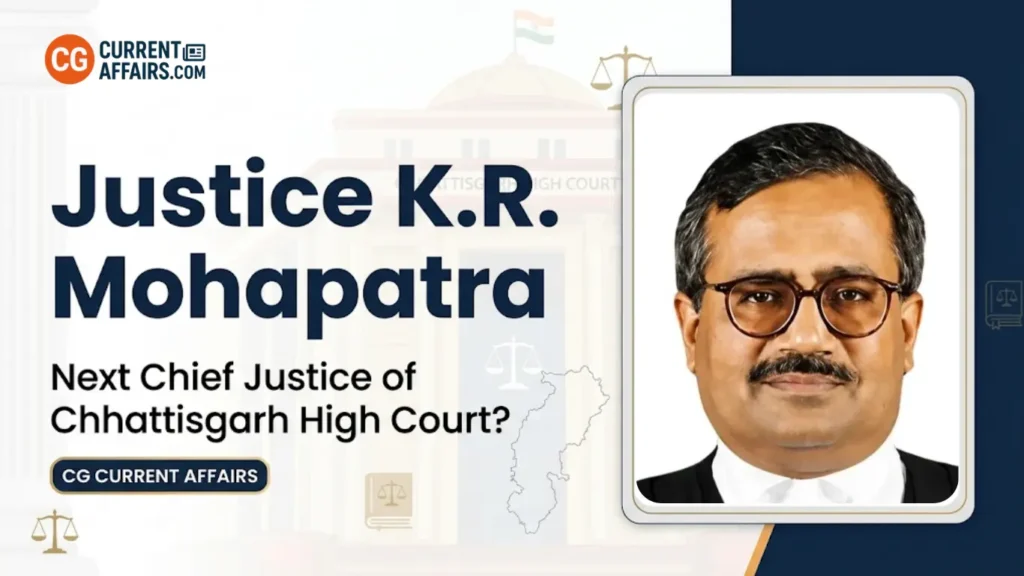
This article gives information about Justice K.R. Mohapatra, next Chief Justice of Chhattisgarh High Court, Supreme Court Collegium. It also explains the role of the Supreme Court Collegium, the constitutional provisions related to High Court appointments, and key facts relevant to CGPSC and CG Vyapam examinations.
The Supreme Court Collegium has recommended Justice Krishna Ram Mohapatra (K.R. Mohapatra), a senior judge of the Odisha High Court, for appointment as the next Chief Justice of the Chhattisgarh High Court.
The Collegium has also recommended the transfer of Justice Sanjay K. Agrawal, a senior judge of the Chhattisgarh High Court, for appointment as Chief Justice of the Rajasthan High Court.
Why in News?
The Supreme Court Collegium has made recommendations concerning the leadership of the Chhattisgarh and Rajasthan High Courts. Justice K.R. Mohapatra has been recommended for Chhattisgarh, while Justice Sanjay K. Agrawal has been recommended for Rajasthan.
Key Points
- Justice K.R. Mohapatra → Recommended as next Chief Justice of Chhattisgarh High Court.
- Present High Court: Odisha High Court.
- Justice Sanjay K. Agrawal → Recommended as Chief Justice of Rajasthan High Court.
- Present High Court: Chhattisgarh High Court.
- Collegium meeting for Justice Mohapatra: 6 August 2026.
- Collegium meeting for Justice Agrawal: 31 August 2026.
- Present Chhattisgarh High Court Chief Justice: Due to retire on 4 September 2026.
- The recommendations will be followed by the prescribed constitutional and governmental process before formal appointment.
Justice K.R. Mohapatra: Proposed Chief Justice of Chhattisgarh High Court
Justice Krishna Ram Mohapatra is a senior judge of the Odisha High Court with extensive experience in different branches of law. His recommendation for the Chhattisgarh High Court is significant for the judicial administration of the state.
Professional Background
Who is Krishna Ram Mohapatra?
- Justice Krishna Ram Mohapatra has had an extensive legal and judicial career spanning several decades.
- His experience in constitutional, civil, criminal and service matters is an important part of his professional profile and is relevant for understanding his proposed elevation as Chief Justice of the Chhattisgarh High Court.
Personal and Educational Details
- Name: Justice K.R. Mohapatra
- Date of Birth: 18 April 1965
- Educational Qualification: B.A., LL.B.
- Father: Late Justice Sarat Chandra Mohapatra
- Bar Council: Odisha State Bar Council
Legal Career
- Justice K.R. Mohapatra enrolled as an advocate with the Orissa State Bar Council on 7 February 1988.
- He subsequently gained around 26 years of experience at the Bar, appearing in matters involving several branches of law.
Areas of Legal Practice
His professional experience includes matters relating to:
- Civil law
- Service law
- Criminal law
- Constitutional law
- Guardians and Wards Act
- Hindu Minority and Guardianship Act
- Hindu Adoption and Maintenance Act
- Juvenile Justice (Care and Protection) Act
Professional Responsibilities
During his legal career, Justice K.R. Mohapatra also served in various professional capacities.
- Worked as Additional Standing Counsel for the State.
- Served as Additional Standing Counsel for the Odisha Public Service Commission.
- Represented Central Cooperative Banks Limited, Keonjhar.
- Appeared for the National Institute of Open Schooling (NIOS) under the Ministry of Human Resource Development, Government of India.
- Represented Neelachal Ispat Nigam Limited.
- Appeared for Bank of Baroda and other institutions.
Elevation to the High Court
- Justice K.R. Mohapatra was elevated as a Judge of the Orissa High Court on 17 April 2015.
- His elevation marked the transition from a long legal career at the Bar to the Bench, adding extensive courtroom and legal experience to his judicial career.
Career Timeline
18 April 1965
→ Born
B.A., LL.B.
→ Completed legal education
7 February 1988
→ Enrolled as Advocate with Orissa State Bar Council
1988 onwards
→ Practised across various branches of law
17 April 2015
→ Elevated as Judge of the Orissa High Court
6 August 2026
→ Supreme Court Collegium recommended him as the next Chief Justice of Chhattisgarh High Court.
Also read: CG’s Prabhtej Singh Bhatia becomes BCCI Joint Secretary
List of Chief Justices of Chhattisgarh High Court
| No. | Chief Justice | Tenure |
|---|
| 1 | Justice W. A. Shirsath | 2000–2002 |
| 2 | Justice K. P. N. Agrawal | 2002–2004 |
| 3 | Justice A. S. V. Murti | 2004–2005 |
| 4 | Justice Anang Kumar Patnaik | 2005 |
| 5 | Justice S. R. Nayak | 2005–2006 |
| 6 | Justice A. L. Dattu | 2007 |
| 7 | Justice Rajeev Gupta | 2008–2012 |
| 8 | Justice Yatindra Singh | 2012–2014 |
| 9 | Justice Navin Sinha | 2015–2016 |
| 10 | Justice Deepak Gupta | 2016–2017 |
| 11 | Justice T. B. Radhakrishnan | 2017–2018 |
| 12 | Justice Ajay Kumar Tripathi | 2018–2019 |
| 13 | Justice P. R. Ramachandra Menon | 2019–2021 |
| 14 | Justice Arup Kumar Goswami | 2021–2023 |
| 15 | Justice Ramesh Sinha | 2023–2026 |
| 16 | Justice K. R. Mahapatra | 7 September 2026–Present |
Justice Sanjay K. Agrawal: Recommended for Rajasthan High Court
Justice Sanjay K. Agrawal is a senior judge of the Chhattisgarh High Court. His recommendation as Chief Justice of the Rajasthan High Court is particularly significant for Chhattisgarh because of his strong professional and personal association with the state.
Background
- Born in Ratanpur, Chhattisgarh.
- Received his education in Bilaspur.
- Studied at:
- Guru Ghasidas University
- Pt. Ravishankar Shukla University
- Practised law before various judicial forums.
- Worked before the Bilaspur District and Sessions Court.
- Practised before the Madhya Pradesh High Court at Jabalpur.
- Practised before the Chhattisgarh High Court.
- Appointed as an Additional Judge of the Chhattisgarh High Court in 2013.
- Has significant experience in civil and constitutional matters.
Justice Sanjay K. Agrawal: Career Journey
Justice Agrawal’s judicial career reflects a strong connection with Chhattisgarh. His proposed move to another High Court represents the broader system of judicial transfers and leadership appointments in India’s higher judiciary.
Career Path
Ratanpur, Chhattisgarh
↓
Education in Bilaspur
↓
Legal Practice
↓
Additional Judge, Chhattisgarh High Court – 2013
↓
Senior Judge, Chhattisgarh High Court
↓
Recommended as Chief Justice of Rajasthan High Court
What Is the Supreme Court Collegium?
- The Supreme Court Collegium is the judicial mechanism through which recommendations for appointments and transfers in the higher judiciary are made.
- It has developed through a series of Supreme Court judgments rather than through a separate law enacted by Parliament.
Collegium system in India
- The Collegium is not expressly mentioned in the Constitution.
- It evolved through Supreme Court judgments.
- It plays an important role in:
- Appointment of judges
- Transfer of judges
- Appointment of Chief Justices
- Recommendations subsequently pass through the prescribed constitutional and governmental procedure.
- The formal appointment is made by the President of India.
Collegium System and High Court Appointments
The appointment of High Court judges has a constitutional foundation, while the present recommendation mechanism has evolved through judicial decisions.
For a High Court appointment, the process begins with the concerned High Court and subsequently moves through the Supreme Court Collegium and the Union Government before the formal appointment.
Key Points
- The Chief Justice of the concerned High Court initiates the proposal.
- The Chief Justice consults the two senior-most judges of the High Court.
- The recommendation is processed through the prescribed channels.
- The Supreme Court Collegium considers the proposal.
- The Union Government processes the recommendation.
- The President formally appoints the judge.
Appointment of High Court Judges: Constitutional Provision
Article 217 of the Constitution deals with the appointment and conditions of service of High Court judges. It provides the constitutional framework within which appointments are made.
Key Points
- High Court judges are formally appointed by the President of India.
- The President consults:
- Chief Justice of India
- Governor of the concerned State
- Chief Justice of the concerned High Court, where applicable
- The present Collegium mechanism operates within this broader constitutional framework.
- The Constitution itself does NOT contain the term “Collegium.”
Appointment of Chief Justices of High Courts
The appointment of a Chief Justice is part of the broader system of higher judicial appointments. The Supreme Court Collegium considers suitable candidates based on factors such as seniority, suitability, judicial experience and institutional requirements.
Key Points
- The Supreme Court Collegium makes the recommendation.
- Chief Justices are generally transferred or appointed from outside their parent High Court.
- This practice is intended to support:
- Judicial independence
- Institutional neutrality
- Impartial administration
- The recommendation is followed by the formal constitutional appointment process.
Role of the Chief Justice of a High Court
The Chief Justice is the administrative head of a High Court and has an important role in ensuring the effective functioning of the institution.
Major Responsibilities
- Administrative supervision of the High Court.
- Allocation of cases.
- Constitution of benches.
- Administrative coordination.
- Supervision of the High Court Registry.
- Monitoring judicial administration.
- Supporting efficient disposal of cases.
- Ensuring effective functioning of the court system.
Also read: Arun Kumar Pandey Appointed PCCF of Chhattisgarh
Evolution of the Collegium System
The Collegium system evolved through three landmark Supreme Court decisions commonly referred to as the Judges Cases. These cases are particularly important for CGPSC Polity preparation.
First Judges Case — 1981
The S.P. Gupta v. Union of India judgment is known as the First Judges Case. It dealt with the respective roles of the Executive and Judiciary in judicial appointments.
Key Points
- The judgment gave greater weight to the role of the Executive.
- The CJI’s opinion did not have absolute primacy.
- The Executive could differ from judicial recommendations under certain circumstances.
- This position was subsequently changed by later judgments.
Second Judges Case — 1993
The Supreme Court Advocates-on-Record Association v. Union of India case fundamentally changed the appointment mechanism and laid the foundation for the Collegium system.
Key Points
- Greater importance was given to the Judiciary in appointments.
- “Consultation” was interpreted in a manner that strengthened judicial concurrence.
- The Collegium system emerged from this judgment.
- The CJI’s opinion was treated as an institutional opinion.
- The CJI was required to consult senior Supreme Court judges.
Third Judges Case — 1998
The Third Judges Case arose from a Presidential Reference seeking clarification regarding the earlier judgments.
Key Points
- The Supreme Court further clarified the Collegium system.
- The Collegium for Supreme Court appointments consists of:
- CJI
- Four senior-most Supreme Court judges
- It strengthened collective decision-making.
- The judgment provided greater clarity regarding consultation and judicial appointments.
High Court Collegium
At the High Court level, the initial recommendation is made by the Chief Justice of the concerned High Court in consultation with senior colleagues.
Key Points
- High Court Collegium:
- Chief Justice of the High Court
- Two senior-most judges
- It considers candidates for appointment as High Court judges.
- Recommendations are forwarded for consideration by the Supreme Court Collegium.
- The process ultimately leads to formal appointment by the President.
Why Are High Court Transfers Important?
The transfer of judges between High Courts is an established feature of the higher judicial system. It can help meet institutional requirements and strengthen judicial independence.
Major Objectives
- Maintain judicial independence.
- Reduce the possibility of local influence.
- Bring varied judicial experience to different High Courts.
- Meet administrative and institutional requirements.
- Facilitate leadership changes.
- Strengthen the functioning of High Courts.
The recommendation of Justice Sanjay K. Agrawal for Rajasthan illustrates how a senior judge from one High Court can be considered for leadership of another High Court.
Ad-hoc Judges of High Courts
The Constitution also provides a mechanism for using the experience of retired judges to deal with the workload of High Courts. Article 224A deals with the appointment of retired judges as ad-hoc judges.
Key Points
- Article 224A relates to retired judges serving as ad-hoc judges.
- The Chief Justice of a High Court may request a former judge to sit and act as a judge.
- Previous consent of the President is required.
- The person must have previously served as a judge of:
- The concerned High Court, or
- Another High Court.
- The provision can help address case pendency.
Importance of Judicial Independence
The Collegium system is closely linked with the principle of judicial independence. Its supporters argue that giving senior judges a central role in appointments helps limit excessive executive influence over the higher judiciary.
Key Points
- Protects judicial independence.
- Limits direct political influence.
- Gives experienced judges a role in judicial selection.
- Promotes institutional decision-making.
- Strengthens the autonomy of the higher judiciary.
At the same time, the system continues to generate debate over transparency, accountability and representation.
Major Issues Associated with the Collegium System
While the Collegium system is intended to safeguard judicial independence, its functioning has been debated on several grounds.
- 1. Delay in Appointments
- Delays in filling judicial vacancies can increase the workload of serving judges.
- Vacancies can affect the speed of justice delivery.
- Delayed appointments contribute to pressure on existing judges.
- Timely recommendations can improve judicial efficiency.
- 2. Transparency
- Transparency remains one of the major areas of debate surrounding the Collegium.
- Selection criteria may not always be fully visible.
- Reasons behind individual recommendations may attract public discussion.
- Greater institutional disclosure can improve public confidence.
- 3. Accountability
- The relatively closed nature of Collegium deliberations raises questions about accountability.
- There is debate over the appropriate level of external scrutiny.
- Conflict-of-interest safeguards are important.
- Institutional checks can improve credibility.
- 4. Representation
- The composition of the higher judiciary is also discussed from the perspective of social and regional representation.
- Diversity within the judiciary is important.
- Gender representation is an important consideration.
- Wider representation can strengthen public confidence.
- 5. Judicial Vacancies
- Vacancies in High Courts can affect the overall efficiency of the justice delivery system.
- Fewer judges increase the workload.
- Vacancies can contribute to delays.
- Timely filling of sanctioned posts is essential.
- 6. Pendency of Cases
- The large number of pending cases remains a major challenge for India’s judicial system.
- Adequate judicial strength can help reduce pendency.
- Case management and procedural reforms are also required.
- Technology and alternative dispute resolution can complement judicial reforms.
Chhattisgarh High Court: Important Facts
The Chhattisgarh High Court is the highest judicial institution at the State level for Chhattisgarh and is located in Bilaspur.
Key Facts
- High Court: Chhattisgarh High Court
- Location: Bilaspur
- State: Chhattisgarh
- Jurisdiction: State of Chhattisgarh
- Current development: Justice K.R. Mohapatra recommended as next Chief Justice.
- Justice in transfer news: Justice Sanjay K. Agrawal.
- Proposed destination: Rajasthan High Court.
CGPSC Prelims Practice Questions
Q1. Justice K.R. Mohapatra has been recommended for appointment as the Chief Justice of which High Court?
Odisha High Court
B. Rajasthan High Court
C. Chhattisgarh High Court
D. Madhya Pradesh High Court
Answer: C. Chhattisgarh High Court
Q2. Justice K.R. Mohapatra is associated with which High Court?
Odisha High Court
B. Chhattisgarh High Court
C. Rajasthan High Court
D. Jharkhand High Court
Answer: A. Odisha High Court
Q3. Justice Sanjay K. Agrawal has been recommended as Chief Justice of:
- Gujarat High Court
B. Rajasthan High Court
C. Odisha High Court
D. Madhya Pradesh High Court
Answer: B. Rajasthan High Court
CGPSC Mains Questions
Question 1
Discuss the role of the Supreme Court Collegium in the appointment and transfer of High Court judges. Explain its significance in the context of the recent recommendations concerning the Chhattisgarh High Court.
Question 2
Explain the constitutional framework governing the appointment of High Court judges in India with special reference to Article 217.
Conclusion
The recommendation of Justice K.R. Mohapatra as the next Chief Justice of the Chhattisgarh High Court is an important development in the state’s judicial administration. The simultaneous recommendation of Justice Sanjay K. Agrawal as Chief Justice of the Rajasthan High Court also highlights the broader system of judicial transfers and leadership appointments.