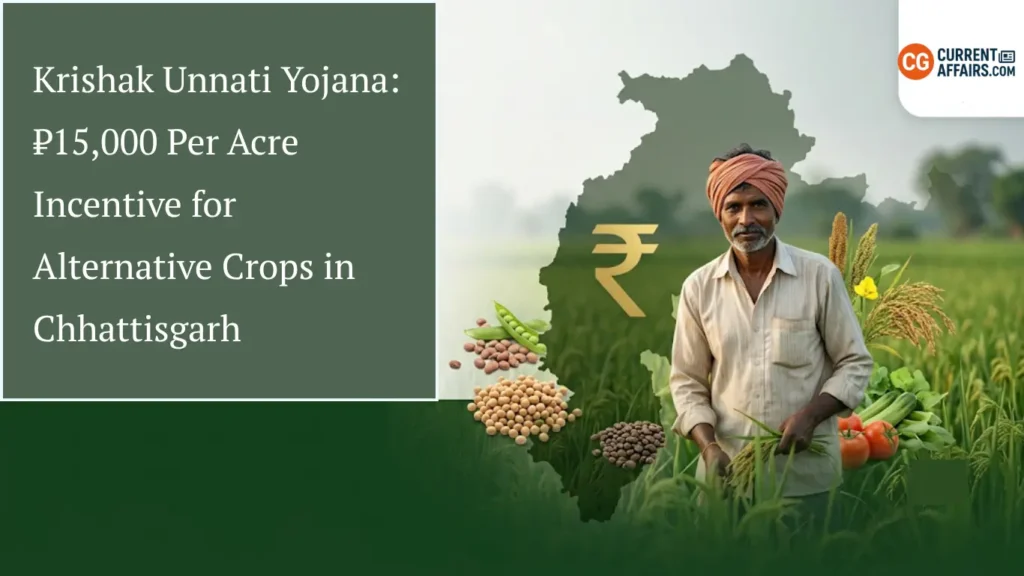
Chhattisgarh is one of India’s important rice-producing states, with paddy being a major kharif crop for farmers. However, excessive dependence on paddy can increase irrigation requirements, put pressure on groundwater resources and limit agricultural diversification.
To encourage farmers to shift from paddy to more water-efficient and economically beneficial crops, the Chhattisgarh Government has increased the incentive under the Krishak Unnati Yojana Chhattisgarh to ₹15,000 per acre for farmers who cultivate eligible alternative crops in place of paddy.
The decision particularly promotes pulses and oilseeds, along with other alternative crops. The policy aims to improve farm income while encouraging the conservation of groundwater and soil resources.
Why in news?
The Chhattisgarh Government has increased the incentive under the Krishak Unnati Yojana from ₹10,000 to ₹15,000 per acre for farmers replacing paddy with eligible alternative crops.
Key Points
- The scheme promotes pulses, oilseeds, maize, Kodo, Kutki, Ragi, cotton and other eligible crops.
- It aims to promote crop diversification, groundwater conservation, better soil health and higher farm income.
- Farmers must register through AgriStack and the Integrated Farmer Portal.
- A Digital Crop Survey will verify the crop and cultivated area.
- Assistance will be provided through Direct Benefit Transfer (DBT).
- For Kharif 2026, registration/modification is allowed up to 31 October 2026.
- Notified pulses and oilseeds will also receive MSP-based procurement under PM-AASHA.
What is the Krishak Unnati Yojana Chhattisgarh?
Krishonnati Yojana Chhattisgarh is an umbrella programme of the Ministry of Agriculture & Farmers Welfare aimed at strengthening agriculture and allied sectors, increasing farm productivity and improving farmers’ income.
Recently, the Union Cabinet approved the consolidation of various Centrally Sponsored Schemes (CSS) under the Ministry into two broad programmes:
- PM-RKVY: Focuses on sustainable agriculture.
- Krishonnati Yojana (KY): Focuses on food security and agricultural self-sufficiency.
Objectives
The main objectives of Krishonnati Yojana Chhattisgarh are to:
- Increase agricultural production and productivity.
- Improve farmers’ income and returns.
- Promote sustainable and scientific agriculture.
- Strengthen food security and agricultural self-sufficiency.
- Develop agriculture and allied sectors holistically.
Key Facts
Particular | Details |
Nodal Ministry | Ministry of Agriculture & Farmers Welfare |
Type | Umbrella programme |
Implemented | Since 2016–17 |
Focus | Food security and agricultural self-sufficiency |
Major Components
Important schemes and missions under Krishonnati Yojana include:
- Mission for Integrated Development of Horticulture (MIDH)
- National Food Security Mission (NFSM)
- National Mission for Sustainable Agriculture (NMSA)
- National Mission on Oilseeds and Oil Palm (NMOOP)
- Sub-Mission on Agricultural Mechanisation (SMAM)
- Sub-Mission on Agricultural Extension (SMAE)
- Sub-Mission on Seeds and Planting Material (SMSP)
- Integrated Scheme on Agricultural Marketing (ISAM)
- National e-Governance Plan in Agriculture (NeGP-A)
- Mission Organic Value Chain Development for North Eastern Region (MOVCDNER)
What Has Changed?
The major change announced under the scheme is the increase in incentive support for eligible alternative crops.
Aspect | Earlier | New Provision |
Incentive for eligible alternative crops replacing paddy | ₹10,000/acre | ₹15,000/acre |
Major focus | Crop diversification | Greater encouragement for crop diversification |
Payment method | Scheme-based assistance | DBT to eligible farmers |
Verification | Agricultural records | Digital Crop Survey + verified area |
The increase from ₹10,000 to ₹15,000 per acre provides an additional economic incentive to farmers considering a shift away from paddy.
Why Promote Alternative Crops Instead of Paddy?
Paddy is an important crop in Chhattisgarh, but its cultivation can require substantial water and other agricultural inputs.
Promoting alternative crops can therefore help address both economic and ecological concerns.
- Lower Irrigation Requirement
- Many pulses and oilseeds can be cultivated with comparatively lower irrigation requirements than paddy.
- This can reduce dependence on irrigation resources.
- Groundwater Conservation
- Reduced irrigation demand can contribute to the conservation of groundwater, particularly in areas where agricultural water use places pressure on groundwater reserves.
- Lower Production Costs
- Alternative crops with lower irrigation requirements can potentially reduce:
- Irrigation expenditure
- Energy costs
- Certain input costs
- This can improve farm profitability.
- Improvement in Soil Health
- Crop diversification can reduce the continuous cultivation of a single crop and can contribute to better soil management.
- Pulses are particularly significant because leguminous crops can contribute to soil nitrogen enrichment through biological nitrogen fixation.
- Increased Farm Income
- The combination of:
- Government incentive + crop diversification + lower resource requirements + market support
- Can potentially improve farmers’ economic returns.
Crops Covered Under the Diversification Approach
The policy promotes a range of alternative kharif crops.
Major crops in Krishak Unnati Yojana Chhattisgarh:
- Maize
- Kodo
- Kutki
- Ragi
- Pulses
- Oilseeds
- Cotton
Among these, pulses and oilseeds receive particular attention because they can contribute to both agricultural diversification and reduced water dependence.
Pulses and Oilseeds: Why Are They Important?
The promotion of pulses and oilseeds has significance beyond individual farm income.
Pulses
- Examples include crops such as:
- Pulses are important sources of protein and can contribute to nutritional security.
- They can also support soil fertility through biological nitrogen fixation.
Oilseeds
- Oilseed crops are important sources of edible oils.
- Greater domestic production can contribute to:
- Reducing dependence on imported edible oils.
- Increasing farmers’ income opportunities.
- Diversifying agricultural production.
- Therefore, encouraging pulses and oilseeds can have both state-level and national-level significance.
Digital Registration and Verification
- An important feature of the scheme is its reliance on digital agricultural records.
Mandatory registration
- Farmers seeking the benefit must be registered through:
- AgriStack
- Integrated Farmer Portal
- Farmers are required to visit their respective cooperative society for registration or necessary modifications within the prescribed period.
Kharif 2026 deadline
- For the Kharif 2026 season:
- 31 October 2026 is the deadline for new registration and necessary modifications.
Role of Digital Crop Survey
- The actual cultivated area and crop sown will be verified through a Digital Crop Survey.
- This provides a mechanism to establish:
- Farmer → Land area → Crop cultivated → Eligibility → Financial assistance
Why is digital verification important?
It can help:
- Improve transparency.
- Verify actual crop cultivation.
- Reduce errors in beneficiary identification.
- Link assistance to verified land and crop information.
- Strengthen DBT-based agricultural support.
Direct Benefit Transfer
- After verification, eligible farmers will receive input assistance directly into their bank accounts.
- Registration → Crop Sowing → Digital Crop Survey → Verification → Eligible Area Determination → DBT Payment
- The assistance will be calculated according to the validated/eligible area.
- This reduces dependence on intermediaries and strengthens transparency in benefit delivery.
PM-AASHA and MSP Support for Pulses and Oilseeds
- The incentive under Krishak Unnati Yojana CG is accompanied by an important market-support mechanism.
- Under the Pradhan Mantri Annadata Aay Sanrakshan Abhiyan (PM-AASHA), notified pulses and oilseeds will be procured at Minimum Support Price (MSP).
Also Read: Union Cabinet Raises wheat MSP to ₹2585 & National Pulses Mission
How does this help farmers?
- Farmers cultivating eligible notified crops can sell their produce at designated procurement centres.
- The sale proceeds will be transferred to the farmer’s bank account through DBT, subject to applicable eligibility and procurement provisions.
Combined support mechanism
- The policy therefore provides two important forms of support:
- 1. Production-side support:
- ₹15,000 per acre incentive for eligible alternative cultivation.
- 2. Market-side support:
- MSP-based procurement of notified pulses and oilseeds under PM-AASHA.
- This combination can reduce some of the financial risks associated with crop diversification.
Significance of the Policy
- Agricultural Diversification
- The policy encourages farmers to move from excessive dependence on a single crop towards a more diversified agricultural system.
- Lower-water-demand crops can reduce agricultural pressure on groundwater and irrigation resources.
- Crop diversification, particularly inclusion of pulses, can contribute to improved soil management.
- The direct incentive provides an additional financial benefit for farmers shifting to eligible alternative crops.
- Greater production of pulses can contribute to the availability of protein-rich food.
- Encouraging oilseeds can contribute to India’s broader objective of increasing domestic edible-oil production.
- Climate-Resilient Agriculture
- Crop diversification can make agricultural systems more resilient to changing rainfall patterns, water availability and other climate-related risks.
Economic and Environmental Linkage
The policy is significant because it attempts to connect farmer welfare with natural-resource conservation.
Economic dimension
- Financial incentive
- Lower input costs
- Alternative income opportunities
- MSP-based market support
Environmental dimension
- Groundwater conservation
- Reduced irrigation demand
- Better soil management
- Crop diversification
Thus, the policy can be viewed as an example of:
“Income support + Agricultural diversification + Resource conservation.”
Also Read: CG wins national award for “Best Sericulture State”
Challenges in Crop Diversification
Despite the increased incentive, shifting farmers from paddy to alternative crops may not be easy.
- Paddy has an established procurement and marketing ecosystem. Farmers may have greater uncertainty regarding alternative crops.
- Prices of pulses and oilseeds can fluctuate depending on production and market conditions.
- Procurement Infrastructure
- Adequate procurement centres and timely procurement are essential for making MSP support effective.
- Farmers need information about:
- Suitable crops
- Cultivation practices
- Expected returns
- Market availability
- Government support
- Seed and Input Availability
- Quality seeds and appropriate agricultural inputs must be available at the right time.
- Local Agro-Climatic Conditions
- Not every alternative crop is suitable for every region. Crop selection should consider:
- Soil type
- Rainfall
- Irrigation availability
- Temperature
- Local market demand
Krishonnati Yojana Chhattisgarh
The policy is highly relevant to Krishak unnati yojana cg 2026 because agriculture is closely linked with the state’s rural economy.
Key areas of relevance
- Agricultural economy:
- Crop diversification can create additional income opportunities.
- Water security:
- Reducing dependence on water-intensive crops can contribute to groundwater conservation.
- Soil health:
- Greater crop diversity can support sustainable soil management.
- Millets:
- Promotion of crops such as Kodo, Kutki and Ragi is also relevant to Chhattisgarh’s traditional agricultural practices and nutritional security.
- Farmer welfare:
- The ₹15,000-per-acre incentive provides direct financial support to eligible farmers.
- Digital agriculture:
- AgriStack, the Integrated Farmer Portal and Digital Crop Survey demonstrate the increasing use of technology in agricultural governance.
Way Forward
- Strengthen assured markets
- Alternative crops need reliable procurement and marketing mechanisms so that farmers do not face excessive price risk.
- Procurement centres for notified pulses and oilseeds should be accessible, timely and transparent.
- Provide crop-specific technical support
- Farmers should receive region-specific advice on seed selection, sowing, irrigation, pest management and harvesting.
- Processing units for pulses, oilseeds and millets can increase the value realised by farmers.
- Strengthen Farmer Producer Organisations
- FPOs can help farmers with:
- Collective procurement
- Storage
- Processing
- Marketing
- Better bargaining power
- Improve storage infrastructure
- Adequate warehouses and scientific storage can reduce post-harvest losses and distress sales.
- Use data for crop planning
- Digital agricultural databases and crop surveys can be used to develop better district-level crop diversification strategies.
Conclusion
The increase in Chhattisgarh Krishak Unnati Yojana incentive to ₹15,000 per acre aims to promote crop diversification in CG by encouraging pulses, oilseeds, maize, millets and cotton.
The initiative addresses water use, soil health and farm income, with MSP-based procurement, digital registration, Digital Crop Survey and DBT supporting implementation.
For long-term success, incentives need to be backed by assured markets, procurement, storage, processing and farmer awareness. Overall, the scheme promotes farmer welfare, crop diversification and sustainable agriculture.
CGPSC Prelims Practice Questions
Q1. Under the Krishak Unnati Yojana CG 2026, what incentive has been announced for eligible farmers replacing paddy with alternative crops?
- ₹5,000 per acre
B. ₹10,000 per acre
C. ₹15,000 per acre
D. ₹20,000 per acre
Answer: C. ₹15,000 per acre
Q2. Which of the following is the major objective of increasing the incentive under the Krishak Unnati Yojana CG 2026?
- Promote only wheat cultivation
B. Encourage crop diversification away from paddy
C. Eliminate all kharif crops
D. Promote only horticultural crops
Answer: B. Encourage crop diversification away from paddy
Q3. Consider the following statements:
- Registration through AgriStack is required to avail the scheme benefit.
- Digital Crop Survey will be used to verify cultivated area and crop.
- Eligible assistance will be transferred through DBT.
- Registration and modifications for Kharif 2026 are permitted up to 31 October 2026.
Which of the statements are correct?
- 1 and 2 only
B. 1, 2 and 3 only
C. 2, 3 and 4 only
D. 1, 2, 3 and 4
Answer: D. 1, 2, 3 and 4
CGPSC Mains Questions
Question 1
The promotion of alternative crops under the Krishak Unnati Yojana Chhattisgarh represents an attempt to balance farmer income with natural-resource conservation. Discuss.
Question 2
Explain the importance of crop diversification for sustainable agriculture in Chhattisgarh. What are the major challenges in shifting farmers from paddy to alternative crops?
Question 3
How can the combination of financial incentives, MSP procurement and digital agricultural systems strengthen crop diversification in Chhattisgarh?
Quick Revision
Topic | Key Fact |
Scheme | Krishak Unnati Yojana |
State | Chhattisgarh |
New Incentive | ₹15,000/acre |
Earlier Incentive | ₹10,000/acre |
Main Objective | Promote alternative crops instead of paddy |
Major Crops | Maize, Kodo, Kutki, Ragi, Pulses, Oilseeds, Cotton |
Key Focus | Crop Diversification |
Environmental Benefit | Groundwater & soil conservation |
Registration | AgriStack + Integrated Farmer Portal |
Verification | Digital Crop Survey |
Payment | DBT |
Kharif 2026 Deadline | 31 October 2026 |
Market Support | PM-AASHA |
MSP Procurement | Notified Pulses & Oilseeds |