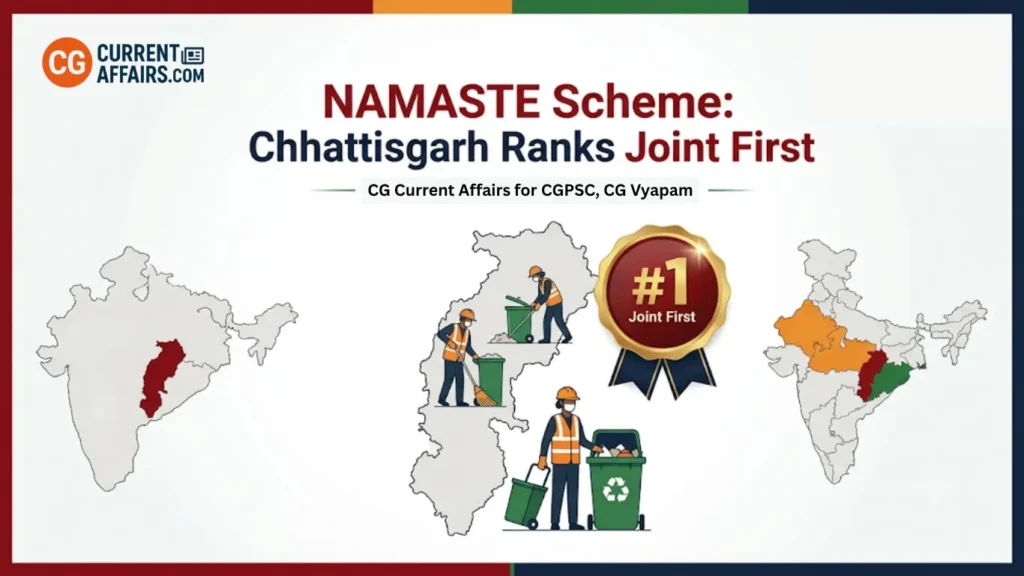
Chhattisgarh has achieved a major national-level milestone in the implementation of the Namaste Scheme Chhattisgarh, emerging jointly first in the country along with Andhra Pradesh, Odisha, Tripura, Uttar Pradesh and Puducherry. The achievement relates to the safety of sewer and septic tank workers and the mechanisation of sanitation work.
Under the Namaste Scheme Chhattisgarh, the state has surveyed 1,487 sewer and septic tank workers, of whom 1,465 have been verified. In 169 urban local bodies, 1,428 sanitation workers have received PPE kits, while 1,374 have been provided Ayushman Bharat cards. The state has also conducted occupational safety training and workshops for sanitation workers.
The achievement highlights Chhattisgarh’s efforts to replace hazardous manual sanitation work with mechanised sanitation, while improving the safety, health coverage, dignity and livelihood opportunities of sanitation workers.
Why in News?
- Chhattisgarh has been ranked joint first nationally for the implementation of the NAMASTE Scheme, highlighting its progress in sanitation-worker safety and mechanised sanitation.
- The state has made significant progress in worker profiling, verification, PPE distribution, health coverage, occupational-safety training and establishment of Emergency Response Sanitation Units (ERSUs).
Key Points
- National ranking: Chhattisgarh ranked joint first along with Andhra Pradesh, Odisha, Tripura, Uttar Pradesh and Puducherry.
- Workers surveyed: 1,487 sewer and septic tank workers.
- Workers verified: 1,465.
- Urban Local Bodies covered: 169.
- PPE kits: 1,428 sanitation workers provided PPE kits.
- Ayushman Bharat cards: 1,374 workers provided health coverage.
- Occupational safety training: 139 sanitation workers trained.
- Safety workshops: 923 sanitation workers covered.
- Emergency Response Sanitation Units (ERSUs): 47 established.
- ERSU safety kits: 39 units provided with safety kits.
- Emergency sanitation helpline: 14420.
- Main focus: Eliminating hazardous manual sanitation work through mechanisation, safety equipment, training and health protection.
- Scheme: National Action for Mechanised Sanitation Ecosystem (NAMASTE).
- Launch: 2023.
- Implementing agency: National Safai Karamcharis Finance & Development Corporation (NSKFDC).
- Key ministries: Ministry of Social Justice and Empowerment (MoSJE) and Ministry of Housing and Urban Affairs (MoHUA).
What Is the NAMASTE Scheme?
- The National Action for Mechanised Sanitation Ecosystem (NAMASTE) is a human-centred and rights-based initiative aimed at eliminating hazardous manual cleaning of sewers and septic tanks.
- The scheme was launched in 2023 as a Central Sector Scheme for three years, covering the period 2023–24 to 2025–26. It replaced the earlier Self-Employment Scheme for Rehabilitation of Manual Scavengers (SRMS).
- The programme covers more than 4,800 Urban Local Bodies (ULBs) across India.
- The Namaste Scheme Chhattisgarh implementation is therefore part of a broader national effort to ensure that sanitation work is carried out safely and with greater use of machines rather than direct human contact with human waste.
Objectives of the NAMASTE Scheme
The major objectives include:
- Eliminating hazardous manual cleaning of sewers and septic tanks.
- Ensuring the safety and dignity of sanitation workers.
- Providing PPE and safety equipment.
- Providing occupational safety training and skill development.
- Expanding health insurance coverage.
- Promoting mechanised sanitation.
- Formalising and profiling sanitation workers.
- Supporting sanitation entrepreneurship.
- Strengthening emergency response mechanisms.
- Creating sustainable livelihood opportunities.
The broader objective is to move towards zero deaths in sanitation work by improving safety standards and mechanisation.
Also Read: CG becomes first state to admit 100 laborer’s talented children in elite schools
Who Implements the NAMASTE Scheme?
The scheme is jointly associated with:
- Ministry of Social Justice and Empowerment (MoSJE)
- Ministry of Housing and Urban Affairs (MoHUA)
- National Safai Karamcharis Finance & Development Corporation (NSKFDC)
NSKFDC is responsible for implementing the scheme.
Major Components of the NAMASTE Scheme
1. Support for Sewer and Septic Tank Workers
The scheme provides several forms of support to sewer and septic tank workers, including:
- Digital profiling through mobile applications.
- Personal Protective Equipment (PPE) kits.
- Safety equipment.
- Occupational safety training.
- Skill development.
- Ayushman Bharat–PMJAY health coverage.
- Access to sanitation vehicles and equipment at subsidised rates.
- Support for sanitation entrepreneurship.
These interventions are particularly important for Chhattisgarh critical minerals? No — the focus here is entirely on sanitation worker safety and should not be confused with unrelated mineral-sector programmes.
2. Support for Waste Pickers
Waste pickers were added to the programme in 2024.
The component focuses on:
- Enumeration and profiling.
- Need-based PPE kits.
- Occupational safety and skill development.
- Ayushman Bharat–PMJAY coverage.
- Capital support for waste-collection vehicles.
- Sustainable livelihood projects.
This expansion makes the programme broader than only sewer and septic tank workers.
Emergency Response Sanitation Units in Chhattisgarh
- A significant part of the Namaste Scheme Chhattisgarh implementation is the creation of Emergency Response Sanitation Units (ERSUs).
- Chhattisgarh has established 47 ERSUs for responding to hazardous sanitation situations. Safety kits have already been provided to 39 units.
- The state has also established a 14420 helpline to facilitate rapid response to emergency sanitation requirements.
These units are important because hazardous sewer and septic tank situations may require immediate intervention, and trained personnel with appropriate equipment can reduce the risks faced by sanitation workers.
Training and Safety of Sanitation Workers
Worker safety is one of the central elements of the Namaste Scheme.
In Chhattisgarh, 139 sanitation workers have received occupational safety training, while workshops have been organised for 923 sanitation workers.
Training helps workers understand:
- Safe sanitation practices
- Use of PPE
- Operation of safety equipment
- Emergency response
- Occupational hazards
- Mechanised sanitation procedures
Thus, the Namaste Scheme Chhattisgarh approach combines technology, training, protective equipment and health coverage.
What Is Manual Scavenging?
Manual scavenging refers to the manual removal of human excreta from dry latrines, sewers, septic tanks, drains and other sanitation facilities under unsafe and degrading conditions.
It is prohibited under the Prohibition of Employment as Manual Scavengers and their Rehabilitation Act, 2013.
The legislation recognises manual scavenging as an inhuman practice and provides for prohibition of such employment and rehabilitation of affected persons.
NAMASTE Scheme and Sustainable Development Goals
The NAMASTE initiative is aligned with several United Nations Sustainable Development Goals (SDGs), particularly:
- SDG 6: Clean Water and Sanitation
- SDG 8: Decent Work and Economic Growth
- SDG 10: Reduced Inequalities
The programme therefore connects sanitation, occupational safety, social protection and inclusive development.
Why Is the NAMASTE Scheme Important for Chhattisgarh?
The success of the Namaste Scheme Chhattisgarh is important because sanitation workers often face serious occupational risks while cleaning sewer and septic tank systems.
Mechanisation can reduce direct human contact with hazardous waste and improve workplace safety.
For Chhattisgarh, the programme also supports:
- Better sanitation management in urban areas.
- Improved occupational safety.
- Wider health-insurance coverage.
- Professionalisation of sanitation work.
- Greater use of sanitation technology.
- Emergency response capacity.
- Dignity and social inclusion of sanitation workers.
The state’s joint-first national ranking indicates progress in implementing these measures.
Other Initiatives Related to Sanitation Workers
Several government initiatives and institutions have been associated with sanitation worker welfare, rehabilitation and sanitation management, including:
These initiatives complement the broader objective of improving sanitation, worker safety and livelihood opportunities.
Challenges in Eliminating Hazardous Sanitation Work
Despite progress, several challenges remain:
- Ensuring complete mechanisation of sanitation work.
- Preventing workers from entering hazardous spaces without adequate safety equipment.
- Expanding occupational safety training.
- Ensuring regular availability and use of PPE.
- Strengthening emergency response systems.
- Improving awareness among sanitation workers.
- Providing sustainable alternative livelihood opportunities.
- Ensuring effective implementation of legal safeguards.
Technology alone cannot solve the problem unless it is supported by training, enforcement, monitoring and social protection.
Way Forward
Chhattisgarh can build on its joint-first performance by expanding mechanised sanitation equipment, strengthening ERSUs, improving worker training and ensuring that every sanitation worker receives appropriate safety equipment and health coverage.
Greater emphasis should also be placed on digital worker profiling, preventive safety measures, emergency response and sanitation entrepreneurship.
The long-term goal should be to ensure that no worker has to enter a sewer or septic tank under hazardous conditions without appropriate mechanisation and safety arrangements.
Conclusion
The national joint-first ranking achieved by Chhattisgarh under the Namaste Scheme Chhattisgarh reflects the state’s progress in improving sanitation-worker safety and promoting mechanised sanitation.
The scheme goes beyond providing PPE kits. It combines worker identification, occupational training, health protection, mechanisation, emergency response and livelihood support.
For CGPSC aspirants, the development is important from the perspective of social justice, urban governance, sanitation, labour welfare and sustainable development.
CGPSC Prelims Quick Revision
- NAMASTE: National Action for Mechanised Sanitation Ecosystem
- Launch: 2023
- Initial duration: 2023–24 to 2025–26
- Focus: Mechanised sanitation and sanitation-worker safety
- Implementing ministries: MoSJE and MoHUA
- Implementing agency: NSKFDC
- Chhattisgarh ranking: Joint first nationally
- Workers surveyed: 1,487
- Workers verified: 1,465
- Urban Local Bodies: 169
- PPE kits provided: 1,428 workers
- Ayushman Bharat cards: 1,374 workers
- ERSUs in Chhattisgarh: 47
- Emergency helpline: 14420
- Manual scavenging law: Prohibition of Employment as Manual Scavengers and their Rehabilitation Act, 2013
CGPSC Mains Practice Question
- Discuss the significance of the NAMASTE Scheme in eliminating hazardous sanitation work and improving the dignity and safety of sanitation workers in Chhattisgarh.