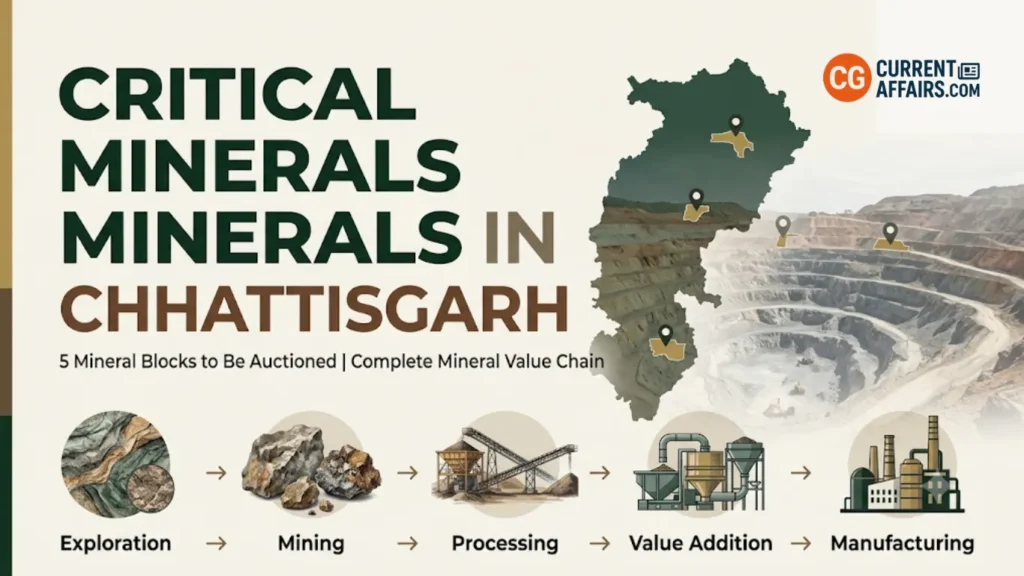
The Centre has included five mineral blocks from Chhattisgarh in the 8th tranche of the auction of critical and strategic mineral blocks. The development was highlighted during a roadshow organised by the Ministry of Mines in Raipur on 31 August 2026.
The 8th tranche includes 20 mineral blocks across nine states, of which 17 are Composite Licence blocks and three are Mining Lease blocks. The minerals covered include graphite, rare earth elements (REE), rare metals, vanadium, gallium, titanium, molybdenum, tungsten, potash, phosphorite and glauconite.
This topic covers critical minerals in chhattisgarh, the development is significant for Chhattisgarh because the state already has an important mineral-based economy and is now emerging as a potential contributor to India’s supply of minerals considered strategically important for clean energy, advanced technology, defence and domestic manufacturing.
Why in News?
Critical Minerals in Chhattisgarh are in the news following the roadshow organised by the Ministry of Mines in Raipur on 31 August 2026 for the 8th tranche of the auction of The Central Government has introduced dedicated auctions of critical mineral blocks in Chhattisgarh.
Key points
- Venue: Raipur, Chhattisgarh
- Date: 31 August 2026
- Organised by: Ministry of Mines
- Total blocks in 8th tranche: 20
- States covered: 9
- Blocks in Chhattisgarh: 5
- Types of blocks: 17 Composite Licence and 3 Mining Lease
- Minerals covered in the tranche: Graphite, Rare Earth Elements (REE), Rare Metals, Vanadium, Gallium, Titanium, Molybdenum, Tungsten, Potash, Phosphorite and Glauconite.
- The Centre has so far offered 88 Critical and Strategic Mineral Blocks, of which 56 had been successfully auctioned, according to the Ministry of Mines Secretary at the Raipur roadshow.
What are Critical Minerals?
Critical minerals are minerals that are considered essential for a country’s economic development, technological progress and national security, while their supply can be vulnerable because of limited availability, geographical concentration or dependence on imports.
Their criticality is generally assessed using two major factors:
1. Economic Importance
It considers how important a mineral is for important industries and what would happen if its supply were disrupted.
2. Supply Risk
It considers factors such as:
- Concentration of global production.
- Dependence on imports.
- Geographical concentration of resources.
- Trade restrictions.
- Political and environmental risks in supplier countries.
- Availability of substitutes.
Why are Critical Minerals Important?
1. Clean Energy Transition
Critical minerals are essential for technologies such as:
- Electric vehicle batteries
- Solar photovoltaic systems
- Wind turbines
- Energy storage systems
- Advanced batteries
They are therefore closely linked with India’s energy-transition goals.
2. Electric Vehicles
Minerals such as lithium, graphite, nickel and cobalt are important in battery technologies.
Therefore, the availability of these minerals is closely connected with the expansion of electric mobility.
3. Electronics and Digital Technologies
Critical minerals are used in:
- Semiconductors
- Smartphones
- Telecommunications equipment
- Electronic components
- Advanced computing technologies
This makes mineral security an important component of digital and technological security.
4. Defence and Strategic Applications
Several critical minerals are used in:
- Aerospace equipment
- Missiles
- Defence electronics
- Advanced alloys
- Radar and communication systems
- Nuclear and strategic technologies
Consequently, dependence on external sources can create strategic vulnerabilities.
5. Industrial Development
Critical minerals are important inputs for advanced manufacturing and emerging industries.
Their availability can support the development of domestic manufacturing capabilities and reduce India’s vulnerability to global supply-chain disruptions.
India’s Critical Mineral List
A Ministry of Mines committee undertook a detailed assessment of minerals critical to India.
The assessment involved:
- Studying critical-mineral strategies of countries such as Australia, the United States, Canada, the UK, Japan and South Korea.
- Consulting different ministries and government departments.
- Conducting statistical analysis involving factors such as import reliance, substitutability and cross-cutting industrial use.
The assessment identified 30 minerals as critical for India, including two minerals classified as critical fertilizer minerals.
Separately, through amendments to the Mines and Minerals (Development and Regulation) Act, 1957, the Central Government notified 24 minerals as Critical and Strategic Minerals for the purpose of central auction powers.
Important critical minerals in India
The Indian list includes minerals such as:
- Lithium
- Cobalt
- Graphite
- Nickel
- Rare Earth Elements
- Tin
- Tungsten
- Vanadium
- Niobium
- Tantalum
- Gallium
- Germanium
- Molybdenum
- Platinum Group Elements
- Titanium
- Silicon
- Selenium
- Tellurium
- Potash
- Phosphorus
Also Read: Types of minerals in CG
Critical Minerals in Chhattisgarh
Chhattisgarh is traditionally one of India’s important mineral-producing states. Its importance is now expanding from conventional minerals towards critical and strategic minerals.
1. Lithium
Lithium is one of the most strategically important minerals because of its use in:
- Electric vehicle batteries
- Rechargeable batteries
- Energy storage
- Electronics
- Ceramics and glass
- Lubricants
Katghora Lithium and REE Block
The Katghora Lithium and Rare Earth Elements (REE) Block in Korba district is particularly important.
According to Ministry of Mines block information:
- Location: Katghora-Guchapur
- Tehsil: Katghora
- District: Korba
- Area: 256.12 hectares
- Exploration stage: G-4 reconnaissance survey
- Exploration agency: Geological Survey of India, Chhattisgarh State Unit, Central Region, Raipur
- The block has been identified for Lithium and Rare Earth Elements.
The geological investigation reported anomalous lithium values in stream-sediment samples and lithium-bearing characteristics in granitoids and pegmatites. The block is therefore important from an exploration perspective, although exploration-stage findings should not be treated as established commercial reserves.
Historical significance
- GSI exploration in the Katghora-Garhatara area of Korba had earlier identified potential for lithium and rare metals at the G-4 stage.
2. Rare Earth Elements (REE)
Rare Earth Elements are a group of elements that have applications in:
- Permanent magnets
- Electric vehicle motors
- Wind turbines
- Electronics
- Defence equipment
- Aerospace
- Renewable energy technologies
The Katghora block is significant because it combines lithium and REE potential.
The Ministry of Mines’ geological information for the block has identified REE-bearing phases including minerals such as monazite and xenotime, along with other REE-related indications.
3. Graphite
Graphite is important for:
- Lithium-ion batteries
- Battery anodes
- Fuel cells
- Lubricants
- Advanced manufacturing
Chhattisgarh is increasingly being included in national critical-mineral exploration and auction activities involving graphite.
The state’s growing graphite potential is significant because battery manufacturing requires secure supplies of suitable graphite.
4. Tin
Tin is an important critical mineral and Chhattisgarh has a notable association with tin production.
The Ministry of Mines’ critical-mineral report records tin production in Chhattisgarh in the form of concentrates and metal, including production by CMDC and Precision Minerals & Smelting in Dantewada.
Tin is used in:
- Soldering
- Electronics
- Metal packaging
- Lead-acid batteries
- Industrial applications
Chhattisgarh significance
The state is especially important because its tin resources and production are concentrated in the Bastar region, making tin an important part of Chhattisgarh’s critical-mineral profile.
5. Columbite and Rare Metals
Chhattisgarh is also exploring the potential of columbite from tin-bearing resources.
Columbite is significant because it can contain niobium and tantalum, both of which have strategic applications.
At the August 2026 Raipur roadshow, the Chhattisgarh Mineral Development Corporation (CMDC) highlighted exploration of critical minerals such as columbite.
Applications of niobium and tantalum
They are used in areas including:
- Advanced alloys
- Aerospace
- Electronics
- Capacitors
- Defence technologies
- Superconducting applications
Thus, Chhattisgarh’s tin-bearing resources may have importance beyond tin production alone.
6. Graphite and Vanadium
Chhattisgarh also features in national critical-mineral auction activity involving graphite and vanadium.
The Oranga Revatipur Graphite & Vanadium Block in Chhattisgarh was offered under the critical-mineral auction process, with Coal India emerging as the preferred bidder under the relevant tranche.
Importance of vanadium
Vanadium is used in:
- High-strength steel
- Aerospace applications
- Defence equipment
- Energy-storage technologies
- Special alloys
This makes the combination of graphite and vanadium strategically relevant for both industrial and clean-energy applications.
Also Read: Chhattisgarh boosts mining with 29 new projects
Chhattisgarh and the 8th Tranche of Critical Mineral Auctions
The latest development further strengthens Chhattisgarh’s position.
The 8th tranche consists of:
- 20 blocks
- 17 Composite Licence blocks
- 3 Mining Lease blocks
- Spread across 9 states
- 5 blocks located in Chhattisgarh
The broader mineral portfolio includes graphite, REE, rare metals, vanadium, gallium, titanium, molybdenum, tungsten, potash, phosphorite and glauconite.
The Raipur roadshow focused on:
- Greater investment
- Faster exploration
- Mineral-block operationalisation
- Private-sector participation
- Transparent auctions
- Processing and refining
- Value addition
- Stronger domestic supply chains
Why Chhattisgarh is Important for Critical Minerals?
Chhattisgarh has several advantages that can support the development of a critical-mineral ecosystem.
- 1. Strong Mineral Base
- The state already has substantial experience in mineral exploration and mining.
- 2. Existing Industrial Infrastructure
- Its established mining and industrial ecosystem can support the development of new mineral value chains.
- 3. Geological Potential
- Areas of the state have shown potential for lithium, REE, graphite, tin and associated rare metals.
- 4. Existing Tin Production
- The state already has an established tin-mineral ecosystem, particularly in southern Chhattisgarh.
- 5. Exploration Opportunities
- GSI and other agencies are undertaking exploration for critical and strategic minerals.
- 6. Connectivity and Skilled Workforce
- The state’s existing infrastructure and industrial workforce can provide a foundation for further mineral-based industrial development.
The Union and state governments have emphasised the need to move beyond extraction towards processing, refining and value addition.
Five Pillars of the Critical Mineral Value Chain
A strong critical-mineral ecosystem cannot depend only on mining.
The complete value chain includes:
- 1. Geoscience and Exploration
- Identification of deposits through geological surveys, mapping and exploration.
- 2. Mineral Extraction
- Mining of identified resources using appropriate technologies.
- 3. Intermediate Processing
- Beneficiation, separation and refining of mineral resources.
- 4. Advanced Manufacturing
- Conversion of processed minerals into high-value industrial products.
- 5. Recycling
- Recovery of critical minerals from used batteries, electronics and industrial waste.
Environmental and Social Concerns
Critical minerals in Chhattisgarh development can generate economic opportunities, but mining must be balanced with environmental and social considerations.
Major concerns
- Deforestation
- Land degradation
- Water consumption
- Waste generation
- Biodiversity loss
- Displacement of local communities
- Impact on tribal livelihoods
- Pollution from processing activities
This is particularly important in Chhattisgarh because several mineral-rich areas overlap with forest and tribal regions.
Therefore, critical-mineral in Chhattisgarh development should follow the principles of:
Economic development + Environmental protection + Community participation
Critical Minerals in Chhattisgarh and Tribal Communities
Chhattisgarh’s mineral-bearing regions include areas with significant tribal populations.
The development of critical minerals can create:
- Local employment
- Infrastructure
- Skill-development opportunities
- New industrial activities
- Government revenue
However, benefits must reach local communities.
The state has also highlighted transparent benefit distribution to tribal tin collectors through its TIN Portal, along with technology-based mineral monitoring.
Critical Minerals and Atmanirbhar Bharat
India imports several critical minerals or processed products because domestic production is insufficient for demand.
Therefore, strengthening domestic mineral resources can help:
- Reduce import dependence.
- Strengthen strategic autonomy.
- Support domestic manufacturing.
- Secure supply chains.
- Promote clean-energy technologies.
- Improve defence preparedness.
The critical minerals in chhattisgarh strategy is consequently linked with the broader objective of Atmanirbhar Bharat.
Challenges for Chhattisgarh
Despite its potential, Chhattisgarh faces several challenges.
- 1. Exploration Risk
- Several resources are still at exploration stages, and geological potential does not automatically mean commercially recoverable reserves.
- 2. Limited Processing Capacity
- Mining alone does not create maximum economic value. Advanced processing and refining capabilities are essential.
- 3. Environmental Sensitivity
- Many mineral-bearing areas are ecologically sensitive.
- 4. Tribal and Community Concerns
- Mining projects need meaningful participation of local communities and protection of legitimate rights.
- 5. Technology Gap
- Extraction and processing of some critical minerals require advanced technologies.
- 6. Global Price Volatility
- Critical-mineral markets can be affected by geopolitical tensions, technological changes and international price fluctuations.
Government Initiatives for Critical Minerals
National-level measures
- MMDR Amendment
- The MMDR Amendment Act, 2023 empowered the Central Government to auction 24 critical and strategic minerals under the relevant provisions of the Act.
- Mineral Auctions
- The Central Government has introduced dedicated auctions of critical mineral blocks in Chhattisgarh and other states.
- Exploration Licences
- A new Exploration Licence has been introduced for deep-seated minerals, including several critical minerals, to encourage exploration.
- Private-sector Exploration
- The MMDR framework has also enabled greater participation of private exploration agencies.
Way Forward
- 1. Increase Exploration
- Chhattisgarh should accelerate scientific exploration of lithium, REE, graphite, rare metals and other critical minerals.
- 2. Focus on Value Addition
- The state should encourage mineral processing, refining and downstream manufacturing instead of exporting raw materials.
- 3. Build Critical-Mineral Industries
- Processed critical minerals can support industries such as:
- Battery manufacturing
- Electronics
- Renewable energy
- Defence equipment
- Advanced materials
- 4. Strengthen Research and Development
- Universities, research institutions, mining companies and government agencies should collaborate on exploration and processing technologies.
- 5. Protect the Environment
- Mining should follow strict environmental safeguards, particularly in forest and biodiversity-rich areas.
- 6. Ensure Tribal Participation
- Local communities should receive employment, livelihood and development benefits from mineral projects.
- 7. Promote Recycling
- Recycling of batteries, electronics and industrial waste can reduce pressure on primary mineral resources.
- 8. Develop an Integrated Value Chain
- The long-term objective should be to establish:
- Exploration → Extraction → Processing → Refining → Manufacturing → Recycling
- within a stronger domestic ecosystem.
Conclusion
Critical minerals are becoming increasingly important for India’s economic security, technological development, energy transition and national security.
For Chhattisgarh, the emergence of lithium, REE, graphite, tin and associated rare-metal potential provides an opportunity to diversify its traditional mineral economy.
The Katghora Lithium and REE Block in Korba, existing tin production in the Bastar region, exploration of columbite and the inclusion of five Chhattisgarh blocks in the 8th tranche of critical and strategic mineral auctions demonstrate the state’s growing role in India’s critical-mineral strategy.
However, the real benefit will come only when the state moves beyond extraction towards processing, refining, value addition, manufacturing and recycling. At the same time, environmental protection and the interests of tribal and local communities must remain central to mineral development.
CGPSC Prelims Practice Questions
Q1. Consider the following statements about critical minerals:
- They are important for economic development and national security.
- Their criticality is influenced by economic importance and supply risk.
- Their importance is limited only to the mining sector.
Which of the statements given above is/are correct?
- 1 only
B. 1 and 2 only
C. 2 and 3 only
D. 1, 2 and 3
Answer: B. 1 and 2 only
Q2. The Katghora Lithium and REE Block is located in which district of Chhattisgarh?
- Dantewada
B. Korba
C. Bastar
D. Surguja
Answer: B. Korba
Q3. Which of the following minerals are associated with the Katghora block?
- Lithium and Rare Earth Elements
B. Coal and Iron Ore
C. Gold and Copper
D. Uranium and Thorium
Answer: A. Lithium and Rare Earth Elements
Q4. Consider the following pairs:
Mineral | Major Application |
1. Lithium | Electric vehicle batteries |
2. Graphite | Battery anodes |
3. Rare Earth Elements | Permanent magnets |
4. Tin | Electronics and soldering |
Which of the above pairs are correctly matched?
- 1 and 2 only
B. 1, 2 and 3 only
C. 2, 3 and 4 only
D. 1, 2, 3 and 4
Answer: D. 1, 2, 3 and 4
CGPSC Mains Questions
Question 1
What are critical minerals? Explain their importance for India’s economic and strategic security. Discuss the emerging role of Chhattisgarh in India’s critical-mineral ecosystem.
Question 2
Chhattisgarh’s mineral economy is gradually expanding from conventional minerals towards critical and strategic minerals. Discuss the opportunities and challenges associated with this transition.
Question 3
Discuss the significance of lithium, rare earth elements, graphite and tin for Chhattisgarh’s future industrial development.