
CGPSC Preparation 2027: Complete Strategy, Study Plan & Preparation Guide
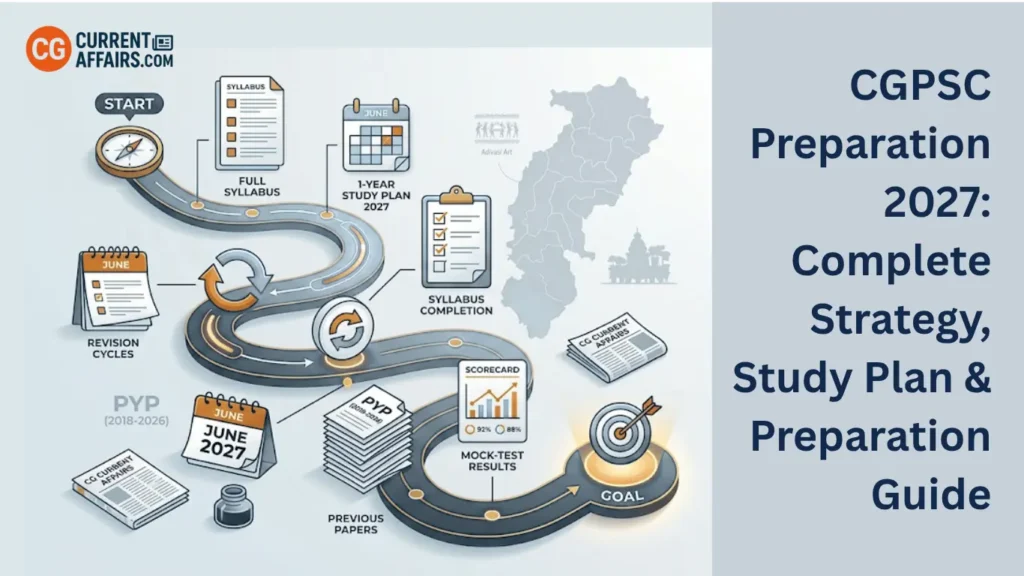
How to Start Your CGPSC Preparation in 2027?
Most CGPSC aspirants don’t struggle because they lack effort — they struggle because they don’t know where to begin, what to prioritise, or how to turn months of reading into exam-ready answers. You open the syllabus, feel overwhelmed, pick up a few books, and a month later you’re still not sure if you’re actually “preparing” or just consuming information.
A structured strategy fixes this. It tells you what to study first, how much time each subject deserves, when to start Chhattisgarh current affairs and answer writing, and how to convert your effort into results you can measure through CGPSC PYQs and mock tests.
This guide is built as a complete roadmap for CGPSC preparation 2027 — from your very first week to your final 30 days before the exam. It covers the exam pattern and syllabus, a full 1-year study plan, subject-wise strategy for Prelims and Mains, Chhattisgarh GK and Daily current affairs for Chhattisgarh, note-making, revision, answer writing, mock test analysis, and separate approaches for beginners, working professionals, and college students.
One important note before you begin: exam dates, vacancies, eligibility criteria, and any syllabus or pattern changes for the CGPSC 2027 cycle have not been officially announced at the time of writing. Wherever this guide refers to exam-specific details, treat them as general patterns based on how CGPSC has historically conducted its exam, and always cross-check the latest figures against the official CGPSC notification before you rely on them.
Table of Contents
- CGPSC Preparation 2027: Where to Start?
- What Is the CGPSC Exam?
- CGPSC 2027 Exam Pattern and Selection Process
- CGPSC 2027 Syllabus: What You Need to Study
- How to Prepare for CGPSC 2027
- CGPSC Preparation Strategy for Beginners
- CGPSC 1-Year Preparation Strategy
- CGPSC Study Plan: Month-by-Month
- CGPSC Prelims Preparation Strategy
- CGPSC Paper 1 Preparation
- CGPSC Paper 2 / Aptitude Preparation
- Chhattisgarh GK Preparation Strategy
- Current Affairs Preparation for CGPSC
- CGPSC Mains Preparation Strategy
- How to Start CGPSC Mains Answer Writing
- How to Make Effective CGPSC Notes
- Best Books for CGPSC Preparation
- How to Use CGPSC Previous Year Papers
- CGPSC Mock Tests and Test Series Strategy
- CGPSC Revision Strategy
- Daily Study Timetable for CGPSC Aspirants
- CGPSC Preparation Strategy for Working Professionals
- CGPSC Preparation Strategy for College Students
- Common CGPSC Preparation Mistakes
- How Many Hours Should You Study for CGPSC?
- CGPSC Preparation in the Last 3 Months
- CGPSC Preparation in the Last 30 Days
- Final 1-Year CGPSC Preparation Roadmap
1. CGPSC Preparation 2027: Where to Start?
If you are starting from zero, do not open a book on day one. Spend your first week understanding the exam itself. Aspirants who skip this step end up re-studying the same topics repeatedly because they never had a map to begin with.
What a beginner should do in the first 7 days:
- Read the official CGPSC syllabus for Prelims and Mains line by line, not just skim it
- Go through at least 5 years of previous year question papers to see how topics are actually asked
- Shortlist 2-3 standard resources per subject instead of collecting everything available online
- Draft a rough weekly schedule that fits around your existing commitments (college, job, family)
- Honestly assess which subjects you’re already comfortable with and which are completely new to you
- Set up a simple system for notes and current affairs from day one, so you’re not retrofitting one later
- Start your first subject — ideally Chhattisgarh GK or History, since both are static and give early confidence
First 7 Days of CGPSC Preparation
Day | Focus | Action |
Day 1 | Understand the exam | Read about CGPSC’s structure, Prelims-Mains-Interview pattern, and selection process |
Day 2 | Syllabus | Print or save the full Prelims and Mains syllabus; do not summarise yet, just read |
Day 3 | PYQ analysis | Solve one full previous year Prelims paper without preparation, just to gauge the exam |
Day 4 | Resource shortlisting | Finalise 1-2 books/resources per subject; stop searching for “best” resources after this |
Day 5 | Self-assessment | List subjects you’re strong in, weak in, and completely new to |
Day 6 | Schedule design | Build a realistic weekly timetable based on your available hours, not an ideal one |
Day 7 | Start studying | Begin your first topic — Chhattisgarh History or Geography is a good starting point |
2. What Is the CGPSC Exam?
The Chhattisgarh Public Service Commission (CGPSC) conducts the State Service Examination to recruit candidates for various administrative and allied posts within the Chhattisgarh state government, such as Deputy Collector, DSP, and other Group A, B, and C services. The exam is conducted in three broad stages, following a pattern similar to other state PSC exams and the UPSC Civil Services Examination, but with a strong emphasis on Chhattisgarh-specific content.
The purpose of the exam is to select candidates who combine general administrative aptitude with a solid understanding of the state’s history, geography, economy, governance, and current issues. This is why CGPSC preparation cannot simply mirror UPSC preparation — a large portion of your score depends on how well you know Chhattisgarh specifically.
Broadly, the selection process moves through:
- Preliminary Examination (Prelims): An objective-type screening test used to shortlist candidates for Mains
- Main Examination (Mains): Descriptive, written papers that test depth of knowledge and answer-writing ability
- Interview/Personality Test: A final stage assessing suitability for administrative service
Understanding this full pipeline before you start studying matters because Prelims and Mains preparation are not the same activity. Prelims rewards speed, wide coverage, and objective accuracy. Mains rewards depth, structured writing, and the ability to connect facts with analysis. Preparing for both simultaneously, in the right proportion, is one of the biggest strategic decisions you’ll make — and it’s covered in detail in the sections ahead.
3. CGPSC 2027 Exam Pattern and Selection Process
CGPSC has historically followed a three-stage selection process: Prelims (objective type, generally with a General Studies paper and an Aptitude paper), Mains (multiple descriptive papers), and an Interview. Exact details such as the number of Mains papers, marks distribution, negative marking rules, and duration have varied across cycles and are periodically revised by the Commission.
Because the CGPSC 2027 notification has not yet been officially released, this guide will not state specific numbers for marks, question counts, negative marking, or paper duration. Treat the table below as a general description of how the exam has historically been structured, and always verify the exact CGPSC 2027 pattern from the official notification once released.
CGPSC Exam Pattern 2027
Stage | Nature | Purpose |
Prelims | Objective type, multiple papers including General Studies and Aptitude | Screening stage to shortlist candidates for Mains |
Mains | Descriptive, written papers covering GS, language, and optional/allied subjects as notified | Tests depth of knowledge, analytical ability, and answer writing |
Interview | Personal interview/personality test | Assesses administrative aptitude, awareness, and communication |
What you should do instead of guessing numbers: bookmark the official CGPSC website and check it directly when the 2027 notification is expected. Build your preparation around the general structure (Prelims → Mains → Interview) rather than around numbers that could change.
4. CGPSC 2027 Syllabus: What You Need to Study
Simply reading through the CGPSC syllabus 2027 document is not the same as being able to use it. The syllabus needs to be broken down into a working tool you can track against.
How to convert the syllabus into a usable framework:
- List every subject exactly as mentioned in the official CGPSC syllabus 2027 (e.g., Chhattisgarh History, Indian Polity, Geography, Economy, Science and Technology)
- Under each subject, break the syllabus line into specific topics (e.g., under “Chhattisgarh History,” list Ancient CG, Medieval CG, British-era CG, Freedom Movement in CG, Post-independence CG)
- Under each topic, note sub-topics you encounter while studying — this list grows as you go
- Mark which topics have appeared in previous year papers, and how frequently
- Add a revision-status column so you always know what’s fresh and what’s due for review
CGPSC Syllabus 2027 Tracker (Framework)
Subject | Topic | Sub-topics | Appeared in PYQs? | Study Status | Revision Status |
Chhattisgarh History | Ancient CG | Rock art, early dynasties | Yes – frequent | Not started | – |
Indian Polity | Fundamental Rights | Articles, landmark cases | Yes | In progress | Due |
Geography | Chhattisgarh Rivers | Mahanadi system, tributaries | Yes | Completed | Revised once |
Maintain this as a spreadsheet rather than on paper — it’s far easier to sort, filter, and update as your preparation progresses. Update the “Study Status” and “Revision Status” columns honestly; this tracker is only useful if it reflects reality.
5. How to Prepare for CGPSC 2027
CGPSC Preparation 2027 is not just reading. Aspirants who read a book three or four times but never test themselves often plateau, because recognition (feeling familiar with content) is very different from recall (being able to reproduce it under exam conditions).
A more reliable preparation cycle looks like this:
- Understand — Read the topic properly, from a reliable source, until the concept is clear
- Study — Make notes, mark important facts, connect the topic to the syllabus and any related current affairs
- Revise — Go back to your notes within a few days, not weeks, to consolidate memory
- Practice — Attempt PYQs and mock questions related to the topic to test actual recall
- Analyze — Review what you got wrong or couldn’t recall, and identify the exact gap
Repeating this five-step cycle for every topic — instead of just reading it once and moving on — is what separates aspirants who can answer PYQ-style questions from those who only “recognise” the content when they see it.
6. CGPSC Preparation Strategy for Beginners
Starting from zero is not a disadvantage if your early months are structured correctly. The biggest risk for beginners is trying to do everything at once — syllabus of CGPSC 2027, current affairs, answer writing, and mock tests — without a foundation.
- First month: Focus entirely on understanding the exam and CGPSC syllabus, and start with static, high-weightage subjects like Chhattisgarh GK and History. Begin a simple daily current affairs habit (30-45 minutes) so it becomes routine early, not something you scramble to catch up on later.
- First three months: Build foundational understanding across all major subjects. Don’t aim for depth yet — aim for a complete first pass so nothing feels unfamiliar. Start light note-making. Begin solving PYQs subject-wise as you finish each topic, purely to understand question patterns, not to test yourself seriously yet.
- Foundation phase (roughly months 1-4): Complete a first reading of the entire syllabus. This phase should feel like laying bricks — unglamorous but necessary.
- Consolidation phase (roughly months 5-7): Go deeper into each subject, connect static topics with current affairs, and start proper note revision.
- Revision phase (roughly months 8-10): Shift from learning new content to strengthening recall. Increase PYQ practice and begin sitting full-length mock tests.
- Practice phase (roughly months 11-12): Heavy PYQ and mock test practice, along with Mains answer writing, running in parallel with final revision.
- Common beginner mistakes: trying to make Mains-quality notes before finishing a basic first reading, jumping between resources out of comparison anxiety, ignoring Chhattisgarh-specific content in favour of generic material, and postponing answer writing until “the syllabus is complete” — which rarely happens on schedule.
7. CGPSC 1-Year Preparation Strategy
A 1-year timeline is workable for most aspirants if the phases are sequenced correctly and the plan stays realistic about how much can genuinely be absorbed each month. This is a framework to adapt to your own pace, not a rigid schedule to follow blindly.
- Phase 1 – Foundation (Months 1-2): Understand the syllabus and exam pattern deeply. Begin static subjects. Establish a daily current affairs habit.
- Phase 2 – Syllabus Completion (Months 3-6): Complete a first pass of the full syllabus across all subjects, including optional/allied subjects as applicable. Keep building notes and your syllabus tracker.
- Phase 3 – Revision + PYQs (Months 7-8): Revise everything covered so far. Solve subject-wise and full-length PYQs. Start identifying weak areas through this practice.
- Phase 4 – Prelims-Focused Preparation (Months 9-10): Shift primary focus to Prelims — objective practice, speed, accuracy, current affairs revision, and regular mock tests.
- Phase 5 – Mains-Focused Preparation (Months 10-12, overlapping with Prelims run-up and continuing after): Intensify answer writing, Mains-specific revision, and Mains-style mock tests, while keeping Prelims revision alive until the actual exam.
12-Month CGPSC Roadmap
Month | Main Focus | Subjects/Topics | Revision | PYQ/Test Practice |
1 | Foundation | Exam understanding, syllabus, CG History (early) | Light, topic-end only | Solve 1 old paper untimed |
2 | Foundation | CG Geography, Indian Polity basics | Weekly revision begins | Subject-wise PYQs |
3 | Syllabus completion | Indian Economy, CG Economy | Weekly | Subject-wise PYQs |
4 | Syllabus completion | Science & Tech, Environment | Weekly + monthly | Subject-wise PYQs |
5 | Syllabus completion | History (India), CG Culture & Tribes | Monthly consolidation | Mixed-topic PYQs |
6 | Syllabus completion | Remaining GS topics, Aptitude basics | Monthly | Mixed-topic PYQs |
7 | Revision + PYQs | Full syllabus revision round 1 | Structured revision cycle | Full previous papers, timed |
8 | Revision + PYQs | Weak-area focus | Active recall revision | Full previous papers, timed |
9 | Prelims focus | Current affairs consolidation, static revision | High-frequency revision | Prelims mock tests begin |
10 | Prelims focus + Mains start | Final Prelims revision; begin daily answer writing | Short notes only | Prelims mocks + first Mains answers |
11 | Mains focus | Answer writing across all GS papers | Mains-focused revision | Mains mock tests |
12 | Mains focus + final revision | Consolidation, mistake correction | Final short-notes revision | Full Mains mocks + PYQ recall |
Adjust the pace based on your starting point — a repeat candidate with an existing base may compress Phases 1-2, while a first-time beginner may need to extend them slightly and shorten the buffer in Phase 5.
8. CGPSC Study Plan: Month-by-Month
The month-by-month structure above is a template, not a fixed rulebook. How you adapt it depends on your starting point:
- Beginners: Follow the roadmap closely, but don’t rush Phase 1. A rushed foundation causes problems in every later phase.
- Repeat candidates: You likely already have subject familiarity. Compress Phases 1-2 into 2-3 months and spend the extra time on PYQ-based revision, Mains answer writing, and fixing the specific weak areas that showed up in your last attempt.
- Working professionals: Stretch the same phases over more calendar time if needed rather than compressing your daily hours unrealistically — consistency across a longer timeline beats sporadic long study days.
- College students: Use semester breaks for concentrated syllabus completion (Phase 2) and regular weeks for lighter revision and current affairs, since exams and coursework will compete for your time during term.
Whichever version you follow, the sequence matters more than the exact month numbers: foundation before revision, revision before intensive PYQ practice, and Prelims-intensive focus before you narrow entirely onto Mains-only preparation.
9. CGPSC Prelims Preparation Strategy
Prelims is a screening exam, and the strategy for it is different from Mains in almost every respect — it rewards breadth, speed, and elimination skills over depth of analysis.
- Subject prioritisation: Give proportionally more time to subjects that appear frequently in PYQs and carry consistent weightage — this typically includes Chhattisgarh GK, Indian Polity, and Current Affairs. Static subjects with a wide but stable syllabus (History, Geography) are worth mastering early since the content doesn’t change year to year.
- Static subjects: Build these to near-complete accuracy since the facts don’t shift. This is where consistent revision pays off the most.
- Current affairs: Needs a running system (covered in detail in Section 13) rather than last-minute cramming.
- Chhattisgarh-specific topics: Disproportionately important for CGPSC compared to a generic GS approach — never treat CG topics as a footnote to national-level content.
- PYQs: Use them to understand what “important” actually means for this exam — CGPSC’s question style has its own patterns that generic GS material won’t fully prepare you for.
- Mock tests: Simulate real exam conditions regularly in the final months to build both stamina and pacing.
- Time management and elimination strategy: Practice moving past questions you’re unsure of instead of getting stuck. In an objective exam, recognising what you don’t know quickly is as valuable as recalling what you do know.
- Accuracy vs. attempts: Depending on the negative marking structure notified for CGPSC 2027 (verify this from the official notification), your strategy on how many questions to attempt should be calibrated through mock tests — not guessed on exam day. Practice this trade-off deliberately during your mock test phase rather than deciding it for the first time in the actual exam.
10. CGPSC Paper 1 Preparation
For each major GS subject, use this consistent approach:
Chhattisgarh History, Indian History, Geography, Polity, Economy, Science & Technology, Environment:
- What to study: Start with the syllabus-mapped topics, not random chapters. Prioritise areas with high PYQ frequency.
- How to study: Read from one primary source per subject first; use a second source only to fill gaps, not to re-read everything.
- Resources: NCERT-level books for foundational subjects, plus Chhattisgarh-specific state board or specialised CG GK material for state topics (see Section 17 for how to select resources without over-collecting).
- Notes: Short, topic-wise notes capturing facts, not rewritten textbook paragraphs.
- Revision: Weekly for recently studied topics, monthly for consolidation.
- PYQ use: After finishing each subject’s first pass, solve subject-wise PYQs to check which areas need more depth.
The exact subject list and any optional papers for CGPSC 2027 should be confirmed against the official syllabus once notified, since state PSC syllabi are periodically revised.
11. CGPSC Paper 2 / Aptitude Preparation
The Aptitude paper (often referred to as a qualifying paper in many state PSC exams, though you should confirm CGPSC’s exact treatment of it from the official notification) generally covers areas like quantitative aptitude, reasoning, comprehension, and basic data interpretation.
- Who should give it extra time: Aspirants from a non-mathematical academic background, or those who haven’t practiced quantitative/reasoning questions in several years, should start early rather than assuming this paper needs minimal preparation.
- Daily practice: Even 20-30 minutes of consistent aptitude practice compounds significantly over months, especially for speed-based question types.
- PYQs: Solve previous aptitude papers to understand the actual difficulty level — it’s often more moderate than aspirants expect, but consistent practice is still necessary to maintain speed.
- Mock tests: Include a full aptitude section in your Prelims mocks so you get used to switching between GS and aptitude question styles under time pressure.
- Time management and accuracy: Decide in advance, through mock practice, how much time you’ll allocate to this section relative to GS, so you’re not making that decision live in the exam.
12. Chhattisgarh GK Preparation Strategy
Since CGCurrentAffairs.com is focused specifically on Chhattisgarh exams, this is one of the highest-leverage areas of your entire preparation. Generic GS content is available everywhere; strong, organised Chhattisgarh-specific knowledge is what actually differentiates a well-prepared CGPSC candidate.
Areas to cover systematically:
- History: Ancient, medieval, and modern/British-era Chhattisgarh; the freedom movement in the region; post-independence and state formation history
- Geography: Physical geography, river systems, climate, forests, minerals, and district-level geography
- Polity and administration: State government structure, local self-governance (Panchayati Raj in CG), and administrative divisions
- Economy: Key sectors, industries, agriculture patterns, and state-specific economic indicators
- Culture: Festivals, folk art, music, dance forms, and literature specific to the state
- Tribes: Major tribal communities, their traditions, and tribal welfare issues — a consistently important area for CGPSC
- Important personalities: Historical and contemporary figures connected to Chhattisgarh
- Government schemes: State-specific schemes and their objectives, beneficiaries, and current status
- Districts and important places: District profiles, notable towns, and geographically or historically significant locations
- Environment and biodiversity: State forests, wildlife sanctuaries, national parks, and conservation issues
- State-specific developments: Ongoing policy changes, infrastructure projects, and administrative news
Connecting static GK with current affairs: Whenever a current news item touches a static topic (for example, a new scheme launched in a district, or an infrastructure project in a particular region), link it back to that topic’s static notes. This dual-tagging turns current affairs into reinforcement for your static preparation instead of a separate, disconnected stream of information.
Chhattisgarh GK Preparation Checklist
- [ ] Completed a first read of CG History (ancient to post-independence)
- [ ] Mapped all major rivers, forests, and physical geography features
- [ ] Listed all major tribal communities and their key characteristics
- [ ] Compiled a running list of state government schemes with one-line summaries
- [ ] Noted key facts for every district (not just the well-known ones)
- [ ] Linked at least one current affairs item to each static topic covered
- [ ] Solved CG-GK-specific PYQs and reviewed the pattern of questions
- [ ] Created one-page revision notes for each CG GK sub-area
13. Current Affairs Preparation for CGPSC
The most common failure point in current affairs preparation isn’t lack of reading — it’s lack of a revision system. Aspirants read daily news for months, but without a structured recall mechanism, most of it is forgotten by exam time.
Areas to cover: National current affairs, international current affairs, Chhattisgarh current affairs (a distinct and essential category for this exam), government schemes, reports and indices, economy, environment, science and technology, awards, appointments, sports, and important government decisions.
How to avoid collecting dozens of PDFs: Pick one primary daily source and stick with it. Constantly switching sources or downloading every compilation you come across creates a false sense of productivity without any actual retention. The goal is a small, revisable set of notes — not an ever-growing archive of unread PDFs.
Daily → Weekly → Monthly Current Affairs Workflow
- Daily: Read from your single primary source, spend 30-45 minutes, and write down only genuinely exam-relevant points in short-note format.
- Weekly: Revise the week’s notes in one sitting; this is where most retention actually happens.
- Monthly: Consolidate the month into a single compact summary, discarding anything that has clearly lost relevance.
- Revision: Before Prelims, revise your monthly summaries rather than re-reading daily notes from months ago.
- PYQ: Cross-check which types of current affairs questions have appeared historically, to calibrate what level of detail is actually needed.
- Mock Test: Include current affairs questions in your mock practice to test recall under exam conditions, not just recognition while reading.
What to note vs. what to ignore: Note facts with clear exam relevance — numbers, names, places, scheme objectives, and Chhattisgarh linkages. Skip opinion pieces, excessive analysis, and news with no plausible connection to the syllabus.
14. CGPSC Mains Preparation Strategy
A common mistake is treating Mains as something to think about only after Prelims results are out. Since Mains demands both subject depth and writing skill — both of which take months to build — postponing it entirely creates unnecessary time pressure later.
Key components of Mains preparation:
- Answer writing: A skill built through repetition, not something you can turn on right before the exam
- Understanding the question: Learning to identify exactly what’s being asked, including directive words (discuss, analyse, critically examine)
- Structure: A clear introduction, a well-organised body, and a conclusion that ties back to the question
- Examples: Weaving in specific, relevant examples — including Chhattisgarh-specific ones wherever applicable — to strengthen an answer
- Facts: Accurate, specific data used sparingly rather than vague generalisations
- Diagrams and flowcharts: Used where they genuinely add clarity, not as decoration
- Presentation: Neat structure, appropriate use of headings/underlining where useful, and legible writing
- Time management: Practising the exact time-per-answer split you’ll need to maintain in the real exam
- Revision: A separate Mains-focused revision track that runs alongside your Prelims revision, not after it
15. How to Start CGPSC Mains Answer Writing
For most aspirants, the hardest part of Mains preparation isn’t knowledge — it’s the unfamiliar discipline of writing structured, time-bound answers. Building this as a gradual 30-day practice removes the intimidation factor.
- Week 1: Write 1 answer every 2 days, untimed. Focus purely on structure — introduction, body, conclusion — without worrying about speed yet.
- Week 2: Write 1 answer daily, now with a loose time limit. Start paying attention to whether your answer actually addresses every part of the question.
- Week 3: Write 1-2 answers daily under strict exam time limits. Begin comparing your answers against model answers or PYQ-based expected points to identify gaps.
- Week 4: Attempt a mix of question types (factual, analytical, opinion-based) daily under full exam conditions, and start self-evaluating using a simple checklist.
How to self-evaluate: After writing, check whether you answered the actual question asked, whether your structure was clear, whether you used specific facts/examples, and whether you stayed within the word/time limit. Compare against a model answer only after this self-check, so you’re training your own judgment first.
What makes an answer better over time: Sharper introductions that directly engage with the question, more precise use of facts instead of generic statements, better linking between paragraphs, and conclusions that add value rather than simply repeating the introduction. There’s no fixed number of practice answers that guarantees a strong Mains score — improvement comes from consistent writing combined with honest self-review, not volume alone.
16. How to Make Effective CGPSC Notes
What deserves notes: New information, facts you’re likely to forget, connections between static topics and current affairs, and PYQ-relevant points.
What should NOT be copied: Entire textbook paragraphs. If you’re rewriting full sentences from a book, you’re transcribing, not making notes — this wastes time without aiding recall.
Types of notes worth maintaining:
- Short notes: Bullet-point facts for quick daily revision
- One-page revision notes: A condensed summary per subject, useful in the final months
- Current affairs notes: Following the daily-weekly-monthly system from Section 13
- Chhattisgarh GK notes: Organised by the categories listed in Section 12
- PYQ-linked notes: Notes tagged to the specific PYQ topics they relate to, so you know what’s actually been tested
- Mistake notebook: A running log of errors from mock tests and PYQ practice, along with the correct answer and why you got it wrong
- Revision sheets: Extremely condensed, glance-and-recall sheets for the last few weeks before the exam
A good note structure moves from broad to specific: subject → topic → 3-5 bullet facts → one PYQ-style question testing that fact. This format keeps notes short while still being directly useful for practice.
17. Best Books for CGPSC Preparation 2027
Rather than listing dozens of titles, focus on selecting a small, purposeful set of resources per subject. Buying or downloading more material than you can realistically revise is one of the most common ways aspirants waste both time and money.
How to choose resources for each subject:
- Purpose: Is this for building foundational understanding, or for revision closer to the exam?
- Who should use it: Beginners need simpler, foundational material; repeat candidates may need more advanced or exam-specific resources.
- When to use it: Foundational books early in your preparation; compact revision material in the final months.
- Essential or optional: Not every recommended resource is necessary for every aspirant — prioritise based on your existing strengths and weaknesses.
Categories to build your resource list around:
- Standard/national-level books: NCERT-level textbooks remain a strong foundation for History, Geography, Polity, and Economy before you move to more specialised material.
- Chhattisgarh-specific books: Look for state board publications or CG-specific GK guides that are updated for recent syllabus versions — since CG-specific content is a major differentiator for this exam, don’t treat it as an afterthought to national-level books.
- Current affairs resources: A single reliable daily/monthly current affairs source, rather than multiple overlapping ones.
- Previous year papers: An official or well-compiled PYQ collection covering as many past years as available.
- Test series: A structured Prelims and Mains test series, ideally one that includes detailed solutions and Chhattisgarh-relevant questions.
No single book or resource guarantees selection — resources are only as effective as the revision and practice built around them. This guide intentionally avoids naming specific book titles, authors, or publishers, since recommending unverified editions could point you toward outdated content; check current editions and CG-specific study material availability through reliable booksellers or the [CGPSC Books and Study Material] section on this site.
18. How to Use CGPSC Previous Year Papers
CGPSC PYQs are one of the most reliable indicators of what actually matters for this specific exam — arguably more useful than any single book, because they reflect the exam-setters’ own priorities rather than a general syllabus interpretation.
The PYQ method:
- Solve the paper under timed, exam-like conditions whenever possible
- Check your answers against a reliable answer key
- Identify mistakes — was it a knowledge gap, a careless error, or a misread question?
- Categorize mistakes by type (factual gap, conceptual confusion, time pressure, silly error)
- Find the related syllabus topic for each mistake and mark it in your syllabus tracker
- Revise that specific topic properly, not just the one question you got wrong
- Reattempt similar questions later to confirm the gap is actually closed
When to use PYQs at different stages:
- Before completing the syllabus: Solve subject-wise, right after finishing each subject’s first pass, purely to understand question style and important areas.
- During preparation: Use PYQs to guide how much depth each topic actually needs.
- During revision: Use full previous papers, timed, to build exam stamina and pacing.
- Before the examination: A final PYQ pass focused on recall speed and confidence, not new learning.
19. CGPSC Mock Tests and Test Series Strategy
- When to begin: Start mock tests once you’ve completed a reasonable first pass of the syllabus — typically in the revision phase of your plan, not right at the start when foundational gaps would make the scores meaningless.
- How often: A regular, sustainable frequency (for example, weekly or biweekly) works better than sporadic bursts of test-taking followed by long gaps.
- How to analyze a mock test: Don’t just check your score. Go question by question — for every wrong or skipped answer, note whether it was a knowledge gap, a time-management issue, or a careless mistake.
- Maintaining a mistake log: Add every recurring error type to your mistake notebook (see Section 16), along with the correct approach, and review this log periodically — not just once.
- Why testing without analysis is ineffective: A mock test only becomes useful once you’ve extracted the specific lessons from it. Taking test after test without reviewing errors just repeats the same mistakes under a new set of questions.
- Identifying recurring weaknesses: After 4-5 tests, look for patterns — the same subject, question type, or error category showing up repeatedly is a clear signal of where your focused revision should go next.
Mock Test Analysis Framework
Step | Action |
1 | Take the test under strict timed conditions |
2 | Score it and note overall accuracy |
3 | Review every wrong/skipped question individually |
4 | Categorise each error: knowledge gap / time pressure / careless mistake |
5 | Log recurring error patterns in your mistake notebook |
6 | Revise the specific topics behind knowledge-gap errors |
7 | Retest similar questions after a few days to confirm improvement |
20. CGPSC Revision Strategy
A single revision pass is rarely enough for long-term recall. A multi-stage system, spaced over your preparation timeline, works better:
- Revision 1 – Understanding: The first revision, done shortly after initial study, focused on making sure the concept is genuinely clear.
- Revision 2 – Active Recall: Testing yourself without looking at notes first, then checking — this is significantly more effective than passive re-reading.
- Revision 3 – PYQ-linked Revision: Revising a topic specifically through the lens of how it’s been asked in previous papers.
- Revision 4 – Mock-based Revision: Revisiting topics that mock tests have flagged as weak.
- Final Revision – Short Notes: In the last few weeks, revising only from your condensed one-page notes and revision sheets, not full books or original notes.
Reducing study material as the exam approaches: Each revision stage should involve less raw material than the last. By the final weeks, you should be revising from short notes and mistake logs only — not returning to full textbooks, which is both time-consuming and unnecessary this close to the exam.
21. Daily Study Timetable for CGPSC Aspirants
These are illustrative structures to adapt, not fixed schedules to copy exactly. What matters most is that each version includes study, revision, current affairs, and periodic practice — not the specific clock times.
- Full-time aspirant
Block | Activity |
Morning | Deep study session — new syllabus topic |
Late morning | Current affairs reading and notes |
Afternoon | Second study session — different subject or revision |
Evening | PYQ practice or answer writing |
Night | Light revision of the day’s notes; short break for rest |
- College student
Block | Activity |
Early morning (before college) | Current affairs reading |
Evening (after college) | Focused study session, one subject |
Night | Short revision of earlier notes |
Weekend | Longer study blocks, PYQ practice, answer writing |
- Working professional
Block | Activity |
Early morning | Current affairs and quick revision |
Commute/breaks | Audio content or quick note review, if feasible |
Evening (after work) | Main study session |
Weekend | Extended study, mock tests, answer writing |
Across all three versions, prioritise productive, focused study over simply maximising hours. A tired, distracted 3-hour session is often less useful than a focused 90-minute one.
22. CGPSC Preparation Strategy for Working Professionals
- Weekday strategy: Protect a fixed, non-negotiable study window each day, even if it’s short — consistency matters more than duration on weekdays when energy and time are both limited.
- Weekend strategy: Use weekends for the activities that need longer, uninterrupted blocks — full-length mock tests, extended answer writing sessions, and deeper subject study that’s hard to fit into short weekday windows.
- Current affairs: A quick daily habit (even 20-30 minutes) is more sustainable than trying to catch up on a week’s worth of news over the weekend.
- Revision: Use short, frequent revision sessions rather than long ones, since working professionals often have fragmented time throughout the day.
- PYQs and mock tests: Schedule these specifically for weekends when full, uninterrupted time blocks are available.
- Realistic time management: Accept that your timeline may need to stretch longer than a full-time aspirant’s, and plan your 1-year (or longer) roadmap accordingly rather than trying to compress an unrealistic number of hours into weekdays.
23. CGPSC Preparation Strategy for College Students
- Building foundation: Use the relatively lighter early years of your course, if applicable, to complete a first pass of static subjects like History, Geography, and Polity, when your syllabus load allows for it.
- Balancing college and preparation: During intensive academic periods (exams, projects), scale back to maintenance mode — current affairs and light revision — rather than trying to push full CGPSC study alongside heavy coursework.
- Weekend study: Use weekends and semester breaks for concentrated syllabus coverage, PYQ practice, and answer writing that’s hard to fit into regular weekdays.
- Basic books: Start with foundational, NCERT-level material before moving to more specialised or CG-specific resources, since this also strengthens your general academic base.
- Current affairs: Build the daily habit early — it’s one of the easiest components to sustain alongside college life if started as a consistent routine rather than an occasional activity.
- Gradual answer writing: Begin with occasional, untimed answer practice during college years, and increase frequency as you move closer to your intended attempt.
24. Common CGPSC Preparation Mistakes
- Studying without the syllabus — Always study against the syllabus, not against a book’s table of contents.
- Ignoring PYQs — PYQs reveal the exam’s actual priorities; skipping them means preparing somewhat blind.
- Collecting too many books — More resources create more anxiety and less revision time, not better preparation.
- Changing resources constantly — Switching sources repeatedly out of comparison prevents you from building depth in any one of them.
- Postponing revision — Revision delayed too long means re-learning instead of reinforcing.
- Ignoring Chhattisgarh-specific topics — A critical, exam-differentiating area that generic GS preparation overlooks.
- Ignoring current affairs — Without a running system, this becomes an overwhelming last-minute task.
- Making excessive notes — Notes that take longer to write than to revise defeat their own purpose.
- Avoiding answer writing — A skill that needs months to develop, not days.
- Taking mocks without analysis — A test without a review session teaches you very little.
- Following unrealistic timetables — Schedules that assume 12-16 hours daily usually collapse within weeks.
- Comparing study hours with other aspirants — Comparing raw hours ignores differences in starting point, retention, and study quality.
- Preparing only for Prelims — Leaves you unprepared if you clear the screening stage.
- Preparing only for Mains — Risky, since you must clear Prelims first regardless of Mains readiness.
- Not analyzing mistakes — Repeating the same errors across PYQs and mocks without a structured mistake log.
How to correct these: Build your preparation around a syllabus tracker, a PYQ-driven understanding of priorities, a lean resource list, a running current affairs and mistake-log system, and a schedule you can actually sustain for months — not weeks.
25. How Many Hours Should You Study for CGPSC?
There’s no single “correct” number of hours that applies to every aspirant — what matters far more is consistency, focus, and how effectively you convert study time into retained, testable knowledge. Someone studying 5 focused hours can outperform someone studying 9 distracted ones.
That said, here’s what different daily study windows can realistically accomplish when used well:
- 3 hours/day: Workable for working professionals or students with heavy existing commitments. Requires a longer overall timeline and very efficient use of time — prioritise current affairs, revision, and PYQs over trying to cover everything in depth.
- 5 hours/day: A reasonable working baseline for many aspirants balancing preparation with some other commitment. Enough to make steady progress through the syllabus while maintaining a current affairs and revision routine.
- 7 hours/day: Suitable for full-time aspirants in the active study phase. Allows for a full study-revise-practice cycle most days without feeling rushed.
- 9 hours/day: Achievable for some full-time aspirants during intensive phases (like the final months before Prelims or Mains), but difficult to sustain for a full year without burnout — best used selectively rather than as a permanent daily target.
Whatever number you choose, track output — topics completed, PYQs solved, mock scores — rather than hours alone. Hours are an input; syllabus coverage and recall are the actual measure of progress.
26. CGPSC Preparation in the Last 3 Months
The final 90 days should shift almost entirely from new learning to consolidation and practice.
Prioritise:
- Revision: Full syllabus revision using your condensed notes, not original books
- PYQs: A structured, timed run through previous papers across all subjects
- Mock tests: Increased frequency, with disciplined post-test analysis after every attempt
- Weak areas: Direct your remaining time toward topics your mistake log and mock analysis have flagged repeatedly
- Current affairs: Shift to monthly summary revision rather than continuing extensive daily reading of new material
- Chhattisgarh GK: A dedicated revision pass, since this is a high-yield, differentiating area
- Short notes: Rely increasingly on your one-page and revision-sheet notes rather than full material
What to stop doing: Stop starting new resources or books at this stage, stop making detailed fresh notes on new topics, and avoid comparing your preparation level with other aspirants online — it rarely leads to productive action this close to the exam.
27. CGPSC Preparation in the Last 30 Days
- Revision: Focus exclusively on short notes and revision sheets; this is not the time to revisit full textbooks.
- Mocks: Continue taking tests, but taper the frequency slightly in the final week to allow time for reviewing accumulated mistakes rather than only generating new ones.
- Current affairs: Revise your monthly summaries from the past several months rather than adding significant new daily material.
- Mistake notebook: This becomes one of your most valuable resources in the final stretch — revise it thoroughly.
- Short notes: Do a full, rapid pass across every subject using only your condensed notes.
- Sleep and routine: Maintain a consistent sleep schedule and daily routine that matches your exam-day timing, so your body and mind are already adjusted by exam day.
- Avoiding new resources: Resist the temptation to pick up new books, join new test series, or explore unfamiliar sources this late — it typically adds anxiety without proportional benefit.
28. Final 1-Year CGPSC Preparation Roadmap
Month | Focus | Study | Revision | Practice | Target |
1 | Foundation | Exam pattern, syllabus, CG History | Topic-end revision | 1 old paper, untimed | Clear understanding of exam and syllabus |
2 | Foundation | CG Geography, Polity basics | Weekly | Subject-wise PYQs | Confident first-pass on 2 subjects |
3 | Syllabus completion | Indian & CG Economy | Weekly | Subject-wise PYQs | Steady current affairs habit established |
4 | Syllabus completion | Science & Tech, Environment | Weekly + monthly | Subject-wise PYQs | 50% syllabus first-pass complete |
5 | Syllabus completion | Indian History, CG Culture & Tribes | Monthly consolidation | Mixed PYQs | Notes system fully in place |
6 | Syllabus completion | Remaining GS + Aptitude basics | Monthly | Mixed PYQs | Full syllabus first-pass complete |
7 | Revision + PYQs | Full revision round 1 | Structured cycle | Timed full papers | Clear view of weak areas |
8 | Revision + PYQs | Weak-area focus | Active recall | Timed full papers | Mistake notebook active and growing |
9 | Prelims focus | Current affairs + static revision | High-frequency | Prelims mocks begin | First mock scores as baseline |
10 | Prelims + Mains start | Final Prelims revision; daily answer writing begins | Short notes only | Prelims mocks + first Mains answers | Prelims-ready; Mains writing habit started |
11 | Mains focus | Answer writing across GS papers | Mains-focused | Mains mock tests | Consistent, structured Mains answers |
12 | Mains + final revision | Consolidation | Final short-notes pass | Full Mains mocks + PYQ recall | Exam-ready across Prelims and Mains |
This roadmap is a starting framework — adapt the pace to your own timeline, starting point, and daily availability using the beginner, working-professional, or college-student adjustments covered earlier in this guide.
A final note: This guide covers the strategy and process side of CGPSC preparation, which stays broadly consistent regardless of the exact 2027 exam details. For anything specific to dates, vacancies, eligibility, or syllabus changes, always verify against the official CGPSC notification once released — treat this guide as your roadmap for how to prepare, and the official notification as your source for what exactly to expect.
📚 Free Monthly Current Affairs Magazine for CGPSC & CG Vyapam
Get the latest CGPSC Current Affairs Magazine covering important topics for Prelims and Mains.
📩 Daily CG Current Affairs for CGPSC, CG Vyapam & Other Exams
Read the latest Chhattisgarh, India & World current affairs with exam-focused analysis for CGPSC Prelims and Mains.
📩 Get Free Monthly Magazine
Enter your details to receive the latest CGPSC Current Affairs Magazine.
📰 Read Daily Chhattisgarh Current Affairs in English
100 Women Cooperative Societies in Chhattisgarh 2026

Nagarnar Model Solar Village: Bastar’s First Solar Village

Bastar Olympics 2026 begins registration from October 1
PRAGATI-50 Chhattisgarh: Raipur & Bilaspur Model Clean Cities
Project Rahat, Project Dhwast & Takat Hai MY AI Launched in Raipur

Chhattisgarh Rakshak Course Gets SKOCH Gold Award

Ramnami Documentary Wins Best Documentary National Film Award


African Swine Fever Vaccine in CG: India’s First Indigenous Shot

Hembati Nag: Chhattisgarh Judo Player at World School Games
📰 Read Daily Chhattisgarh Current Affairs in Hindi
हेमबती नाग: विश्व स्कूल खेलों में छत्तीसगढ़ की पहली खिलाड़ी

छत्तीसगढ़ AI मिशन: CG में AI विकास के लिए ₹500 करोड़ का मिशन

बस्तर से वैश्विक बाजारों तक: जिलों को निर्यात केंद्र छत्तीसगढ़

स्वच्छ वायु सर्वेक्षण 2026: कोरबा 10वें स्थान पर

सेवा संकल्प अभियान छत्तीसगढ़ 2026, 17 सितंबर से शुरू

कृषक उन्नति योजना छत्तीसगढ़ 2026: वैकल्पिक फसलों पर ₹15,000 प्रोत्साहन
नमस्ते योजना छत्तीसगढ़: राष्ट्रीय स्तर पर संयुक्त प्रथम
छत्तीसगढ़ में क्रिटिकल मिनरल्स: 5 ब्लॉक होंगे नीलाम
छत्तीसगढ़ जल संरक्षण में प्रथम, जल संचय अभियान में अव्वल

न्यायमूर्ति के.आर. मोहापात्रा कौन हैं? छत्तीसगढ़ HC के अगले CJ
🔗 Found This Helpful? Share It!
📣 Follow CGCurrentAffairs


Frequently Asked Questions
Learn more about CGPSC preparation, exam strategy, syllabus, study plans, and other important preparation-related questions.
Start by understanding the exam pattern and syllabus thoroughly, then build a structured, multi-phase study plan that moves from foundation to revision to intensive practice. Combine subject study with a running current affairs system, regular PYQ practice, and mock tests, and start Mains answer writing well before Prelims rather than after. Since specific 2027 exam details haven’t been officially notified yet, base your early preparation on the general pattern and update your plan once the official notification is released.
Spend the first week understanding the exam and syllabus rather than jumping straight into books. Shortlist a small set of resources, build a realistic weekly schedule, and start with static, high-weightage subjects like Chhattisgarh GK and History to build early confidence before tackling more complex areas.
Yes, many aspirants prepare successfully through self-study using a structured plan, reliable books, PYQs, and test series. Self-study requires more discipline around scheduling, resource selection, and self-evaluation, since there’s no external structure enforcing it — the frameworks in this guide are designed to help fill that gap.
A 1-year timeline is workable for many aspirants, especially with a well-sequenced plan like the one outlined in Section 7. The key is moving through foundation, revision, and practice phases in the right order and not spending too long on any single phase, particularly the initial syllabus-completion stage.
There’s no universal number — what matters is consistency and focused output rather than raw hours. Section 25 breaks down what different daily study windows (3, 5, 7, and 9 hours) can realistically achieve depending on your circumstances and phase of preparation.
Cover it systematically across history, geography, polity, economy, culture, tribes, schemes, districts, and environment, and connect static facts with related current affairs as they come up. Section 12 includes a full checklist to track your coverage across all these sub-areas.
Follow the beginner roadmap in Section 6 and the first-7-days plan in Section 1 — understand the exam first, then build foundational knowledge across subjects before moving into revision-heavy and practice-heavy phases. Avoid the temptation to jump into advanced material or heavy answer writing before your foundation is solid.
Chhattisgarh History or Geography are good starting points since they’re static, syllabus-defined, and build early confidence. Alongside this, start your current affairs habit from day one, since this is the component most aspirants regret not starting earlier.