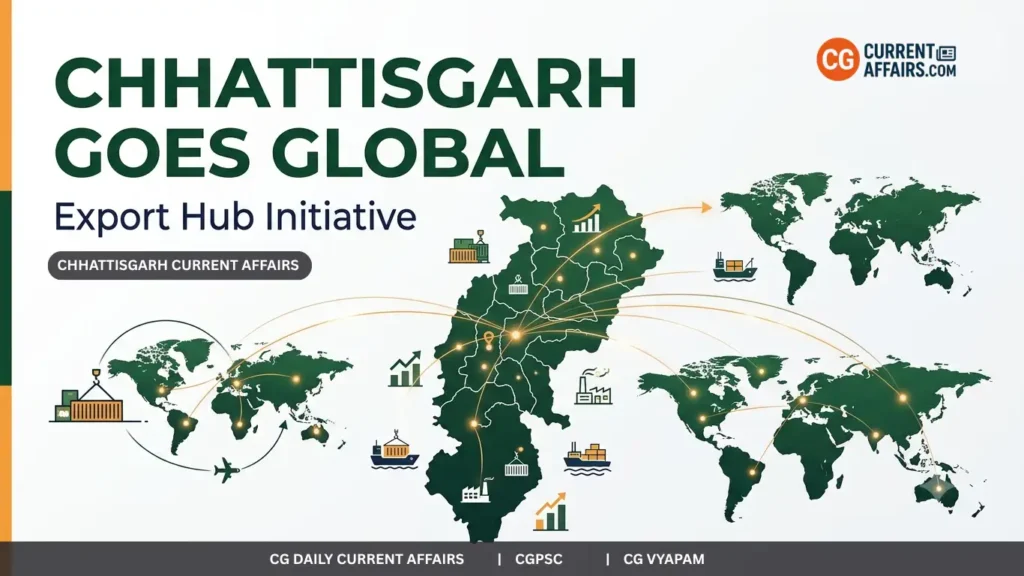
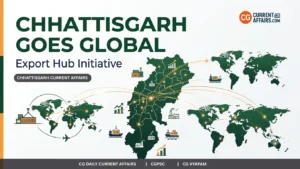
India is moving towards a more inclusive export strategy by giving districts a greater role in international trade. The Districts as Export Hubs Chhattisgarh approach aims to identify the strengths of individual districts and connect local products, producers and enterprises with global markets.
The initiative builds on the One District One Product (ODOP) concept and focuses on strengthening local manufacturing, MSMEs, traditional crafts, agriculture and other products with export potential. For Chhattisgarh, this creates opportunities for products such as Bastar Iron Craft, rice, jowar and maize to reach wider markets.
Why in News?
The Government has highlighted the progress of the Districts as Export Hubs initiative, which aims to make districts important centres of export planning.
- More than 770 districts were covered under the initiative as of January 2026.
- Draft District Export Action Plans were prepared for 590 districts.
- 249 District Export Action Plans had been formally adopted by March 2026.
- Raipur is among six districts selected for support under EXIM Bank’s Grassroots Initiatives for Development (GRID) programme.
- The initiative is being implemented through a focused and phased approach from 1 June 2026.
This makes the Districts as Export Hubs Chhattisgarh framework particularly important for understanding the state’s emerging role in India’s district-led export strategy.
What is Districts as Export Hubs?
The Districts as Export Hubs initiative treats each district as a unit of export planning rather than merely a production centre.
The objective is to identify products and services that have potential in international markets and create an ecosystem that can help local producers become export-ready.
The approach focuses on:
- Identifying products and services with export potential.
- Connecting local producers with international markets.
- Strengthening MSMEs.
- Improving quality and competitiveness.
- Addressing logistics and infrastructure bottlenecks.
- Creating employment opportunities.
- Promoting balanced regional development.
Under the Districts as Export Hubs Chhattisgarh approach, the state’s district-level strengths can therefore become part of a larger national export network.
Also Read: Bastar to become the central hub of state’s development
From ODOP to DEH
The DEH framework builds upon the One District One Product (ODOP) concept.
ODOP focuses on identifying, branding and promoting a distinctive product associated with each district. DEH expands this approach by moving beyond product promotion towards export ecosystem development.
Important fact: ODOP began as a Uttar Pradesh state initiative in 2018, based on Moradabad’s brass industry, before being scaled nationally.
This makes Districts as Export Hubs Chhattisgarh relevant not only to exports but also to rural entrepreneurship, MSME development and employment generation.
DEH: A Convergence Framework
DEH is not a separate funding scheme. It works as a convergence framework, using financial support and resources available under existing Central and State government schemes.
This approach helps address district-specific challenges while improving export competitiveness.
Institutional Architecture
The Districts as Export Hubs initiative works through coordination between the Centre, States and districts.
- The Department of Commerce provides overall policy direction for the initiative.
- Directorate General of Foreign Trade
- The DGFT anchors implementation, facilitates stakeholder coordination and monitors progress.
- State Export Promotion Committees
- State Export Promotion Committees guide implementation at the State level and promote convergence between different departments.
- District Export Promotion Committees
- District Export Promotion Committees, or DEPCs, work at the district level.
- Their responsibilities include:
- Identifying export opportunities.
- Addressing local challenges.
- Coordinating with exporters and industry.
- Preparing District Export Action Plans.
This institutional structure is important for Districts as Export Hubs Chhattisgarh, because district-level planning allows local requirements and bottlenecks to be incorporated into export strategies.
District Export Action Plans
A major component of DEH is the preparation of District Export Action Plans (DEAPs).
These plans:
- Identify products and services with export potential.
- Assess infrastructure and logistics.
- Identify export bottlenecks.
- Recommend measures to improve competitiveness.
- Improve market access.
As of March 2026, draft DEAPs had been prepared for 590 districts, with 249 formally adopted by the respective DEPCs.
For Districts as Export Hubs Chhattisgarh, district-level action plans can help identify and address the specific requirements of Chhattisgarh’s exporters.
Chhattisgarh’s Export Potential
Chhattisgarh has several products with potential under the district-led export approach.
The official material specifically identifies products associated with Bastar, including:
Bastar Iron Craft is particularly significant because it combines the state’s traditional cultural heritage with the potential for wider market access.
The Chhattisgarh export products identified through district-level mapping can help connect local producers with national and international buyers.
The promotion of Chhattisgarh export products also supports artisans, farmers and local enterprises by creating opportunities beyond traditional local markets.
The Chhattisgarh export products approach is therefore closely linked with employment generation, rural entrepreneurship and preservation of traditional skills.
Raipur’s Role in the Export Hub Initiative
Raipur has received particular attention under the initiative.
Raipur is one of six districts selected for support under EXIM Bank’s Grassroots Initiatives for Development (GRID) programme.
The six selected districts are:
- Anantapur
- Raipur
- Solan
- Tiruppur
- Kanpur
- Kolhapur
The programme aims to identify sector-specific constraints, potential beneficiaries and district-specific interventions to strengthen export competitiveness.
- This makes Raipur District Export Hub an important topic for understanding Chhattisgarh’s participation in India’s district-led export model.
- The Raipur District Export Hub approach can help identify local sectors, address export-related constraints and strengthen connections between enterprises and international markets.
- The role of Raipur District Export Hub also demonstrates how district-level institutions can contribute to India’s broader export strategy.
For CGPSC aspirants, Raipur District Export Hub is an important factual point because Raipur has been specifically selected under the EXIM Bank GRID programme.
How the Initiative Supports Local Producers
The Districts as Export Hubs initiative recognises that having a competitive product alone is not enough to succeed in international markets.
1. Quality and Certification
Local producers need to meet international quality requirements. The initiative promotes awareness and capacity building related to:
- Quality standards
- Testing facilities
- Packaging
- Branding
- Certification
2. Digital Export
Digital platforms can help businesses in remote areas access wider markets.
The initiative has partnerships involving platforms and logistics providers such as Amazon, Shiprocket and DHL.
Dak Ghar Niryat Kendras also provide low-cost postal export facilities for documentation, packaging and small consignments.
3. Capacity Building
DGFT Regional Authorities and district administrations conduct programmes covering:
- Export procedures
- Logistics planning
- Packaging norms
- Regulatory compliance
- E-commerce adoption
These measures are particularly relevant for Chhattisgarh export products, where small producers and traditional enterprises may require additional support to enter international markets.
Chhattisgarh Export Products and Global Markets
The identification of Chhattisgarh export products is an important first step, but long-term export success requires stronger infrastructure, branding and market access.
Products such as Bastar Iron Craft can benefit from better packaging, certification, branding and international promotion.
Similarly, agricultural products such as rice, jowar and maize can gain from improved supply chains and export readiness.
The promotion of Chhattisgarh export products can therefore contribute to both economic development and preservation of local identity.
The Chhattisgarh export products model also reflects the broader idea of transforming district-level strengths into sustainable economic opportunities.
Focused Implementation from June 2026
From 1 June 2026, the Government adopted an outcome-oriented, focused and phased approach for implementation.
The first phase covers districts across 27 States and Union Territories, with support from:
- 24 DGFT Regional Authorities
- 11 partner agencies
The focus is on measurable outcomes such as:
- New exporter registrations.
- Increasing export value.
- Greater use of GI products.
- Strengthening MSME clusters.
- Convergence of Central and State schemes.
This focused approach strengthens the Districts as Export Hubs Chhattisgarh framework by shifting attention towards measurable export outcomes.
Significance of the Initiative
The Districts as Export Hubs initiative can contribute to India’s development in several ways.
- Balanced Regional Development
- Export activity has traditionally been concentrated around established industrial centres and port cities. District-level export planning can spread economic opportunities to smaller towns and rural regions.
- Local MSMEs can gain access to wider markets and opportunities for expansion.
- Greater production and exports can create employment throughout district-level value chains.
- Traditional artisans and producers can gain better market access while preserving local heritage.
- Local products can gain international visibility through branding, exhibitions and digital platforms.
Challenges
Despite its potential, district-led export growth faces several challenges:
- Limited awareness of export procedures.
- Inadequate logistics infrastructure.
- Difficulty meeting international standards.
- Limited packaging and branding capabilities.
- Market-access constraints.
- Payment and buyer-verification concerns in e-commerce.
- Need for stronger Centre-State-district coordination.
Addressing these challenges will be essential for the success of Districts as Export Hubs Chhattisgarh and other states.
Read More: APEDA launches BHARATI initiative to boost 100 agri-food exports
India’s Export
- India’s total exports of goods and services reached an all-time high of US$825.25 billion in 2024-25 and were estimated at US$863.11 billion in 2025-26.
- The Government aims to expand export-led growth by bringing more districts into the international trade ecosystem.
- The district-led approach can therefore complement India’s broader objective of making local production more competitive in global markets.
Significance of DEH
The initiative can contribute to:
- Balanced regional development
- MSME growth
- Rural entrepreneurship
- Employment generation
- Artisan empowerment
- Global recognition of local products
- Greater export diversification
- Strengthening of district economies
By connecting local production with global markets, DEH can transform districts into engines of trade, investment and employment.
Challenges
The successful implementation of district-led exports depends on overcoming several practical challenges:
- Limited export awareness among local producers.
- Gaps in logistics and infrastructure.
- Difficulty meeting international quality standards.
- Limited packaging and branding capabilities.
- Lack of international market knowledge.
- E-commerce-related payment and buyer-verification concerns.
- Need for stronger coordination among Central, State and district institutions.
CGPSC Prelims MCQs
Q1. Consider the following statements regarding the Districts as Export Hubs Initiative:
- It treats districts as units of export planning.
- It is a separate financial scheme created by the Central Government.
- District Export Promotion Committees prepare District Export Action Plans.
Which of the statements given above is/are correct?
Answer: 1 and 3 only.
Q2. Which of the following districts of Chhattisgarh has been selected under EXIM Bank’s Grassroots Initiatives for Development programme?
- Bilaspur
B. Raipur
C. Bastar
D. Korba
Answer: B. Raipur
Mains Perspective
Question 1: How can the Districts as Export Hubs initiative promote inclusive and balanced regional development? Discuss with reference to Chhattisgarh.
Conclusion
The Districts as Export Hubs Chhattisgarh approach represents a shift towards making India’s districts active contributors to international trade. By identifying local strengths, improving export readiness and connecting producers with global markets, the initiative can strengthen MSMEs, create employment and promote balanced regional development.
For Chhattisgarh, products such as Bastar Iron Craft, rice, jowar and maize demonstrate the potential of district-level resources. At the same time, Raipur’s selection under the EXIM Bank GRID programme highlights the state’s growing role in India’s district-led export ecosystem.