What is Cervical Cancer?
Cervical cancer develops in the cervix, the lower part of the uterus. Persistent infection with high-risk HPV is the primary cause.
According to the information cited in the campaign material, cervical cancer is the fourth most common cancer among women globally and the second most common cancer among females in India.
India’s cervical cancer burden
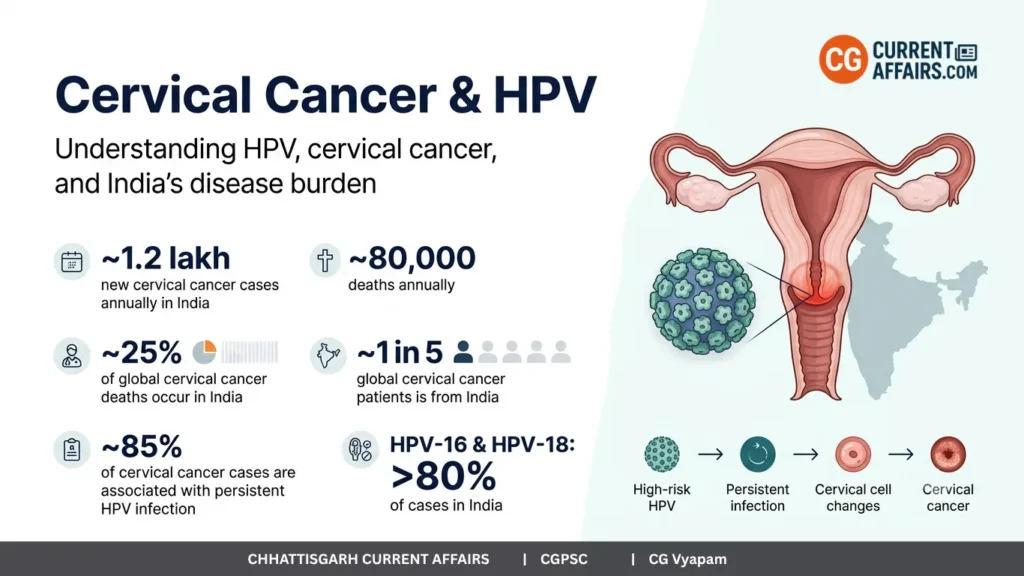
According to GLOBOCAN 2022 figures cited in the source:
- India records around 1.2 lakh new cervical cancer cases annually.
- Around 80,000 deaths occur annually.
- India accounts for about 25% of global cervical cancer deaths.
- Approximately 1 in 5 global cervical cancer patients is from India.
- Persistent HPV infection is associated with around 85% of cervical cancer cases.
- HPV-16 and HPV-18 account for more than 80% of cases in India.
This makes HPV vaccination an important component of India’s long-term cervical cancer prevention strategy.
National HPV Vaccination Campaign
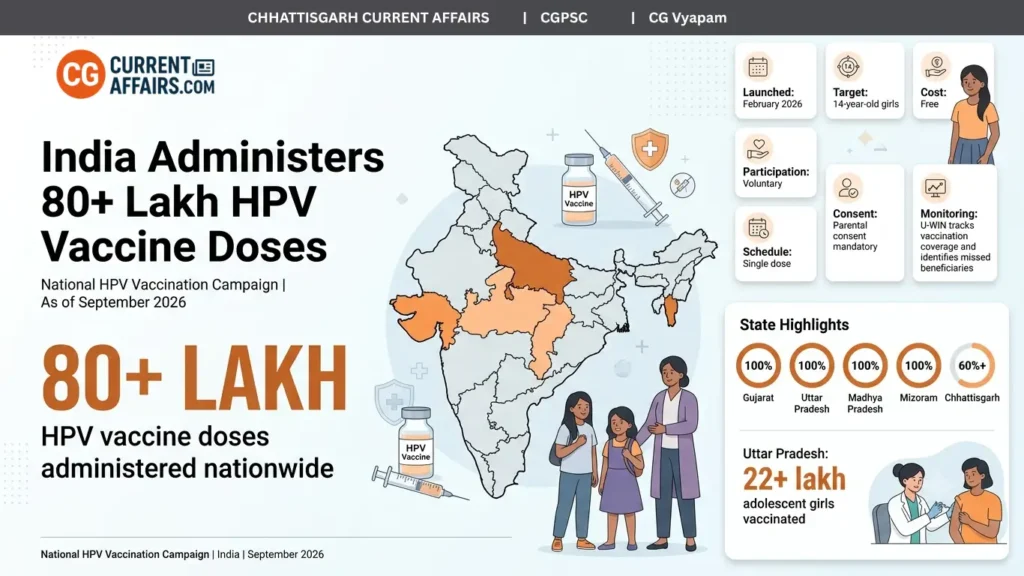
The Government of India launched the nationwide HPV Vaccination Campaign on 28 February 2026.
The campaign targets approximately 1.2 crore 14-year-old girls across the country. Vaccination is provided free of cost at government health facilities.
Main features
Feature | Details |
Target group | 14-year-old girls |
Vaccine | Gardasil-4 |
Schedule | Single dose |
Cost | Free |
Nature | Voluntary |
Consent | Parent/guardian consent required |
Delivery | Government health facilities |
Digital platform | U-WIN |
Vaccine logistics | e-VIN |
Administration | Intramuscular injection |
Monitoring | Medical supervision |
The initial campaign was planned for a 90-day campaign period, after which HPV vaccination would continue through routine immunisation sessions.
What is Gardasil-4?
Gardasil-4 is a quadrivalent HPV vaccine that protects against four HPV types:
India’s national HPV vaccination programme uses Gardasil-4 as a single-dose vaccine for the targeted age group.
The vaccine has been approved for use by India’s regulatory system and is administered through government health facilities under the national programme.
Chhattisgarh HPV Vaccination Coverage
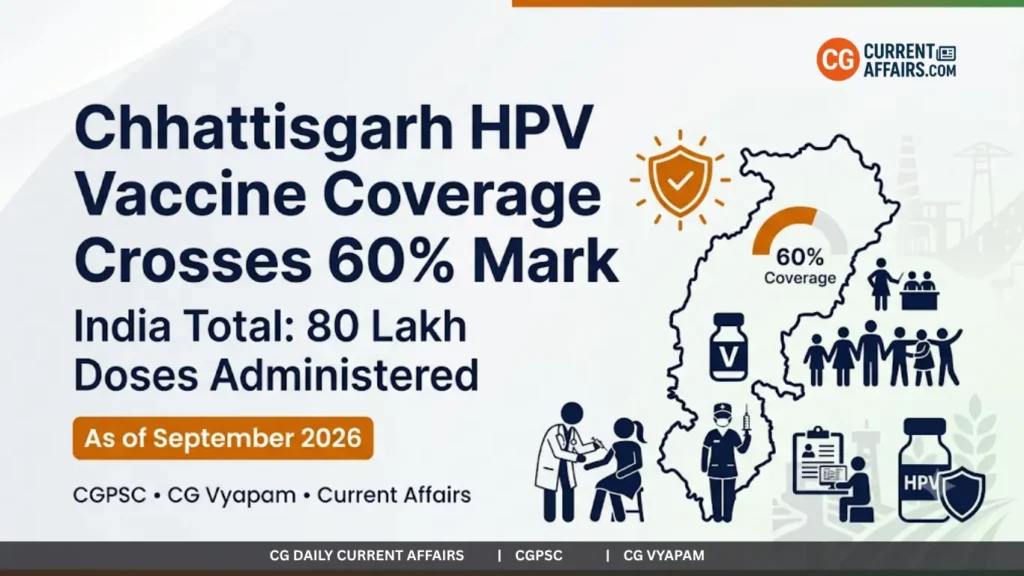
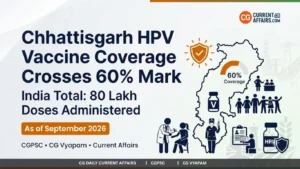
HPV vaccine in Chhattisgarh is among the states that have crossed the 60% vaccination coverage mark under the National HPV Vaccination Campaign.
This is significant for the state’s adolescent health and long-term cancer prevention strategy.
Chhattisgarh perspective
For Chhattisgarh, successful implementation depends on:
- Reaching eligible girls in rural and tribal areas.
- Strengthening awareness among parents and communities.
- Addressing misinformation regarding HPV vaccination.
- Ensuring availability of vaccines at government facilities.
- Maintaining cold-chain systems.
- Training healthcare workers.
- Using U-WIN to identify missed beneficiaries.
- Connecting vaccination with broader preventive healthcare.
The state’s more than 60% coverage indicates substantial progress, but continued mobilisation is important to reach remaining eligible beneficiaries.
Cancer Cases in Chhattisgarh
While Chhattisgarh HPV vaccination is an important tool for cervical cancer prevention, vaccination alone is not sufficient to eliminate cervical cancer. Cancer cases in Chhattisgarh is equally important because screening can help identify cervical abnormalities at an early stage and enable timely diagnosis and treatment.
NFHS-5 data highlights the need to strengthen screening uptake in Chhattisgarh. Screening coverage remains very low in several districts, with some districts reporting uptake below 1%, while some districts have recorded zero screening. These figures underline the importance of improving awareness, accessibility and utilisation of preventive healthcare services.
Major Barriers to Cancer Screening in Chhattisgarh
Several factors can affect cancer screening in Chhattisgarh, particularly among rural and vulnerable populations.
- Lack of awareness: Many people may not be sufficiently aware of the importance of regular cancer screening or where screening services are available.
- Social stigma: Stigma surrounding cancer and reproductive health can discourage people from discussing symptoms or undergoing screening.
- Fear of diagnosis: Fear of receiving a positive diagnosis may cause individuals to avoid screening altogether.
- Financial concerns: Travel expenses, diagnostic costs and loss of wages can discourage people from completing the screening and diagnostic process.
- Rural healthcare limitations: Distance from health facilities, transportation difficulties and limited availability of specialised services can affect access to screening.
- Poor programme integration: Screening needs to be effectively connected with diagnosis, referral and treatment services.
Low Screening Uptake and Loss to Follow-Up
- An important challenge in cancer screening in Chhattisgarh is that screening does not always lead to completion of the diagnostic pathway.
- Some individuals who receive a positive or suspicious screening result may not return for further diagnostic tests. Fear, cost, transportation difficulties, lack of awareness and other social or economic factors can contribute to loss to follow-up.
- Therefore, improving early detection of cancer in Chhattisgarh requires more than simply increasing screening numbers. A strong healthcare pathway should connect:
HPV Vaccination and Cancer Screening: A Combined Prevention Strategy
- The National HPV Vaccination Campaign and cancer screening in Chhattisgarh address different but complementary aspects of cervical cancer prevention.
- HPV vaccination helps prevent infection with important cancer-causing HPV types, while screening can help detect cervical abnormalities before they develop into invasive cancer.
Therefore, a comprehensive cervical cancer prevention strategy should include:
- HPV vaccination for eligible girls
- Awareness about HPV and cervical cancer
- Regular screening as recommended
- Early diagnosis of abnormal findings
- Timely referral and treatment
- Follow-up of patients who require further investigation
How U-WIN Supports the Campaign
The U-WIN platform is an important part of India’s digital vaccination infrastructure.
It helps authorities:
- Register beneficiaries.
- Record vaccination.
- Monitor coverage.
- Identify missed beneficiaries.
- Detect coverage gaps.
- Support session planning.
- Improve resource allocation.
- Maintain digital vaccination records.
This makes U-WIN particularly useful for monitoring large-scale vaccination programmes across different states and districts.
Safety and Medical Supervision
The HPV vaccination programme places emphasis on safety and monitoring.
Vaccination sessions are conducted under the supervision of trained Medical Officers. Government health facilities are linked with 24×7 healthcare facilities for the management of rare Adverse Events Following Immunization (AEFI).
Important safety measures
- Medical supervision during vaccination.
- Proper cold-chain management.
- Observation after vaccination.
- Availability of medical support for rare AEFI.
- Digital recording through U-WIN.
- Trained healthcare personnel at vaccination sites.
Who May Need to Defer or Avoid Vaccination?
The programme guidelines identify certain situations in which vaccination may be deferred or not administered.
These include:
- Moderate or severe illness until recovery.
- Previous severe allergic reaction to vaccination.
- Known allergy to yeast.
- Pregnancy.
- Being outside the targeted age group.
Girls who have already received an HPV vaccine should have their vaccination status recorded through U-WIN.
Also Read: Robotic surgery at AIIMS Raipur, central India’s first
Awareness and Community Participation
Vaccination coverage is not determined only by vaccine availability. Public awareness and community trust are equally important.
The campaign involves:
- Parents and guardians
- Teachers
- ASHAs
- ANMs
- Doctors
- Healthcare providers
- District health teams
- Local communities
These stakeholders help explain the importance of HPV vaccination and address misinformation and vaccine hesitancy.
For states such as Chhattisgarh, community mobilisation can be particularly important in reaching rural, tribal and geographically dispersed populations.
WHO’s 90-70-90 Target
The World Health Organization (WHO) Cervical Cancer Elimination Initiative has established the 90-70-90 targets for 2030.
The targets are:
- 90%
- Girls should be fully vaccinated against HPV by the age of 15.
- 70%
- Women should undergo high-performance screening by ages 35 and 45.
- 90%
- Women identified with cervical pre-cancer should receive treatment, while 90% of women with invasive cervical cancer should receive appropriate management.
Thus, vaccination alone is not enough. Cervical cancer elimination requires a combination of vaccination, screening, early diagnosis and treatment.
Global HPV Vaccination Scenario
HPV vaccination has expanded significantly across the world.
The campaign source notes that more than 800 million HPV vaccine doses have been distributed globally. HPV vaccination has increasingly become part of national immunisation programmes across countries of different income levels.
According to the campaign material:
- 87% of upper-middle-income countries have adopted HPV vaccination.
- 78% of lower-middle-income countries have adopted it.
- 54% of low-income countries have adopted it.
India’s nationwide programme therefore represents an important expansion of preventive cancer healthcare.
Government Initiatives and Support
India’s HPV vaccination programme is part of a broader strategy for cervical cancer prevention.
The government’s approach includes:
- Free HPV vaccination is provided to eligible girls through government health facilities.
- Screening is an important component of cervical cancer prevention, particularly because vaccination does not eliminate every possible cause of cervical cancer.
- Early detection can improve treatment outcomes.
- Women diagnosed with cervical cancer require timely and appropriate treatment.
- U-WIN supports vaccination registration, reporting and monitoring.
- Healthcare workers, teachers and communities are involved in awareness and mobilisation activities.
The Union government’s broader strategy combines HPV vaccination with screening, early diagnosis and treatment.
Significance of the HPV Vaccination Campaign
The campaign is important for several reasons.
- Vaccination can reduce the future risk of HPV-related cancers.
- The programme focuses on girls before the age at which HPV exposure is likely to occur, making early prevention important.
- Higher vaccination coverage can contribute to reducing cervical cancer incidence over the long term.
- Free vaccination through government facilities improves access for beneficiaries who may otherwise face financial or geographical barriers.
- U-WIN provides a mechanism to monitor coverage and identify missed beneficiaries.
- For the HPV vaccine in Chhattisgarh crosses 60% coverage represents progress while also highlighting the need to reach the remaining eligible girls, particularly in rural and tribal communities.
Challenges
Despite the progress, several challenges remain.
- Misinformation and concerns among parents can affect uptake.
- 2. Rural and tribal outreach
- Reaching beneficiaries in remote areas can require additional mobilisation and logistical planning.
- Parents and adolescents need accurate information about HPV and cervical cancer.
- 4. Maintaining cold chain
- Vaccines require proper storage and transportation conditions.
- 5. Identifying missed beneficiaries
- Large-scale programmes need effective digital and field-level monitoring.
- Vaccination should be complemented by cervical cancer screening and timely treatment.
CGPSC Prelims Practice Questions
Q1. Consider the following statements about India’s National HPV Vaccination Campaign:
- It targets 14-year-old girls.
- HPV vaccination under the campaign is free at government health facilities.
- U-WIN is used for monitoring vaccination coverage.
- The campaign provides a single-dose vaccination schedule.
Which of the statements given above are correct?
Answer: 1, 2, 3 and 4
Q2. Which of the following HPV types are considered particularly important in relation to cervical cancer?
- HPV-6 and HPV-11
B. HPV-16 and HPV-18
C. HPV-1 and HPV-2
D. HPV-3 and HPV-4
Answer: B. HPV-16 and HPV-18
CGPSC Mains Practice Questions
Q1. Discuss the significance of India’s National HPV Vaccination Campaign in preventing cervical cancer. What challenges could affect its implementation?
Q2. Examine the role of Chhattisgarh in India’s HPV vaccination campaign and suggest measures to improve coverage among eligible girls.
Conclusion
India’s achievement of more than 80 lakh HPV vaccine doses marks an important milestone in preventive healthcare and cervical cancer prevention. The National HPV Vaccination Campaign moves India’s health strategy beyond treatment towards prevention at an early age.
For Chhattisgarh, crossing 60% coverage is a positive step, but sustained efforts are required to reach the remaining eligible girls. Greater community awareness, last-mile healthcare delivery, digital monitoring through U-WIN and integration with screening and treatment will be essential for achieving long-term cervical cancer prevention.