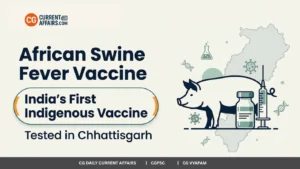
What is African Swine Fever?
African Swine Fever (ASF) is a highly contagious viral disease that affects domestic pigs and wild boars.
It is caused by the African Swine Fever Virus (ASFV), a DNA virus belonging to the Asfarviridae family.
The disease can cause:
- High fever
- Weakness and loss of appetite
- Haemorrhages
- Skin reddening
- Vomiting and diarrhoea
- Breathing difficulties
- Abortions and stillbirths
- Sudden death
In severe outbreaks, mortality can approach 100%.
Important Exam Fact
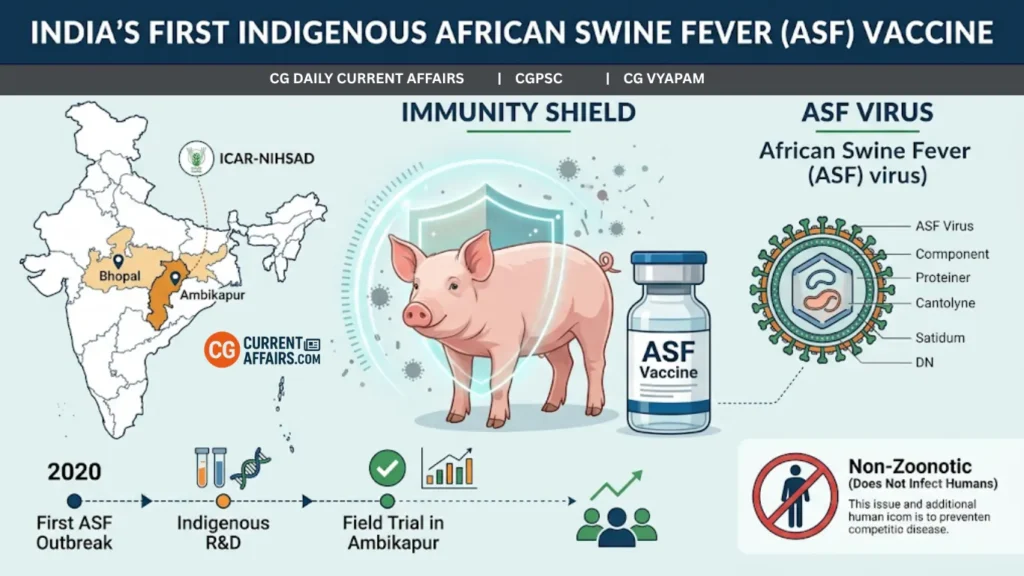
African Swine Fever is not a zoonotic disease.
This means ASF does not infect humans. However, humans can indirectly contribute to its spread by carrying contaminated materials, clothing, footwear, equipment or pork products between infected and uninfected areas.
African Swine Fever Vaccine in India
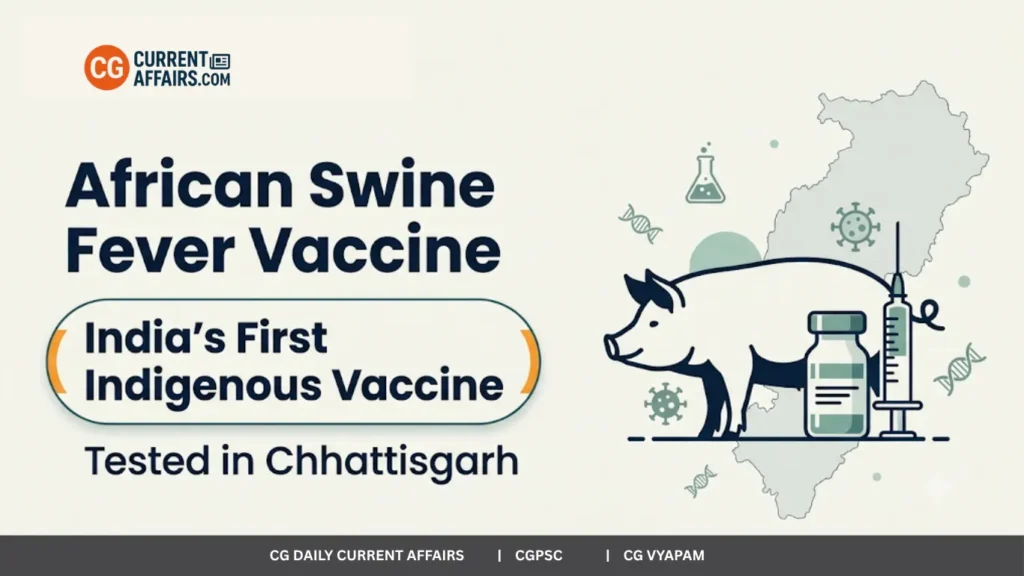
The development of an indigenous African Swine Fever vaccine in CG is significant because ASF has caused substantial losses to pig farming in India.
The vaccine was developed by the ICAR–National Institute of High Security Animal Diseases (ICAR-NIHSAD), Bhopal.
It is described as an MA-104 cell-line-based live attenuated ASF vaccine for pigs.
The successful field trial in Chhattisgarh represents an important step towards making the vaccine available for wider use.
African Swine Fever Vaccine in CG Facts
| Particular | Details |
|---|
| Disease | African Swine Fever |
| Virus | African Swine Fever Virus (ASFV) |
| Affected animals | Domestic pigs and wild boars |
| Vaccine | Indigenous ASF vaccine |
| Developing institution | ICAR-NIHSAD, Bhopal |
| Trial location | Sakalo Government Pig Farm, Ambikapur |
| Trial state | Chhattisgarh |
| Trial duration | Around 6 months |
| Animals tested | 50 pigs |
| Vaccine type | MA-104 cell-line-based live attenuated vaccine |
| Expected availability | Around 6 months to 1 year, subject to required processes |
African Swine Fever in India
India reported its first outbreak of African Swine Fever in 2020 in the northeastern states of Assam and Arunachal Pradesh.
After its initial detection, the disease spread to several other states and Union Territories.
The northeastern region was particularly affected, with outbreaks resulting in large-scale pig deaths and restrictions on the movement of pigs.
The spread of ASF can have serious consequences for regions where pig farming is an important source of livelihood and food supply.
African Swine Fever Trial in Ambikapur
- The field trial of the indigenous vaccine began at the Sakalo Government Pig Farm in Ambikapur in March 2026.
- Scientists from ICAR-NIHSAD, Bhopal supervised the trial.
- The trial involved approximately 50 pigs belonging to different breeds and age groups. Blood samples were collected from the animals at different stages of the trial.
- These samples were subsequently examined at the High Security Animal Disease Laboratory in Bhopal.
- The testing showed positive results, with vaccinated pigs developing an immune response against African Swine Fever.
Scientists Involved
The trial was conducted under the supervision of senior scientists including:
Local veterinary officials, including Dr. C.K. Mishra and Dr. Ajay Agrawal, also assisted in the field trial.
The scientists later shared information about the trial and its results with Ambikapur Divisional Commissioner Narendra Dugga.
Vaccine Dedicated to the Nation
The indigenous African Swine Fever vaccine was formally dedicated to the nation on 16 July 2026, on the occasion of the ICAR Foundation Day.
The vaccine was dedicated by Union Agriculture Minister Shivraj Singh Chouhan.
The development is important because India had previously lacked an effective widely available vaccine for controlling ASF outbreaks.
The availability of an indigenous vaccine could therefore strengthen India’s preparedness against future outbreaks.
Why is the Indigenous ASF Vaccine Important?
African Swine Fever can cause serious losses for pig farmers because infected animals may have to be culled to control the spread of the disease.
The absence of an effective vaccine meant that disease control relied heavily on:
- Early detection
- Movement restrictions
- Strict biosecurity
- Disposal of infected animals
- Culling
- Surveillance
- Control of contaminated materials and feed
An effective indigenous vaccine could provide an additional tool for disease management.
Potential Benefits
- 1. Protecting Pig Farmers
- Reducing disease-related mortality can help protect the livestock assets of farmers.
- 2. Reducing Economic Losses
- ASF outbreaks can affect pig production, transportation, meat trade and related businesses.
- 3. Strengthening Disease Preparedness
- A domestic vaccine can improve India’s ability to respond to future outbreaks.
- 4. Supporting Pig Farming
- Pig farming is an important livelihood activity in several parts of India, particularly in northeastern and tribal regions.
- 5. Reducing Dependence on External Solutions
- Development of an indigenous vaccine strengthens India’s domestic veterinary biotechnology capabilities.
Impact of African Swine Fever in Chhattisgarh
Chhattisgarh has also experienced the economic consequences of African Swine Fever outbreaks.
During previous outbreaks, infected pigs had to be culled according to disease-control protocols.
According to the report:
- Around 100 pigs at a pig farm in Balodabazar had to be culled.
- Around 150 pigs at a farm in Durg were also culled.
- In total, more than 250 pigs were reportedly culled at these two farms.
Such losses affect not only the animals but also the farmers and institutions dependent on pig farming.
The development of an African Swine Fever Vaccine in cg therefore has particular relevance for Chhattisgarh.
How Does African Swine Fever Spread?
ASFV is highly resistant in the environment and can survive on contaminated materials.
Transmission can occur through:
- Direct contact between infected pigs.
- Contact with infected wild boars.
- Contaminated clothing and footwear.
- Vehicles and equipment.
- Contaminated feed.
- Contaminated pork products.
- Certain soft ticks in regions where they act as vectors.
Human Role in Transmission
Although African Swine Fever does not infect humans, human movement can contribute to the spread of the virus.
For example, contaminated:
- Boots
- Clothes
- Vehicles
- Equipment
- Farm tools
can carry the virus from one farm or location to another.
Therefore, strict biosecurity measures are essential for controlling ASF.
Symptoms of African Swine Fever
The clinical symptoms can vary depending on the strain and severity of infection.
Symptoms generally appear within 3–15 days after infection.
Early Symptoms
- High fever
- Lethargy
- Loss of appetite
- Weakness
- Sudden death in some cases
Later Symptoms
- Reddening of the skin
- Red or swollen eyes
- Eye discharge
- Vomiting
- Diarrhoea
- Difficulty in breathing
- Abortions
- Stillbirths
- Increasing weakness
- Reluctance to stand or move
In severe cases, death may be the only visible sign.
African Swine Fever Treatment
At present, there is no specific treatment that cures African Swine Fever.
Therefore, disease control primarily depends on:
- Prevention
- Early detection
- Surveillance
- Biosecurity
- Movement control
- Proper disposal of infected animals
- Culling according to prescribed protocols
The availability of an effective vaccine can add another important layer to disease-control strategies.
Prevention of African Swine Fever
Strict biosecurity is one of the most important measures for preventing ASF outbreaks.
Important Prevention Measures
- Prevent contact between domestic pigs and wild boars.
- Disinfect farm equipment regularly.
- Control movement of people and vehicles.
- Use clean protective clothing and footwear.
- Avoid feeding pigs contaminated or unsafe feed.
- Quarantine newly introduced animals.
- Report suspected infections quickly.
- Follow official animal-health protocols during outbreaks.
- Restrict movement of infected or exposed animals.
Farmers should also avoid moving pigs from outbreak-affected areas to unaffected areas.
Global Distribution of African Swine Fever
African Swine Fever was originally identified in sub-Saharan Africa.
Over time, the disease spread to several regions across:
Today, ASF remains an important global threat to the pig-farming industry.
The disease has caused major economic losses because of pig deaths, culling, movement restrictions and disruptions to pork production and trade.
African Swine Fever in Chhattisgarh
- Trial location: Sakalo Government Pig Farm
- District/City: Ambikapur
- State: Chhattisgarh
- Trial duration: Around six months
- Number of pigs: 50
- Monitoring institution: ICAR-NIHSAD, Bhopal
- Trial started: March 2026
- Previous losses: More than 250 pigs culled at farms in Balodabazar and Durg, according to the report.
The topic can be linked with several CGPSC themes:
- Animal husbandry
- Livestock economy
- Veterinary science
- Rural economy
- Tribal livelihoods
- Agricultural diversification
- Disease management
- Biotechnology
- Indigenous vaccine development
Importance for Chhattisgarh’s Livestock Economy
Livestock is an important component of rural livelihoods. Pig farming can provide income to households, particularly in communities where pig rearing is culturally and economically significant.
An ASF outbreak can create losses at multiple levels:
Animal deaths → Culling → Loss of livestock assets → Reduced farmer income → Supply disruption → Impact on pig-related businesses
An effective vaccine could therefore help reduce the economic impact of future outbreaks, subject to its demonstrated effectiveness, regulatory approval and appropriate deployment.
Role of ICAR-NIHSAD
The Indian Council of Agricultural Research (ICAR) operates research institutions dealing with agriculture and animal sciences.
The National Institute of High Security Animal Diseases (NIHSAD) is based in Bhopal, Madhya Pradesh.
Its work focuses on high-consequence animal diseases and includes research, diagnosis, surveillance and development of disease-control technologies.
The institute’s involvement in the African Swine Fever vaccine in CG development and the Chhattisgarh field trial makes it an important institution to remember for examination purposes.
Challenges
Despite the development of an indigenous vaccine, several challenges remain.
- 1. Commercial Availability
- The vaccine still needs to move through the necessary processes before becoming widely available.
- 2. Disease Surveillance
- Early detection remains essential because ASF can spread rapidly.
- 3. Biosecurity
- Vaccination alone cannot replace strict biosecurity and disease-control measures.
- 4. Farmer Awareness
- Farmers need awareness about symptoms, reporting mechanisms and preventive measures.
- 5. Movement of Animals
- Uncontrolled movement of infected pigs can accelerate disease transmission.
- 6. Wildlife Interface
- Contact between domestic pigs and infected wild boars can create additional transmission risks.
Way Forward
India’s response to African Swine Fever Vaccine in CG should combine vaccination with strong disease surveillance and biosecurity.
- Strengthen Surveillance
- Regular monitoring of pig populations can help identify outbreaks at an early stage.
- Improve Farm Biosecurity
- Farmers should receive training on sanitation, quarantine and movement control.
- Expand Veterinary Infrastructure
- Veterinary laboratories and disease-diagnostic facilities should be strengthened, particularly in rural and pig-producing regions.
- Ensure Farmer Awareness
- Information regarding symptoms, reporting procedures and prevention should reach pig farmers in local languages.
- Support Indigenous Veterinary Research
- Continued investment in Indian veterinary biotechnology can help develop vaccines and diagnostic tools for other livestock diseases.
Conclusion
The successful field trial of India’s first indigenous African Swine Fever vaccine in Chhattisgarh, marks an important development in India’s animal-health and livestock sector.
The trial conducted on 50 pigs at the Sakalo Government Pig Farm showed positive immune-response results under the supervision of ICAR-NIHSAD scientists.
The vaccine could provide an important additional tool for protecting pig populations and reducing farmer losses. However, effective disease management will require a combination of vaccination, surveillance, biosecurity, early detection and farmer awareness.
CGPSC Prelims Current Affairs 2026
- ASF: African Swine Fever.
- ASF is a highly contagious viral disease affecting domestic pigs and wild boars.
- The causative virus is African Swine Fever Virus (ASFV).
- ASFV is a DNA virus.
- It belongs to the Asfarviridae family.
- ASF is not zoonotic.
- Humans do not become infected with ASF.
- Humans can, however, contribute to its spread through contaminated materials.
- India detected its first ASF outbreak in 2020.
- The first reported Indian outbreaks occurred in Assam and Arunachal Pradesh.
- India’s first indigenous ASF vaccine was developed by ICAR-NIHSAD, Bhopal.
- The Chhattisgarh field trial was conducted at Sakalo, Ambikapur.
- Around 50 pigs were included in the trial.
- The trial began in March 2026.
- The vaccine trial lasted around six months.
- The vaccine is an MA-104 cell-line-based live attenuated vaccine.
- The vaccine was dedicated to the nation on 16 July 2026.
- Previous ASF outbreaks in Chhattisgarh resulted in the culling of more than 250 pigs at Balodabazar and Durg farms, according to the report.
CGPSC Prelims Practice Questions
MCQ 1
India’s first indigenous African Swine Fever vaccine was developed by which institution?
A. ICAR-NDRI
B. ICAR-NIHSAD
C. ICMR-NIV
D. DRDO
Answer: B. ICAR-NIHSAD
MCQ 2
Where was the field trial of India’s indigenous African Swine Fever vaccine conducted in Chhattisgarh?
A. Raipur
B. Bilaspur
C. Ambikapur
D. Jagdalpur
Answer: C. Ambikapur
MCQ 4
African Swine Fever is classified as which type of disease?
A. Bacterial zoonotic disease
B. Viral disease of pigs and wild boars
C. Fungal disease of cattle
D. Parasitic disease of poultry
Answer: B. Viral disease of pigs and wild boars
CGPSC Mains Practice Questions
Question 1
Discuss the significance of India’s first indigenous African Swine Fever vaccine in CG for the livestock economy.
Question 2
African Swine Fever is both an animal-health and an economic challenge. Explain with reference to Chhattisgarh.
Also Read:
- Mega Survey of OBC in Chhattisgarh
- Bhilai Steel Plant to built India’s Biggest Blast Furnace