Chhattisgarh has received national recognition at the 72nd National Film Awards with the documentary “Ramnami”, directed by filmmaker Bharatbala Ganapathy, winning the award for Best Documentary.
The documentary portrays the Ramnami community of Chhattisgarh, particularly its distinctive religious traditions, cultural practices and way of life. The award has brought the cultural identity and heritage of Chhattisgarh to a national cinematic platform.
President Droupadi Murmu presented the award to filmmaker Bharatbala at the 72nd National Film Awards ceremony held at Ekta Nagar, Gujarat, near the Statue of Unity.
Why in News?
The documentary Ramnami received the Best Documentary award at the 72nd National Film Awards for the year 2024.
Key Points
- Documentary: Ramnami
- Director: Bharatbala Ganapathy
- Award: Best Documentary
- Awards: 72nd National Film Awards
- Subject: Ramnami community of Chhattisgarh
- Award presented by: President Droupadi Murmu
- Venue: Ekta Nagar, Gujarat
- The film highlights the cultural and devotional traditions of the Ramnami community.
- The recognition has brought Chhattisgarh’s cultural heritage to the national level.
What is the Ramnami Community?
The Ramnami community, also known as Ramnamis or Ramramiyas, is a distinctive devotional community associated with Chhattisgarh.
The community is particularly known for the practice of writing or tattooing the sacred name “Ram” on the body.
The tradition developed as a form of religious assertion among socially marginalised communities. The name of Ram became not merely a religious symbol but an important part of the community’s identity.
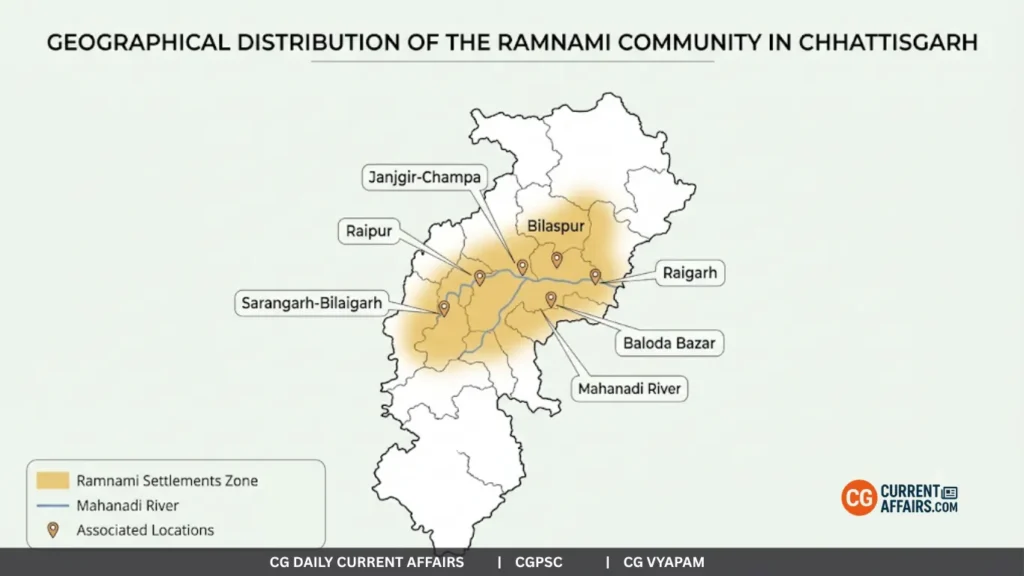
The Ramnamis are particularly associated with the plains of Chhattisgarh and areas around the Mahanadi basin.
Also Read: Ramnami Community of Chhattisgarh
Origin of the Ramnami Tradition
- The Ramnami tradition emerged in the late 19th century in the rural areas of Chhattisgarh.
- According to accounts of the community’s history, it is associated with Sant Parasuram.
- The movement developed among communities that faced social discrimination and restrictions in accessing orthodox religious spaces.
- Instead of relying on temple-based worship, the Ramnamis emphasised direct devotion to the name of Ram.
About Ramnami community of Chhattisgarh
- Strong emphasis on the name Ram.
- Devotional singing and collective prayer.
- Use of the Ramcharitmanas and other devotional literature.
- Distinctive body inscriptions carrying the name “Ram”.
- Community-based religious practices.
- Rejection of dependence on elaborate temple rituals.
Ramnami Community and the Practice of Godna
One of the most distinctive features of the Ramnami tradition is Godna, or the permanent inscription of the name “Ram” on the body.
The practice has both religious and social significance.
For the community, carrying the name of Ram permanently on the body represents a direct relationship between the devotee and the divine.
Types of Ramnami community of Chhattisgarh Categories Based on Body Inscription
Traditional accounts describe different levels of body inscription.
| Category | Description |
|---|
| Shiromani | “Ram” is inscribed on the forehead or crown |
| Sarvang Ramnami | The name of Ram is inscribed across large parts of the body |
| Nakhshikh Ramnami | The inscription extends from the head to the toes and represents the most extensive form |
The practice is often described as a powerful expression of religious identity and devotion.
Distinctive Cultural Practices of Ramnamis
The Ramnami community has several distinctive cultural and devotional practices.
- Ramnami Chadar
- The Ramnami Odhani or Chadar is a white cloth traditionally marked with the name Ram.
- It is an important symbol of the community’s religious identity.
- Mor Mukut
- The Mor Mukut, or peacock-feather crown, is associated with devotional gatherings and community ceremonies.
- Ghungroo and Khartal
- Devotional gatherings may involve musical instruments such as:
- These accompany collective devotional singing.
- Collective Bhajan
- Community members participate in collective devotional singing and recitation.
- The Ramcharitmanas also holds an important place in the community’s devotional traditions.
Ramnami Tradition and Social Reform
The Ramnami tradition is important not only from a religious perspective but also from the perspective of social history and resistance to caste discrimination.
Historically, members of marginalised communities faced restrictions in entering certain temples and accessing religious spaces.
The Ramnamis responded by making the divine name a permanent part of their own bodies.
Thus, the body itself became a form of religious expression.
Significance
The practice represented:
- Assertion of religious identity.
- Resistance to social exclusion.
- Greater accessibility of devotional practices.
- Community solidarity.
- Rejection of caste-based restrictions on religious expression.
Ramnami Tradition and the Bhakti Movement
The Ramnami tradition can be studied in the broader context of India’s Bhakti traditions.
The Bhakti movement emphasised personal devotion and challenged the idea that spiritual access should depend entirely on caste, social status or complex ritual practices.
The Ramnami tradition similarly places strong emphasis on direct devotion to Ram.
Connection with Bhakti Traditions
- 1. Personal Devotion
- The devotee develops a direct relationship with the divine.
- 2. Vernacular Tradition
- Devotional expression is accessible through local languages and community singing.
- 3. Social Equality
- The tradition historically developed among communities facing social discrimination.
- 4. Accessible Worship
- Devotion does not depend exclusively on elaborate temple rituals.
- 5. Importance of the Divine Name
- The name “Ram” occupies a central position in religious practice.
Nirguna and Saguna Bhakti
- The Ramnami tradition is also interesting from the perspective of the Nirguna-Saguna Bhakti distinction.
- Nirguna Bhakti emphasises devotion to a formless and attributeless divine reality, while Saguna Bhakti focuses on devotion to a divine form with attributes.
- The Ramnami tradition places exceptional importance on the name of Ram, and its devotional philosophy can be studied alongside wider North Indian Bhakti traditions associated with figures such as Kabir and Ravidas.
Ramnami Community in Chhattisgarh
- The Ramnami community is primarily associated with the plains of Chhattisgarh.
- It has historically been concentrated in areas associated with the Mahanadi basin.
Important Areas Associated with the Community
- Janjgir-Champa
- Raipur
- Bilaspur
- Raigarh
- Baloda Bazar
The community’s cultural practices form an important part of Chhattisgarh’s social and cultural heritage.
Ramnami Documentary by Bharatbala
The documentary Ramnami explores the lives, traditions and cultural identity of the community.
Filmmaker Bharatbala Ganapathy described the film as more than simply a cinematic project. He highlighted the opportunity to enter the world of the community and document its living traditions and stories.
The filmmaker also described his association with Chhattisgarh as a broader journey of cultural exploration.
His work in the state has included documentation related to:
- Baiga tribal culture
- Dhokra art
- Bison
- Muriya community
- Ghotul tradition
- Sirpur’s heritage
Filmmaker’s Message
After receiving the award, Bharatbala said that the recognition belonged not only to the film but also to the Ramnami community and the people of Chhattisgarh who trusted the filmmaking process and shared their stories.
This aspect makes the award important from the perspective of cultural documentation and representation.
Also Read: Deepak Kingrani wins National Film Award 2025
About National Film Awards
- The National Film Awards are among India’s major national honours for excellence in cinema.
- They were instituted in 1954 and are associated with the Ministry of Information and Broadcasting.
- The awards recognise creative and technical achievements in Indian cinema.
Three Broad Areas
The National Film Awards cover:
- Feature Films
- Non-Feature Films
- Writing on Cinema
- The 72nd National Film Awards recognised achievements in Indian cinema for the year 2024.
- The winners were announced on 18 July 2026.
- The awards ceremony was scheduled for 22 September 2026 at Ekta Nagar, Gujarat.
History of National Film Awards
The history of the National Film Awards can be traced to the recommendations of the Film Enquiry Committee, which was established in 1949.
The awards were established in 1954, with the first awards recognising films from 1953.
First National Film Awards
At the first edition:
- Shyamchi Aai won the President’s Gold Medal for the Best All-India Feature Film.
- Mahabalipuram won the President’s Gold Medal for Best Documentary Film.
- Do Bigha Zamin received a Certificate of Merit.
The awards subsequently expanded to recognise a much wider range of cinematic achievements.
Evolution of the National Film Awards
- Awards for individual artists and technicians were introduced for films of the year 1967.
- The first acting awards were presented in 1968.
History of National Film Awards
| Year | Milestone |
|---|
| 1913 | Dadasaheb Phalke’s Raja Harishchandra became a landmark in Indian cinema |
| 1954 | National Film Awards instituted |
| 1967–68 | Awards for artists and technicians introduced |
| 1969 | Dadasaheb Phalke Award instituted |
| 1973 | Directorate of Film Festivals began administering the awards |
| 2022 | Directorate of Film Festivals merged into NFDC |
| 2026 | 72nd National Film Awards ceremony held at Ekta Nagar, Gujarat |
Dadasaheb Phalke Award
- The Dadasaheb Phalke Award was instituted in 1969.
- It is India’s highest honour in the field of cinema and recognises outstanding contribution to Indian cinema.
- The first recipient was Devika Rani.
- The award is named after Dhundiraj Govind Phalke, widely known as Dadasaheb Phalke, who made Raja Harishchandra in 1913.
Purpose and Significance of National Film Awards
The National Film Awards serve several purposes.
- Promote Socially Relevant Cinema
- The awards recognise films dealing with important social and cultural themes.
- Preserve Cultural Diversity
- Indian cinema reflects the country’s linguistic, regional and cultural diversity.
- Recognition of films such as Ramnami helps bring regional cultural traditions to a national audience.
- Promote National Integration
- Cinema can provide audiences with an understanding of communities and cultures from different parts of India.
- The 72nd National Film Awards therefore contribute to greater awareness of India’s cultural diversity.
Significance for Chhattisgarh
The Best Documentary award for Ramnami is important for Chhattisgarh because it places one of the state’s distinctive communities on a national platform.
- Cultural Significance
The award highlights:
- Ramnami religious traditions.
- Chhattisgarh’s folk and cultural heritage.
- Community-based devotional practices.
- Traditional knowledge and social history.
- Regional stories in Indian cinema.
2. Tourism and Cultural Documentation
Recognition at a national level can also increase awareness of Chhattisgarh’s cultural heritage.
The state has several other important cultural and heritage traditions, including:
- Sirpur
- Bastar’s tribal traditions
- Dhokra art
- Ghotul tradition
- Baiga culture
- Muriya traditions
Thus, the documentary provides an example of how regional stories can contribute to India’s broader cultural narrative.
Challenges in Preserving Traditional Culture
Traditional communities face several challenges in preserving their cultural identity.
- Modernisation
- Rapid social and economic changes can affect traditional practices.
- Migration
- Migration can weaken the transmission of cultural practices between generations.
- Documentation Gaps
- Many local traditions remain poorly documented.
- Commercialisation
- Traditional practices may sometimes be presented primarily for tourism or commercial purposes, potentially reducing their cultural context.
- Generational Change
- Younger generations may adopt new social and cultural practices, making intergenerational transmission increasingly important.
Way Forward
- Document Intangible Heritage
- Traditional practices, oral histories, songs and community knowledge should be systematically documented.
- Community Participation
- Documentation should involve community members rather than treating them merely as subjects of research.
- Promote Cultural Education
- Schools and local institutions can introduce students to the cultural heritage of their region.
- Support Responsible Cinema
- Documentary filmmaking can help preserve stories that may otherwise receive limited national attention.
- Strengthen Cultural Institutions
- Museums, universities and cultural departments can collaborate with communities to preserve their heritage.
Conclusion
The Ramnami documentary winning Best Documentary at the 72nd National Film Awards has brought an important cultural tradition of Chhattisgarh to the national stage.
The documentary directed by Bharatbala Ganapathy focuses on the Ramnami community, known for its distinctive devotional traditions and deep association with the name of Ram.
CGPSC Prelims Current Affairs 2026
- Documentary: Ramnami
- Director: Bharatbala Ganapathy
- Award: Best Documentary
- Edition: 72nd National Film Awards
- Award year: 2024 films
- Award ceremony: 2026
- Award presented by: President Droupadi Murmu
- Venue: Ekta Nagar, Gujarat
- Subject: Ramnami community of Chhattisgarh
- Ramnamis are particularly known for inscribing the name Ram on their bodies.
- The Ramnami tradition emerged in the late 19th century in Chhattisgarh.
- The community is associated with the Mahanadi basin.
- The 72nd National Film Awards were instituted in 1954.
- The first National Film Awards recognised films released in 1953.
- Shyamchi Aai won the President’s Gold Medal for Best All-India Feature Film at the first edition.
- Mahabalipuram won the President’s Gold Medal for Best Documentary Film.
- The Dadasaheb Phalke Award was instituted in 1969.
- Devika Rani was its first recipient.
- Dadasaheb Phalke made Raja Harishchandra in 1913.
- The Directorate of Film Festivals was merged into NFDC in 2022.
CGPSC Prelims Practice Questions
MCQ 1
The documentary “Ramnami”, which received the Best Documentary award at the 72nd National Film Awards, focuses on which community?
A. Baiga
B. Gond
C. Ramnami
D. Muriya
Answer: C. Ramnami
MCQ 2
Who directed the documentary “Ramnami”?
A. Bharatbala Ganapathy
B. Shyam Benegal
C. Prakash Jha
D. Sanjay Leela Bhansali
Answer: A. Bharatbala Ganapathy
MCQ 3
The 72nd National Film Awards were instituted in which year?
A. 1947
B. 1950
C. 1954
D. 1969
Answer: C. 1954
MCQ 4
Who was the first recipient of the Dadasaheb Phalke Award?
A. Satyajit Ray
B. Devika Rani
C. Raj Kapoor
D. Prithviraj Kapoor
Answer: B. Devika Rani
CGPSC Mains Practice Questions
Question 1
Discuss the significance of the Ramnami tradition in the cultural and social history of Chhattisgarh.
Question 2
How can documentary cinema contribute to the preservation of India’s regional cultural heritage? Discuss with reference to the documentary “Ramnami”.