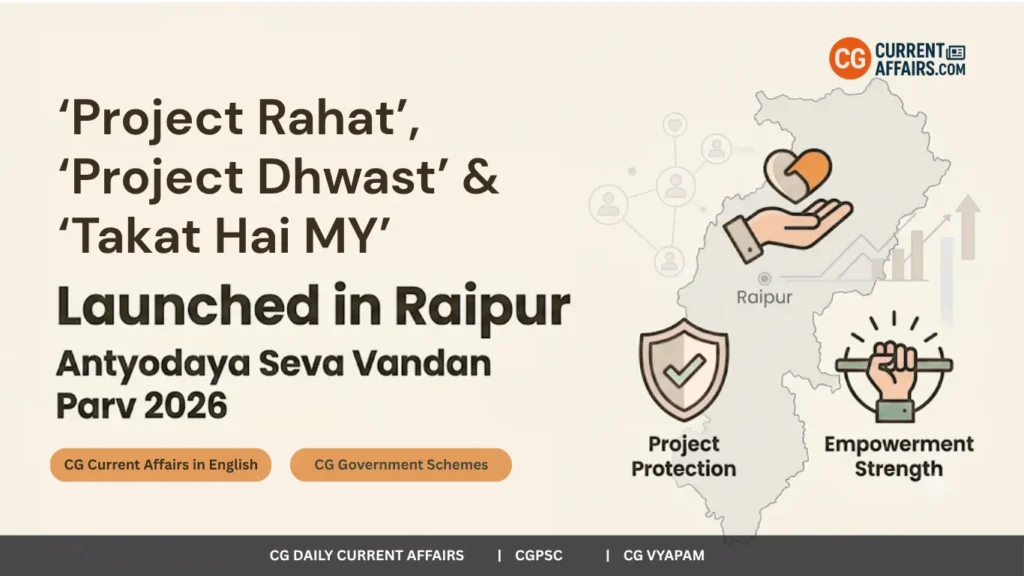
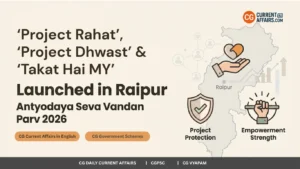
The Antyodaya Seva Vandan Parv 2026 was organised in Raipur on 25 September 2026, highlighting the themes of public service, social responsibility, courage and community participation.
The major administrative highlight of the programme was the launch of three innovations by the Raipur District Administration:
- Project Rahat
- Project Dhwast
- Advance AI – “Takat Hai MY”
These three initiatives focus on different aspects of citizen-centric governance. Project Rahat seeks to improve the delivery of disaster-relief assistance, Project Dhwast focuses on identifying dilapidated and unsafe buildings, while Takat Hai MY promotes the use of Artificial Intelligence and modern technology in administration.
The programme was attended by Chhattisgarh Chief Minister Vishnu Deo Sai at the Sardar Balbir Singh Juneja Indoor Stadium, Raipur.
Three Innovations at a Glance
Innovation | Focus | Governance Area |
Project Rahat | Faster relief assistance after natural disasters | Disaster management |
Project Dhwast | Identification of dilapidated and unsafe buildings | Public safety |
Takat Hai MY | Use of AI and technology in administration | Digital governance |
A simple way to remember the three initiatives is:
Rahat – Disaster Relief | Dhwast – Unsafe Buildings | Takat Hai MY – AI Governance
1. Project Rahat: Faster Delivery of Disaster Relief
Project Rahat is an initiative of the Raipur District Administration aimed at making the process of providing relief assistance to people affected by natural disasters faster and more effective.
The project is associated with relief assistance under RBC 6(4).
During a disaster, affected families may require immediate financial assistance to deal with loss and disruption. Delays in administrative processing can make the situation more difficult for beneficiaries. Project Rahat seeks to improve this process by making the delivery of eligible relief assistance more timely and efficient.
Key Objectives of Project Rahat
The initiative focuses on:
- Speeding up the processing of disaster-relief assistance.
- Reducing administrative delays.
- Improving coordination in the relief process.
- Ensuring timely assistance to eligible affected families.
- Strengthening citizen-oriented disaster management.
Thus, Project Rahat represents an effort to improve the last-mile delivery of disaster relief.
2. Project Dhwast: Identification of Unsafe Buildings
Project Dhwast focuses on identifying dilapidated, unsafe and potentially hazardous buildings in the district and taking necessary administrative action.
Old and structurally unsafe buildings can pose significant risks to residents as well as the general public. Early identification of such structures can enable authorities to take appropriate preventive measures.
Key Objectives of Project Dhwast
The project focuses on:
- Identifying dilapidated buildings.
- Identifying structures that may pose risks to public safety.
- Initiating necessary administrative action.
- Reducing the possibility of accidents.
- Strengthening preventive safety measures.
The importance of Project Dhwast lies in its preventive approach to governance. Instead of waiting for an accident to occur, the administration can identify potentially dangerous structures and take action beforehand.
3. Advance AI – “Takat Hai MY”: AI for Better Governance
The third innovation launched by the Raipur District Administration is Advance AI – “Takat Hai MY”.
The initiative focuses on the use of Artificial Intelligence and modern technology to improve administrative functioning and make public services more effective and citizen-oriented.
It reflects the growing role of technology in public administration and the movement towards technology-enabled governance.
Key Objectives of Takat Hai MY
The initiative focuses on areas such as:
- Improving administrative efficiency.
- Using Artificial Intelligence in government functioning.
- Supporting data-based decision-making.
- Improving the speed and effectiveness of administrative processes.
- Making public services more citizen-oriented.
- Using technology to identify and address administrative problems.
AI and Citizen-Centric Governance
Artificial Intelligence can potentially support government departments in analysing information, identifying patterns and improving administrative processes.
Technology-enabled administration can assist in:
- Data analysis.
- Monitoring government programmes.
- Identifying service-delivery gaps.
- Supporting administrative decision-making.
- Improving the speed of public services.
- Increasing administrative efficiency.
However, effective AI-based governance also requires quality data, cybersecurity, privacy protection, transparency, trained personnel and human oversight.
Comparing the Three Innovations
The three initiatives address three distinct governance challenges.
Feature | Project Rahat | Project Dhwast | Takat Hai MY |
Main concern | Disaster relief | Unsafe buildings | Administrative efficiency |
Primary area | Disaster management | Public safety | AI & digital governance |
Main intervention | Faster relief assistance | Identification and action | Technology-enabled administration |
Citizen benefit | Timely assistance | Safer surroundings | More efficient services |
Key exam keyword | RBC 6(4) | Unsafe buildings | Artificial Intelligence |
The three projects therefore represent a broader approach to citizen-centric administration:
Relief + Safety + Technology
Why Are These Innovations Important?
The three projects are significant because they address practical problems faced by citizens at the district level.
- Project Rahat: Responsive Governance
- Project Rahat focuses on making government assistance reach disaster-affected families more quickly.
- Project Dhwast: Preventive Governance
- Project Dhwast focuses on identifying potential safety hazards before they result in accidents.
- Takat Hai MY: Technology-Enabled Governance
- Takat Hai MY focuses on using Artificial Intelligence and modern technology to improve administrative functioning.
Together, these initiatives demonstrate how district-level innovation can be used to address specific governance challenges.
Antyodaya Seva Vandan Parv 2026
The three innovations were launched during the Antyodaya Seva Vandan Parv 2026, organised under the Seva Sankalp Abhiyan.
The programme focused on recognising and encouraging contributions in areas such as:
- Social service
- Public service
- National service
- Courage and sacrifice
- Community participation
- Social responsibility
During the programme, the Chief Minister honoured individuals and groups associated with different sectors.
A special presentation titled ‘Namo Seva Gatha’, based on the public life and service-oriented activities of Prime Minister Narendra Modi, was also staged.
What is Antyodaya?
Antyodaya refers to the idea of ensuring that development and welfare benefits reach the last person in society, particularly vulnerable and economically weaker sections.
In the context of public administration, the Antyodaya approach emphasises:
- Last-mile delivery of government schemes.
- Access to public services.
- Support for vulnerable sections.
- Inclusive development.
- Citizen-centric governance.
The three Raipur initiatives can also be linked to this broader idea of citizen-centric governance by focusing on timely relief, public safety and efficient administration.
Technology and Good Governance
The launch of Takat Hai MY highlights the growing importance of Artificial Intelligence in public administration.
AI and digital technologies can potentially help governments in:
- Data-based decision-making.
- Monitoring programmes.
- Identifying problems.
- Improving administrative efficiency.
- Speeding up service delivery.
- Supporting officials in handling large volumes of information.
However, technology-based governance must also address challenges such as:
- Data quality.
- Cybersecurity.
- Protection of citizen information.
- Transparency.
- Accountability.
- Digital accessibility.
- Human oversight.
Therefore, the effective use of AI requires a balance between technological innovation and responsible governance.
Other Highlights of the Programme
The Antyodaya Seva Vandan Parv also showcased Chhattisgarh’s cultural traditions and community participation.
Performances included:
- Folk songs
- Jasgeet
- Bhajans
- Raut Nacha
- Traditional group dances
- Flute performances
- Theatre presentations
- Patriotic group songs
Women associated with the National Rural Livelihood Mission (NRLM) participated in cultural performances.
Children from a school for persons with disabilities also presented a patriotic group song.
These activities reflected the broader themes of social participation, service and community involvement.
Significance for Chhattisgarh
The three innovations are important from three different perspectives:
- Disaster Management
- Project Rahat seeks to improve the speed and efficiency of disaster-relief assistance.
- Public Safety
- Project Dhwast focuses on identifying unsafe and dilapidated buildings and taking appropriate action.
- Digital Governance
- Takat Hai MY represents the use of Artificial Intelligence and modern technology to improve administrative functioning.
Together, they illustrate the role of local-level innovation in strengthening citizen-centric governance.
CGPSC Prelims Current Affairs 2026
- Event: Antyodaya Seva Vandan Parv 2026
- Date: 25 September 2026
- Place: Raipur, Chhattisgarh
- Venue: Sardar Balbir Singh Juneja Indoor Stadium
- Campaign: Seva Sankalp Abhiyan
- Three innovations: Project Rahat, Project Dhwast and Advance AI – “Takat Hai MY”
- Project Rahat: Natural disaster relief
- RBC 6(4): Associated with the relief process mentioned under Project Rahat
- Project Dhwast: Dilapidated and unsafe buildings
- Takat Hai MY: AI and technology in administration
CGPSC Prelims Practice MCQs
Q1. Consider the following pairs:
- Project Rahat — Natural disaster relief
- Project Dhwast — Dilapidated and unsafe buildings
- Takat Hai MY — AI-enabled administration
Which of the above pairs is/are correctly matched?
- Only 1
B. Only 1 and 2
C. Only 2 and 3
D. 1, 2 and 3
Answer: D
Q2. Project Rahat, launched by the Raipur District Administration, is primarily associated with:
- Rural employment
B. Natural disaster relief
C. Tourism promotion
D. School infrastructure
Answer: B
Q3. Project Rahat is associated with which provision in the context of relief assistance?
- RBC 6(4)
B. RTI Act
C. Forest Rights Act
D. MGNREGA
Answer: A
Q4. Project Dhwast primarily focuses on:
- Promotion of folk art
B. Identification of unsafe and dilapidated buildings
C. Rural housing
D. Tourism development
Answer: B
Q5. “Takat Hai MY” is associated with:
- Artificial Intelligence and administration
B. Fisheries development
C. Forest conservation
D. Rural employment
Answer: A
CGPSC Mains Practice Questions
Question 1
Discuss the role of district-level innovations in strengthening citizen-centric governance in Chhattisgarh with reference to Project Rahat, Project Dhwast and Takat Hai MY.
Question 2
How can Artificial Intelligence improve administrative efficiency and public-service delivery? Discuss with reference to Takat Hai MY.
Conclusion
The Antyodaya Seva Vandan Parv 2026 provided a platform for the launch of three important district-level innovations in Raipur.
Project Rahat focuses on improving the delivery of disaster-relief assistance, Project Dhwast addresses the identification of unsafe and dilapidated buildings, and Takat Hai MY focuses on the application of Artificial Intelligence and modern technology in administration.
Also Read:
- Seva Sankalp Abhiyaan launched
- Chhattisgarh e-ret Portal launched
- Namaste Scheme Launched