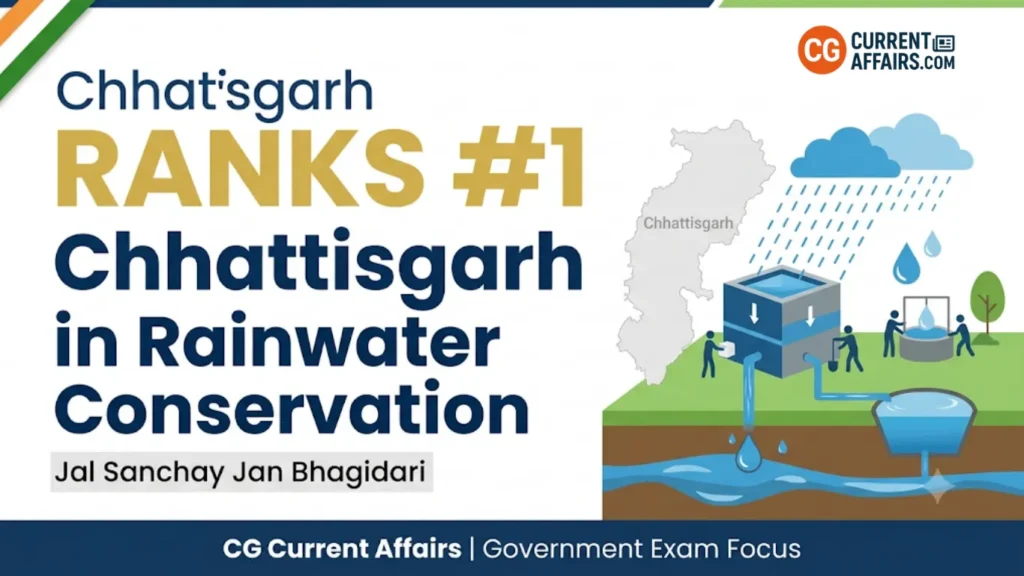
Chhattisgarh has emerged as a leading state in rainwater conservation and groundwater recharge, securing the top position in the third phase of the Centre’s Jal Sanchay Jan Bhagidari campaign. The achievement highlights the state’s emphasis on community participation, water-harvesting infrastructure and groundwater management.
Chief Minister Vishnu Deo Sai presented Chhattisgarh’s community-driven water conservation model at a departmental summit of the Ministry of Jal Shakti in New Delhi in the presence of Prime Minister Narendra Modi.
Why in News?
Chhattisgarh has secured first position in the third phase of the Jal Sanchay Jan Bhagidari campaign for its efforts towards rainwater harvesting and groundwater recharge.
Key Points
- Chhattisgarh secured first position in Phase III of the Jal Sanchay Jan Bhagidari campaign.
- The state had secured second position in the first two phases.
- 79,775 water conservation structures were recorded in the state under the third phase.
- Work on 77,719 structures has been completed.
- Surajpur, Mahasamund, Balod, Baloda Bazar-Bhatapara and Kabirdham featured among the country’s top 10 districts.
Chhattisgarh’s Community-Based Water Conservation Model
Chhattisgarh has attempted to transform water conservation from a government programme into a people’s movement. Farmers, Gram Panchayats, Jal Sakhis, Jal Mitras and local communities have been involved in creating and maintaining water conservation structures.
Major Elements
- Community participation in water conservation.
- Construction of rainwater harvesting and groundwater recharge structures.
- Geotagging and mapping of structures.
- Regular monitoring of completed works.
- Participation of farmers and local communities.
- Focus on both water storage and groundwater recharge.
- Integration of government efforts with community initiatives.
Also Read: Mahasamund tops nation in Jal Sanchay Jan Bhagidari Abhiyaan 2.0
Jal Sanchay Jan Bhagidari Campaign
The Jal Sanchay Jan Bhagidari initiative was launched in 2024 with the objective of promoting water conservation and groundwater recharge through collective participation.
The initiative seeks to ensure that every possible drop of rainwater is conserved through cooperation between government institutions, communities and other stakeholders.
Main Objectives
- Promote rainwater harvesting.
- Increase groundwater recharge.
- Encourage recharge of water bodies and borewells.
- Develop recharge shafts and other water conservation structures.
- Encourage community participation in water management.
- Promote cooperation between government and society.
- Improve local water security.
- Build resilience against drought and climate-related water challenges.
Jal Sanchay Jan Bhagidari: Key Features
| Feature | Significance |
| Launch | 2024 |
| Major focus | Rainwater harvesting and groundwater recharge |
| Approach | Government + community participation |
| Major structures | Recharge structures, recharge shafts and water-harvesting systems |
| Key objective | Conserve every possible drop of rainwater |
| Stakeholders | Government, communities, farmers, NGOs and other institutions |
| Expected outcome | Improved water security and groundwater recharge |
Chhattisgarh’s Performance in the Campaign
The state has demonstrated consistent performance in the Jal Sanchay Jan Bhagidari campaign.
| Campaign Phase | Chhattisgarh’s Position |
| Phase I | 2nd |
| Phase II | 2nd |
| Phase III | 1st |
The improvement in ranking reflects the state’s increasing focus on community participation and the creation of water conservation infrastructure.
Water Conservation Structures in Chhattisgarh
Under the third phase of the campaign, a large number of water conservation structures have been recorded across the state.
| Indicator | Number |
| Total structures recorded | 79,775 |
| Structures completed | 77,719 |
| Structures yet to be completed | 2,056 |
Important Figures
- Total structures recorded: 79,775
- Structures completed: 77,719
- Focus: Rainwater harvesting and groundwater recharge
- Monitoring: Geotagging, mapping and regular monitoring
These structures are intended to increase water availability, improve groundwater recharge and reduce dependence on limited water resources.
Reduction in Water-Deficient Blocks
One of the significant outcomes highlighted by the state is the reduction in the number of water-deficient blocks.
| Indicator | Earlier | Current |
| Water-deficient blocks | 26 | 19 |
| Reduction | | 7 blocks |
Key Development
- Earlier water-deficient blocks: 26
- Current number: 19
- Reduction: 7 blocks
- Five critical blocks are expected to move into the normal category.
This indicates an improvement in the state’s groundwater and water-resource situation, although sustained monitoring and conservation efforts remain necessary.
Districts Among India’s Top 10
Five districts of Chhattisgarh have been included among the top 10 districts in the country for their performance in water conservation.
| District |
- Surajpur
- Mahasamund
- Balod
- Baloda Bazar-Bhatapara
- Kabirdham
|
Korea’s ‘5% Model’
The 5% Model of Korea district has emerged as an important example of community participation in water conservation in Chhattisgarh.
Under this approach, farmers voluntarily dedicate around 5% of their agricultural land for rainwater harvesting and groundwater recharge-related structures.
How the Model Works
Agricultural Land
↓
Around 5% area voluntarily allocated
↓
Rainwater harvesting/recharge structures created
↓
Rainwater retained on the farm
↓
Reduced surface runoff
↓
Improved groundwater recharge
Korea 5% Model: Quick Facts
| Feature | Details |
| District | Korea, Chhattisgarh |
| Contribution | Around 5% of agricultural land |
| Nature | Voluntary participation |
| Main purpose | Rainwater harvesting and groundwater recharge |
| Major benefit | Reduced surface runoff |
| Expected outcome | Improved groundwater recharge |
Significance
- Encourages voluntary participation by farmers.
- Reduces the loss of rainwater through surface runoff.
- Helps retain water within agricultural areas.
- Supports groundwater recharge.
- Demonstrates the potential of community-led water management.
- Provides a replicable model for other regions.
Also Read: Dhamtari ranks 1st in Jal Jeevan Mission
Role of Community Participation
The central feature of Chhattisgarh’s model is the involvement of local communities. Rather than depending entirely on government agencies, the approach encourages stakeholders at the grassroots level to participate in water conservation.
Major Stakeholders
- Farmers
- Gram Panchayats
- Jal Sakhis
- Jal Mitras
- Local communities
- Government departments
- Local administrative bodies
This approach reflects the principle that water conservation requires collective responsibility.
Benefits of Jal Sanchay Jan Bhagidari
The campaign aims to generate multiple environmental, economic and social benefits.
- Groundwater Recharge
- Rainwater and surface runoff can be captured and directed towards groundwater recharge structures.
- Water Security
- Improved storage and recharge can increase the availability of water during dry periods.
- Climate Resilience
- Water conservation structures can help communities deal with both heavy rainfall and periods of water scarcity.
- Reduced Surface Runoff
- Capturing rainwater can reduce the amount of water flowing away as surface runoff.
- Community Ownership
- People’s participation can create greater awareness and responsibility towards local water resources.
- Agricultural Benefits
- Improved groundwater availability can support agricultural activities, particularly in areas dependent on groundwater.
Geotagging and Monitoring
Technology is also being used to improve the monitoring of water conservation structures.
Key Measures
- Geotagging of structures.
- Digital mapping.
- Regular monitoring.
- Tracking of completed works.
- Better identification of water conservation assets.
Such measures can improve transparency and help authorities evaluate the implementation of water conservation programmes.
Jal Sanchay Jan Bhagidari: Key Features
| Feature | Significance |
| Launch | 2024 |
| Major focus | Rainwater harvesting and groundwater recharge |
| Approach | Government + community participation |
| Major structures | Recharge structures, recharge shafts and water-harvesting systems |
| Key objective | Conserve every possible drop of rainwater |
| Stakeholders | Government, communities, farmers, NGOs and other institutions |
| Expected outcome | Improved water security and groundwater recharge |
‘Catch the Rain’ Campaign
The Jal Sanchay Jan Bhagidari approach is closely connected with India’s broader efforts towards rainwater conservation, including the Catch the Rain campaign.
The basic idea is to capture and conserve rainfall wherever it occurs and use suitable local methods for water storage and groundwater recharge.
Key Focus Areas
- Rainwater harvesting.
- Restoration of traditional water bodies.
- Groundwater recharge.
- Construction of recharge structures.
- Community awareness.
- Local water-resource management.
Shallow Aquifer Management Programme
Another important development in the area of groundwater management is the Shallow Aquifer Management (SAM) Programme, implemented by the Ministry of Housing and Urban Affairs (MoHUA) in collaboration with the National Institute of Urban Affairs (NIUA).
The programme focuses on improving groundwater recharge in urban areas through scientific planning, technical support and suitable recharge interventions.
SAM Programme: Key Facts
| Parameter | Details |
| Full Form | Shallow Aquifer Management |
| Ministry | Ministry of Housing and Urban Affairs |
| Technical partner | National Institute of Urban Affairs |
| Coverage | 75 AMRUT cities |
| Major focus | Urban groundwater recharge |
| Approach | Scientific and technical groundwater management |
| Related campaign | Catch the Rain |
Why Is SAM Important?
Rapid urbanisation and changing rainfall patterns have increased pressure on urban water resources. Falling groundwater levels, urban flooding and inadequate rainwater recharge are emerging challenges for many cities.
The SAM programme seeks to address these issues through scientific groundwater management.
Major Objectives
- Improve groundwater recharge in urban areas.
- Promote scientific management of shallow aquifers.
- Support sustainable rainwater harvesting.
- Improve urban water security.
- Reduce surface runoff.
- Help mitigate urban flooding.
- Strengthen climate resilience.
75 AMRUT Cities and SAM Programme
The SAM programme is being implemented with participation from 75 AMRUT cities.
These cities are working on different groundwater recharge techniques suited to their local conditions.
Recharge Techniques
- Recharge shafts.
- Injection wells.
- Check dams.
- Gabion walls.
- Circular structures.
- Modular recharge pits.
These interventions are intended to increase groundwater recharge while improving the management of rainwater in urban areas.
AMRUT and Urban Water Management
The Atal Mission for Rejuvenation and Urban Transformation (AMRUT) was launched in June 2015 to improve basic urban infrastructure.
AMRUT: Quick Facts
| Parameter | Details |
| Full Form | Atal Mission for Rejuvenation and Urban Transformation |
| Launch | June 2015 |
| Major focus | Urban infrastructure |
| Water-related areas | Water supply, sewerage and storm-water drainage |
| Other focus | Green spaces and urban infrastructure |
Major Areas under AMRUT
- Water supply.
- Sewerage.
- Storm-water drainage.
- Development of green spaces.
- Improvement of urban infrastructure.
The SAM programme adds a groundwater-management dimension to urban water security by promoting scientific recharge methods.
National Dialogue on Urban Groundwater Recharge
The Ministry of Housing and Urban Affairs, in collaboration with the National Institute of Urban Affairs, organised a national dialogue involving 75 AMRUT cities.
The platform provided an opportunity for cities to:
- Present their progress.
- Share successful practices.
- Discuss challenges.
- Showcase groundwater recharge initiatives.
- Explore approaches to strengthen urban water security.
Importance of Urban Groundwater Management
Urban areas face increasing pressure on water resources because of population growth, construction and changing rainfall patterns.
Major Challenges
- Declining groundwater levels.
- Increasing water demand.
- Reduced natural groundwater recharge.
- Urban flooding.
- Changing rainfall patterns.
- Increasing climate-related risks.
Scientific groundwater management and rainwater harvesting can help cities address these challenges.
Rural and Urban Water Conservation: A Comparative View
The water conservation approach combines community participation in rural areas with scientific and technical interventions in urban areas.
| Rural Approach | Urban Approach |
| Farmer participation | Scientific groundwater planning |
| Gram Panchayats | Urban local bodies |
| Jal Sakhis and Jal Mitras | Technical agencies |
| Farm-based recharge | Recharge shafts |
| Community water structures | Injection wells |
| Korea 5% Model | Modular recharge pits |
| Local water management | Shallow aquifer management |
Environmental and Developmental Significance
Water conservation is not limited to increasing water availability. It also contributes to agricultural sustainability, rural development, climate resilience and environmental protection.
Wider Significance
- Improves groundwater availability.
- Supports agriculture.
- Reduces vulnerability to drought.
- Helps manage excess rainfall.
- Supports sustainable development.
- Strengthens local participation.
- Improves long-term water security.
- Can reduce pressure on existing water sources.
Challenges
Despite significant progress, water conservation programmes require continuous implementation and monitoring.
Major Challenges
- Long-term maintenance of water structures.
- Ensuring effective community participation.
- Monitoring groundwater levels.
- Preventing over-extraction of groundwater.
- Adapting conservation measures to local geography.
- Ensuring scientific planning of recharge structures.
- Maintaining water quality.
- Coordinating multiple government departments and local stakeholders.
Way Forward
- Strengthen Community Participation
- Local communities should remain central to planning, implementation and maintenance of water conservation structures.
- Promote Scientific Water Management
- Traditional conservation practices should be complemented with groundwater data, mapping and scientific assessment.
- Expand Successful Models
- Successful initiatives such as the Korea 5% Model can be studied for adaptation in other districts with suitable local conditions.
- Improve Monitoring
- Regular geotagging, mapping and groundwater-level monitoring can help measure the actual impact of conservation projects.
- Focus on Maintenance
- Creating water structures is only the first step. Their regular maintenance is necessary for long-term effectiveness.
- Integrate Rural and Urban Approaches
- Water security requires coordinated action across rural and urban areas, combining community participation with scientific groundwater management.
CGPSC Prelims Practice Questions
Q1. Chhattisgarh secured which position in the third phase of the Jal Sanchay Jan Bhagidari campaign?
- First
B. Second
C. Third
D. Fourth
Answer: A. First
Q2. Which district is associated with the ‘5% Model’ highlighted by Chhattisgarh in water conservation?
- Korea
B. Bastar
C. Dhamtari
D. Raigarh
Answer: A. Korea
Q3. Under the Korea 5% Model, farmers primarily contribute towards:
- Forest plantation
B. Rainwater harvesting and groundwater recharge
C. Solar power generation
D. Rural road construction
Answer: B. Rainwater harvesting and groundwater recharge
Q4. The number of water-deficient blocks in Chhattisgarh has declined from:
- 30 to 20
B. 26 to 19
C. 25 to 15
D. 22 to 12
Answer: B. 26 to 19
Q5. The Shallow Aquifer Management Programme is primarily concerned with:
- Forest management
B. Urban groundwater recharge
C. Coastal management
D. Agricultural marketing
Answer: B. Urban groundwater recharge
Q6. How many AMRUT cities are participating in the Shallow Aquifer Management Programme?
- 50
B. 60
C. 75
D. 100
Answer: C. 75
Q7. Consider the following statements:
- Chhattisgarh secured first position in the third phase of Jal Sanchay Jan Bhagidari.
- The Korea 5% Model encourages farmer participation in groundwater recharge.
- The SAM Programme focuses on groundwater management in urban areas.
Which of the statements given above are correct?
- 1 only
B. 1 and 2 only
C. 2 and 3 only
D. 1, 2 and 3
Answer: D. 1, 2 and 3
CGPSC Mains Questions
Question 1
Discuss the significance of Chhattisgarh’s community-based water conservation model in improving groundwater security and climate resilience.
Question 2
Explain the Korea 5% Model of Chhattisgarh. How can community participation contribute to sustainable water-resource management?
Question 3
Chhattisgarh’s performance in the Jal Sanchay Jan Bhagidari campaign reflects the importance of people’s participation in environmental governance. Discuss.
Question 4
What is the Shallow Aquifer Management Programme? Discuss its role in strengthening urban water security and groundwater recharge.
Last-Minute Revision
- Jal Sanchay Jan Bhagidari → Launched in 2024.
- Chhattisgarh → 1st in Phase III.
- Phase I & II → 2nd position.
- Structures recorded → 79,775.
- Structures completed → 77,719.
- Water-deficient blocks → 26 to 19.
- Korea → 5% Model.
- Top districts → Surajpur, Mahasamund, Balod, Baloda Bazar-Bhatapara, Kabirdham.
- SAM → Shallow Aquifer Management.
- SAM → 75 AMRUT cities.
Conclusion
Chhattisgarh’s first-place performance in the third phase of Jal Sanchay Jan Bhagidari demonstrates the importance of combining government intervention with community participation in water conservation. The state’s Korea 5% Model further illustrates how voluntary participation by farmers can support rainwater harvesting and groundwater recharge.