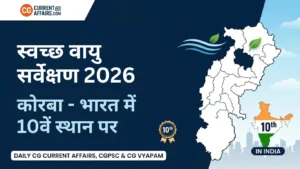
Chhattisgarh’s industrial city Korba has achieved a major milestone in environmental protection and air-quality improvement. In the Korba ranks 10th in Swachh Vayu Sarvekshan 2026 with a population of 3 lakh to 10 lakh.
The achievement is significant because Korba was ranked 18th in the previous survey. This year, the city improved by 8 positions and entered the top 10 cities in its population category.
The improvement reflects efforts related to air pollution control, expansion of green areas, environmental protection, cleanliness and public participation.
Why in News?
The Swachh Vayu Sarvekshan 2026 has highlighted the performance of Indian cities in reducing sources of air pollution under the National Clean Air Programme (NCAP). Lucknow secured the first position among cities with a population of more than 10 lakh, followed by Indore and Jabalpur.
In the 3–10 lakh population category, Korba of Chhattisgarh secured 10th position, improving significantly from 18th in the previous survey.
Key Points
- Survey: Swachh Vayu Sarvekshan 2026
- Framework: National Clean Air Programme (NCAP)
- Purpose: Assess cities’ efforts to reduce sources of air pollution
- Million-plus population category:
- 1st – Lucknow: 198 points
- 2nd – Indore: 197 points
- 3rd – Jabalpur: 195 points
- 3–10 lakh population category:
- Korba: 10th position
- Previous position: 18th
- Improvement: 8 positions
- State: Chhattisgarh
- Important environmental initiative in Korba: Hasdeo River conservation
- Hasdeo River conservation project: More than ₹300 crore
Million-Plus Population Category
| Rank | City | State | Score |
|---|
| 1 | Lucknow | Uttar Pradesh | 198 |
| 2 | Indore | Madhya Pradesh | 197 |
| 3 | Jabalpur | Madhya Pradesh | 195 |
| 6 | Raipur | Chhattisgarh | 189 |
| 17 | Durg-Bhilai | Chhattisgarh | — |
3–10 Lakh Population Category
| Rank | City | State | Previous Rank |
|---|
| 10 | Korba | Chhattisgarh | 18th |
Rank of Chhattisgarh in Swachh Vayu Sarvekshan 2026
Chhattisgarh cities also recorded notable positions in the Swachh Vayu Sarvekshan 2026 assessment:
- Raipur: Ranked 6th nationally among million-plus population cities, with a score of 189 points.
- Korba: Ranked 10th nationally in the 3–10 lakh population category, improving from 18th position previously.
- Durg-Bhilai: Ranked 17th nationally in the million-plus population category.
What Is Swachh Vayu Sarvekshan?
The Swachh Vayu Sarvekshan assesses the efforts made by cities to reduce sources of air pollution and improve air quality.
The survey is associated with India’s broader efforts under the National Clean Air Programme (NCAP), which seeks to address air pollution through coordinated action involving governments, local bodies and other stakeholders.
The assessment provides a mechanism to compare the progress of cities and encourage better practices in air-quality management.
Top Cities in the Million-Plus Population Category
Among cities with a population of more than 10 lakh, the leading performers in Swachh Vayu Sarvekshan 2026 were:
| Rank | City | Score | Population Category |
|---|
| 1 | Lucknow | 198 | More than 10 lakh |
| 2 | Indore | 197 | More than 10 lakh |
| 3 | Jabalpur | 195 | More than 10 lakh |
| 10 | Korba | — | 3–10 lakh |
PM10 Reduction under NCAP
The Swachh Vayu Sarvekshan 2026 reported significant progress in reducing particulate pollution under the National Clean Air Programme (NCAP).
According to the Government of India, during FY 2025–26, 108 out of 130 NCAP cities recorded a decline in annual PM10 concentration compared with the 2017–18 baseline.
- 72 cities achieved more than 20% reduction.
- 26 cities achieved more than 40% reduction.
- 14 cities met the prescribed National Ambient Air Quality Standards (NAAQS) for PM10.
The Swachh Vayu Sarvekshan 2026 highlighted the progress of NCAP cities in reducing annual PM10 concentration and recognised leading-performing cities in different population categories.
Swachh Vayu Sarvekshan Key Facts
| Indicator | Details |
|---|
| Programme | National Clean Air Programme (NCAP) |
| Launched | January 2019 |
| Nodal Ministry | Ministry of Environment, Forest and Climate Change (MoEFCC) |
| NCAP Cities | 130 |
| States/UTs Covered | 24 |
| Baseline Year | 2017–18 |
| Assessment | FY 2025–26 |
| Cities with PM10 decline | 108 |
| Cities with >20% reduction | 72 |
| Cities with >40% reduction | 26 |
| Cities meeting PM10 NAAQS | 14 |
| Annual PM10 standard | 60 µg/m³ |
National Clean Air Programme (NCAP)
What is NCAP?
The National Clean Air Programme (NCAP) was launched by the MoEFCC in January 2019 to improve air quality in cities through coordinated action by:
- Central Government
- State Governments
- Urban Local Bodies
- Pollution Control Boards
- Other stakeholders
Objective
NCAP focuses on reducing particulate pollution, particularly PM10, through city-specific pollution-control measures.
Revised Target
The original target was to reduce particulate pollution by 20–30% from the baseline.
It was later revised to:
Achieve up to 40% reduction in PM10 concentration or meet the national air-quality standard by 2025–26, using 2017–18 as the baseline.
What is PM10?
PM10 refers to particulate matter with a diameter of 10 micrometres or less.
These particles can enter the respiratory system and are an important indicator of ambient air pollution.
Major Sources of PM10
- Road dust – resuspension of dust by vehicles and movement on unpaved surfaces.
- Construction activities – dust from construction, demolition and material handling.
- Vehicular emissions – particularly from older and poorly maintained vehicles.
- Industrial emissions – emissions from industries and other combustion processes.
- Open waste burning – burning of municipal waste, plastics and biomass.
- Solid-fuel burning – use of wood, coal and other solid fuels.
- Agricultural residue burning – crop-residue burning can contribute to particulate pollution.
- Diesel generator sets – release particulate matter and gaseous pollutants.
Major Measures under NCAP
- City-Specific Clean Air Action Plans
- Cities prepare action plans based on their local pollution sources and environmental conditions.
- Road Dust Management
- Measures include:
- Mechanised road sweeping
- Improving road surfaces
- Paving dusty areas
- Better roadside dust management
- Vehicular Pollution Control
- Includes:
- Cleaner vehicles
- Public transport
- Electric mobility
- Traffic management
- Emission-control measures
- Construction & Demolition Management
- Cities take measures to control dust from construction sites, demolition activities and transportation of construction materials.
- Industrial Pollution Control
- Industrial units are monitored for compliance with prescribed emission standards.
- Solid-Waste Management
- Improved collection → segregation → processing → disposal helps reduce open dumping and waste burning.
- Air-Quality Monitoring
- NCAP supports better:
- Air-quality monitoring
- Pollution data availability
- Assessment of city-level progress
- PRANA Portal
- The PRANA portal is used to track the physical and financial progress of NCAP-related activities and air-quality management efforts.
- Performance-Linked Funding
- Financial support is linked to the implementation of pollution-control measures and improvement in air quality.
According to the government update, more than ₹16,400 crore was provided to the 130 NCAP cities during FY 2019–20 to FY 2025–26 for pollution-mitigation activities.
Leading Performing Cities
The Swachh Vayu Sarvekshan 2026 recognised leading cities in different population categories.
Important names include:
- Lucknow
- Rourkela
- Kalinganagar
Why is PM10 Reduction Important?
- Environmental Benefits
- Lower PM10 levels indicate progress in controlling particulate pollution and improving urban air quality.
- Public Health
- Reduced particulate exposure can help lower risks associated with respiratory and cardiovascular health.
- Urban Sustainability
- Cleaner air contributes to healthier and more liveable cities.
- Governance
- City-level assessment helps governments monitor progress and identify areas requiring further intervention.
Challenges
- Despite progress, improving urban air quality remains challenging because:
- Pollution sources vary from city to city.
- Road dust remains an important contributor to PM10.
- Construction activities generate significant dust.
- Vehicular and industrial emissions require continuous control.
- Open waste burning can worsen local air quality.
- Weather and seasonal conditions influence pollution levels.
- Meeting air-quality standards requires sustained and coordinated action.
- Korba Improves from 18th to 10th Position
Korba’s performance is significant because the industrial city improved from 18th position to 10th position in the 3–10 lakh population category.
Korba ranks 10th in Swachh Vayu Sarvekshan 2026 improvement reflects efforts in areas such as:
- Air-pollution control
- Plantation and expansion of green areas
- Environmental protection
- Cleanliness
- Public awareness
- Citizen participation
- Urban environmental management
For an industrial city, the improvement highlights the possibility of pursuing economic development alongside environmental sustainability.
Why Is Korba’s Ranking Important?
The improvement in Korba’s ranking reflects several initiatives aimed at improving the city’s environmental conditions.
Major areas of focus include:
- Air pollution control
- Expansion of green areas
- Plantation activities
- Environmental protection
- Cleanliness
- Public participation
- Better urban environmental management
The Korba Swachh Vayu Survey 2026 result gives national recognition to these collective efforts.
Also Read: Rajnandgaon becomes a national model in green energy
Korba: Industrial Development Along With Environmental Protection
Korba is one of Chhattisgarh’s major industrial centres. The city is associated with significant industrial and energy-related activities.
Because of its industrial character, controlling air pollution and maintaining environmental quality are particularly important.
The improvement in the Swachh Vayu Survey 2026 ranking demonstrates the importance of combining economic development with environmental sustainability.
The state government and district administration have been focusing on pollution control and environmental improvement, while citizens are also being encouraged to participate in environmental protection activities.
Expansion of Green Areas in Korba
The administration has been giving importance to plantation and expansion of green areas to improve environmental balance and air quality.
Various activities related to:
- Plantation
- Green-space development
- Cleanliness
- Pollution control
- Environmental awareness
are being undertaken in the city.
Environmental protection is being treated as a collective responsibility involving government agencies, local bodies and citizens.
Also Read: India ranks 9th globally in total forest area
Hasdeo River Conservation Project
One of the important environmental initiatives associated with Korba is the effort to protect the Hasdeo River from pollution.
A project worth more than ₹300 crore is being implemented for river conservation and environmental improvement.
The initiative is expected to contribute to:
- Protection of the Hasdeo River
- Reduction of pollution
- Improvement of environmental quality
- Long-term ecological sustainability
The Hasdeo River conservation initiative is therefore an important point to remember for Chhattisgarh current affairs 2026.
Public Participation in Environmental Protection
The improvement in Korba’s ranking has been attributed not only to government measures but also to public participation.
Environmental protection requires cooperation among:
- State government
- District administration
- Municipal authorities
- Various government departments
- Industries
- Local communities
- Citizens
The Korba air pollution challenge is particularly important because the city has a strong industrial base. Greater public awareness and participation can therefore support long-term improvements in air quality.
Role of Urban Local Bodies
- Korba ranks 10th in Swachh Vayu Sarvekshan 2026 has also been credited to the collective efforts of the municipal administration and other stakeholders.
- The municipal team has been involved in activities related to cleanliness, environmental management and improvement of urban conditions.
- The achievement therefore represents a combined effort by the municipal corporation, district administration, government departments and citizens.
Environmental Protection in Chhattisgarh
The Swachh Vayu Survey 2026 Chhattisgarh ranking highlights the growing importance of environmental protection in Chhattisgarh’s urban development.
The state has several industrial and mining centres, making air quality, water conservation, green cover and pollution control important policy concerns.
Korba’s improvement demonstrates how industrial cities can work towards better environmental outcomes through:
- Pollution-control measures
- Green-area expansion
- Plantation
- River conservation
- Cleanliness
- Public participation
- Sustainable urban planning
Quick Revision
Swachh Vayu Sarvekshan 2026 – Korba Ranks 10th in India
- Korba’s rank: 10th
- Previous rank: 18th
- Improvement: 8 positions
- Population category: 3 lakh–10 lakh
- State: Chhattisgarh
- Important river: Hasdeo
- Hasdeo conservation project: More than ₹300 crore
- Major focus: Air pollution control and environmental protection
- Key factors: Green areas, plantation, cleanliness and public participation
CGPSC Mains Practice Question
Q. Discuss Korba ranks 10th in Swachh Vayu Sarvekshan 2026 and examine the challenges of balancing industrial development with environmental protection in Chhattisgarh.